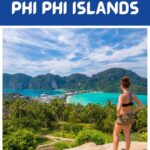

Maya Bay, Beaches & Day Trips from Phuket

Phi Phi Island is the most popular day trip from Phuket, and I understand why. The limestone cliffs rising from turquoise water, the famous Maya Bay from “The Beach” movie, and the parties on the sand at night. It’s all real, and it’s only 40 km south of Phuket.
The archipelago has two main islands. Phi Phi Don is where you’ll find all the hotels, restaurants, and bars. No cars here, just narrow walkways packed with shops and tattoo parlours. The smaller island, Phi Phi Leh, is a national park territory. That’s where Maya Bay and Pi Leh Lagoon are. You can only visit by boat.
I’ve been to Phi Phi dozens of times since 1994. The islands still impress me every time. Yes, it gets crowded, especially at Maya Bay and during peak season. But the scenery makes up for it. The water is impossibly blue. The cliffs are dramatic. And if you stay overnight, you get the viewpoint at sunrise and the beach parties after dark. You can do Phi Phi as a day trip or stay a night or two, both work.
| Phi Phi Islands Quick Info | |
|---|---|
| Location | 40 km southeast of Phuket |
| Islands | Phi Phi Don (inhabited) and Phi Phi Leh (Maya Bay) |
| Speedboat | 50 minutes, from 1,800 Baht |
| Ferry | 2 hours, from 400 Baht |
| National Park Fee | 400 Baht (Maya Bay area) |
| Best Time | November to April |
| Recommended | Day trip or 1 to 2 nights on Phi Phi Don |
| Top Activities | Maya Bay, viewpoint hike, snorkelling, diving, nightlife |
Should You Visit Phi Phi Islands?
Phi Phi is beautiful. The limestone cliffs, the water colour, the dramatic bays. No amount of crowds can take that away. Snorkelling is easy, diving is excellent, and there are enough beaches and bays to fill two or three days without repeating yourself. Getting there is simple: ferries and speedboats run daily from Phuket, and most transfers include hotel pickup.
But you need to know what to expect. Popular spots like Maya Bay and Pi Leh Lagoon are busy, especially between November and April. Tonsai town is loud, commercial, and nothing like the paradise from “The Beach” movie. Accommodation and food cost more here than on less popular islands. And if you prefer quiet evenings, the nonstop nightlife on Loh Dalum Beach might not be for you.
My advice: go with the right expectations, and Phi Phi will impress you. Go expecting an untouched paradise, and you will be disappointed.
Popular Pages About Koh Phi Phi
Popular Day Trips to and around Phi Phi Islands
If you come from Phuket, day trips usually include transfers from and to your hotel, lunch on Tonsai Bay and National Park fees to Maya Bay. If you sleep on the island, you can easily rent a long-tail boat. Expect to pay around 1,500 to 3,000 baht, depending on what you want to visit. If you want to enjoy super blue waters, don’t go too early, as the shadows of the cliffs can affect the colour rendering of the amazing blue water in Loh Dalum Bay. Maybe leave at 10.30 or 11 am.
Here are the usual places where boats will take you: Maya Bay (when open, which is not always predictable), Viking Cave (Used to be open to the public, but it’s now restricted), Loh Dalum Bay, Monkey Beach, Bamboo Island, and sometimes Mosquito Island next to it.
How to Get to Phi Phi Island from Phuket?
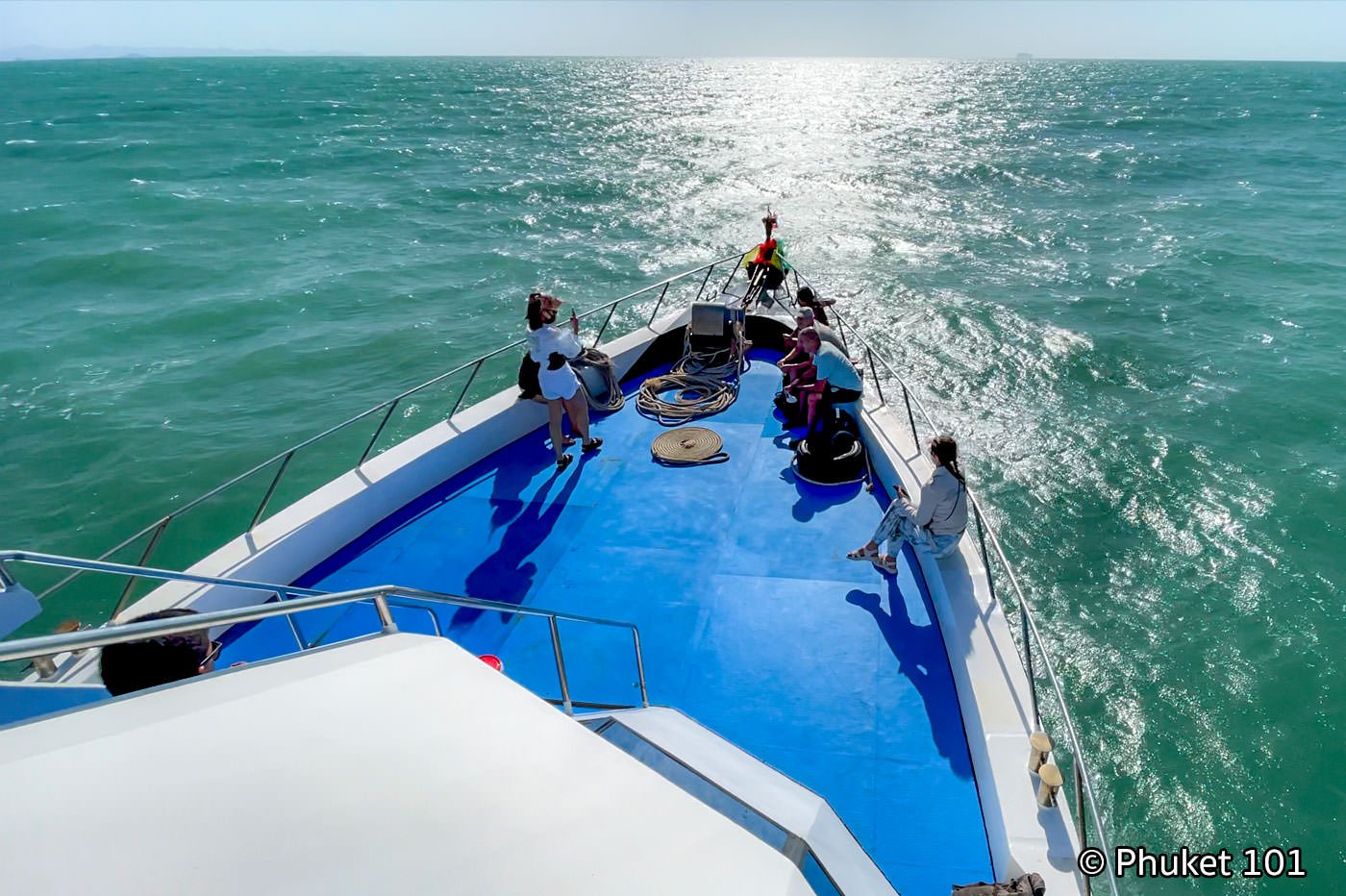
There are two easy ways to get to Phi Phi Island: by ferry or speedboat. A Ferry costs around 400 baht and takes about 2 hours to reach Phi Phi from Phuket. A speedboat ride costs 900 baht per person but only takes 50 minutes. (A ferry from Krabi will take one and a half hours). Usually, the transfer includes pick up from your hotel and is a return ticket, but double-check anyway. Any hotel or street tour counter in Phuket can arrange this for you. If you rented a car, you could also park at the Rassada pier in Phuket town and buy your ferry ticket directly there, but it’s not really cheaper.
What to Do in Phi Phi?
On the following page are some of the best places to discover. Of course, you can expect these places and islands to be busy. It may be a good idea to stay overnight and explore early in the morning to beat the crowds.

As we all sadly remember, a tsunami wiped out the island in 2004, and since then, despite the promises of keeping the island small and manageable, Phi Phi has grown busier but not always better. Nevertheless, Phi Phi is still the most popular of the many islands around Phuket.
Maya Bay on Phi Phi Island
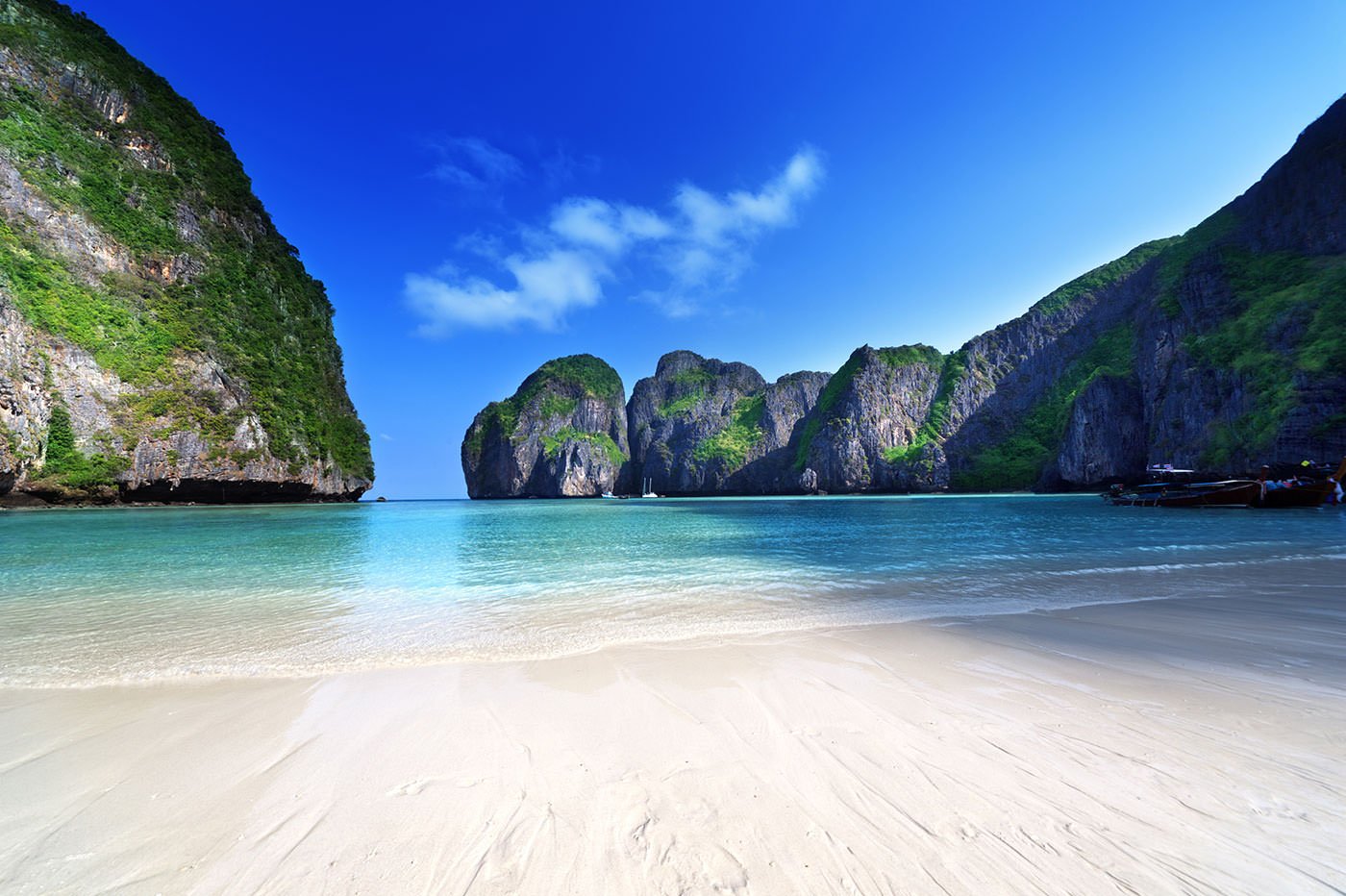
I used to visit Maya Bay before the movie “The Beach” was filmed there in 1999. Back then, it was truly beautiful. Just a few longtail boats, soft sand, and you could swim and snorkel in peace. After the film came out in 2000, the crowds arrived fast. At its worst, up to 5,000 tourists and 200 boats were piling into this small bay every single day. The damage was serious, 80% of the coral was destroyed.
The national park finally shut Maya Bay in June 2018 to let it recover. It stayed closed for nearly four years, much longer than anyone expected. Blacktip reef sharks came back, coral was replanted, and the bay slowly healed.
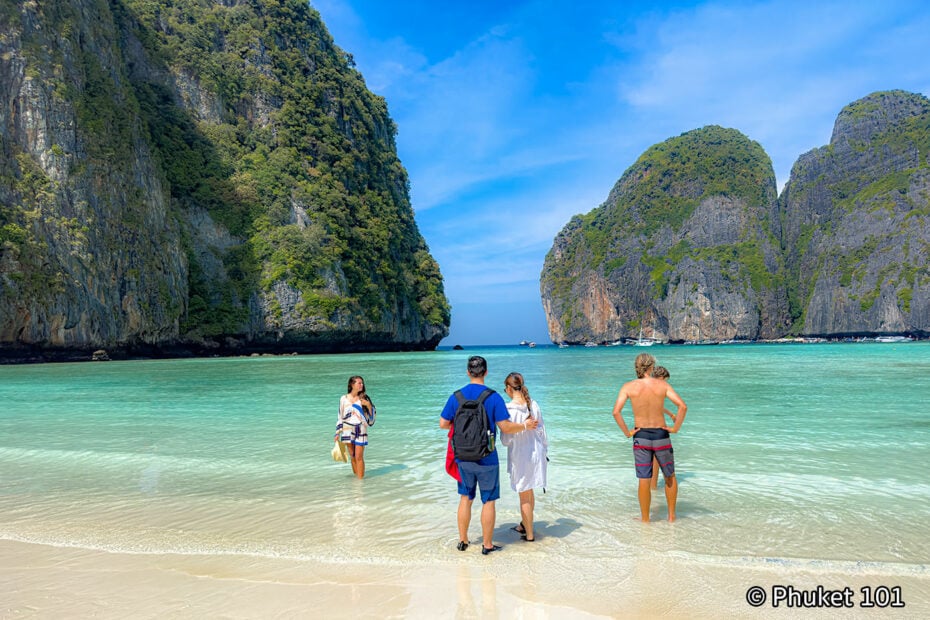
Maya Bay reopened on 1 January 2022 with strict new rules. No boats can enter the bay now. You get dropped off at a floating pier in Loh Samah Bay on the other side of the island and walk about five minutes through a jungle boardwalk to reach the beach. No swimming either, you can only wade knee-deep. A maximum of 375 visitors is allowed per hour, and the bay closes every August and September for ongoing conservation.
The view is back to being beautiful, and it’s a superb photo opportunity. But to be honest, it still feels crowded, and the ballet of speedboats jostling for space in Loh Samah Bay is a bit off-putting. It took a lot of environmental damage to reach this compromise.
Pi Leh Lagoon
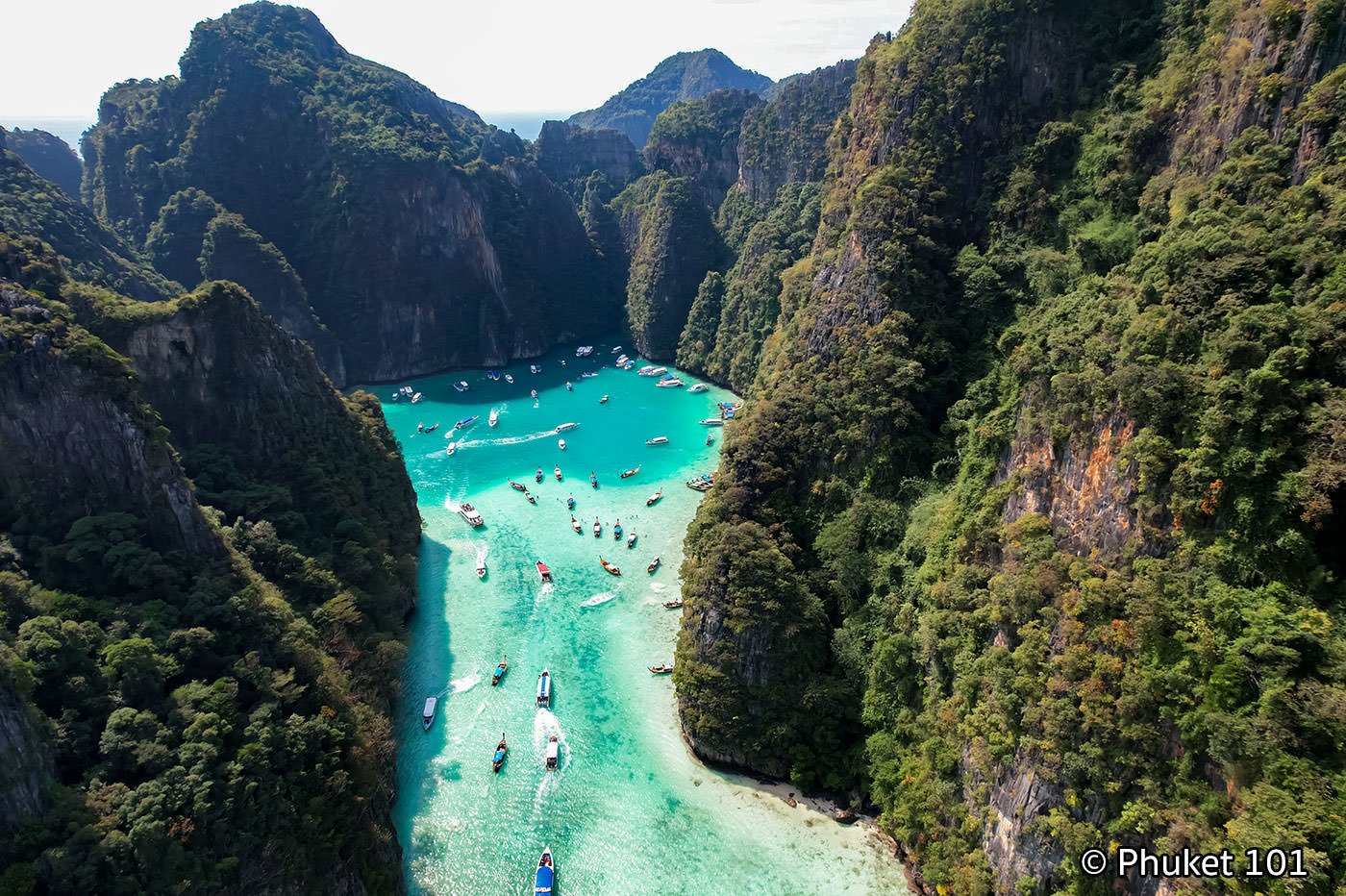
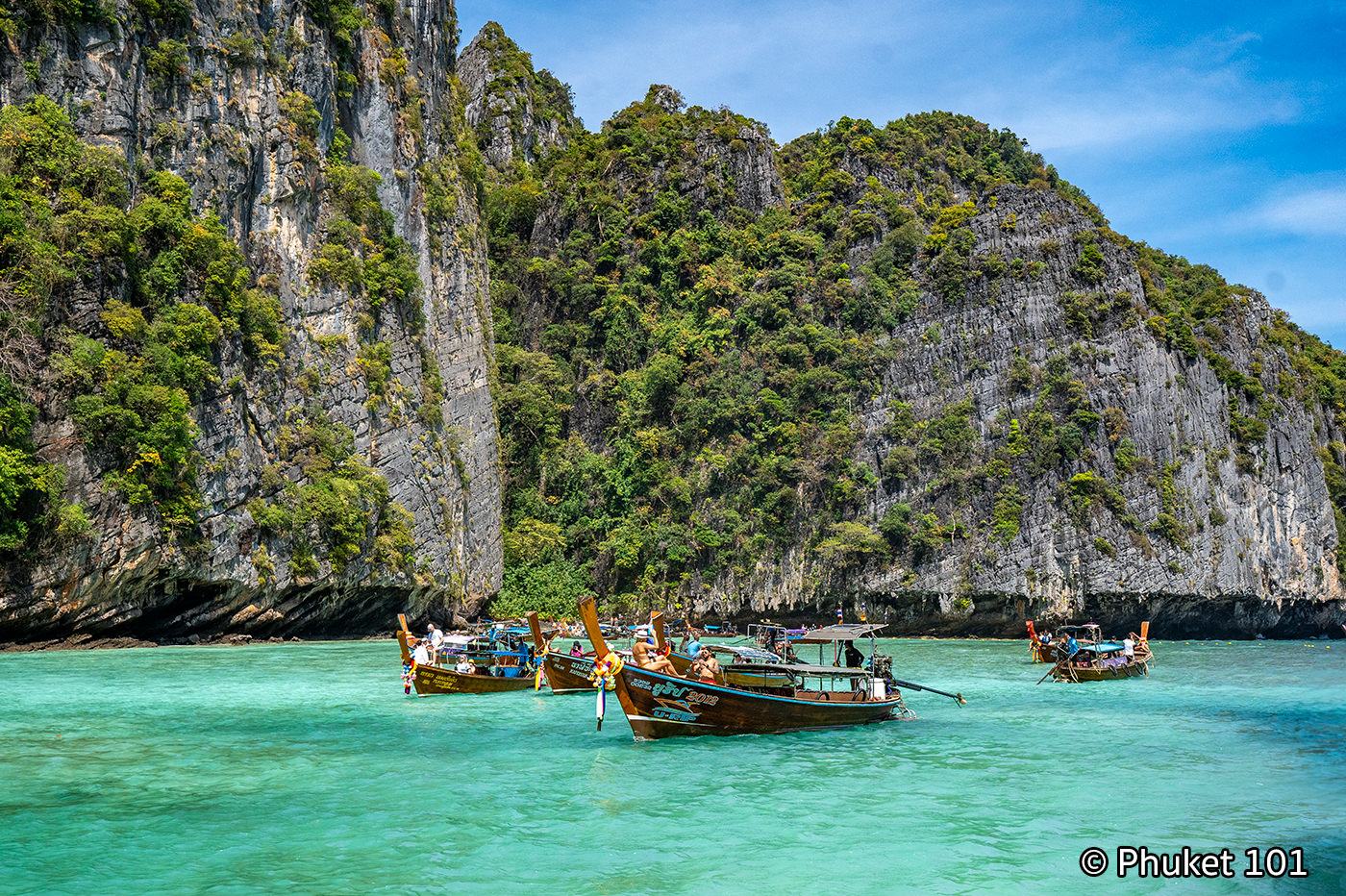
Pi Leh Lagoon is always the first stop before Maya Bay, and it has always been that way. The deep bay is surrounded by immense limestone cliffs, and it is genuinely impressive. It’s a must-do if you go to Phi Phi, but be prepared: it’s very busy. Longtails and speedboats come in and out of the bay nonstop. Once you know that beforehand, it’s a bit easier to accept.
One tip worth knowing: don’t go too early if you want good photos or videos. The cliffs cast immense shadows in the morning. That incredibly blue water you see in most videos? Those shots are taken at midday, when the sun is directly above the bay.
Bamboo Island
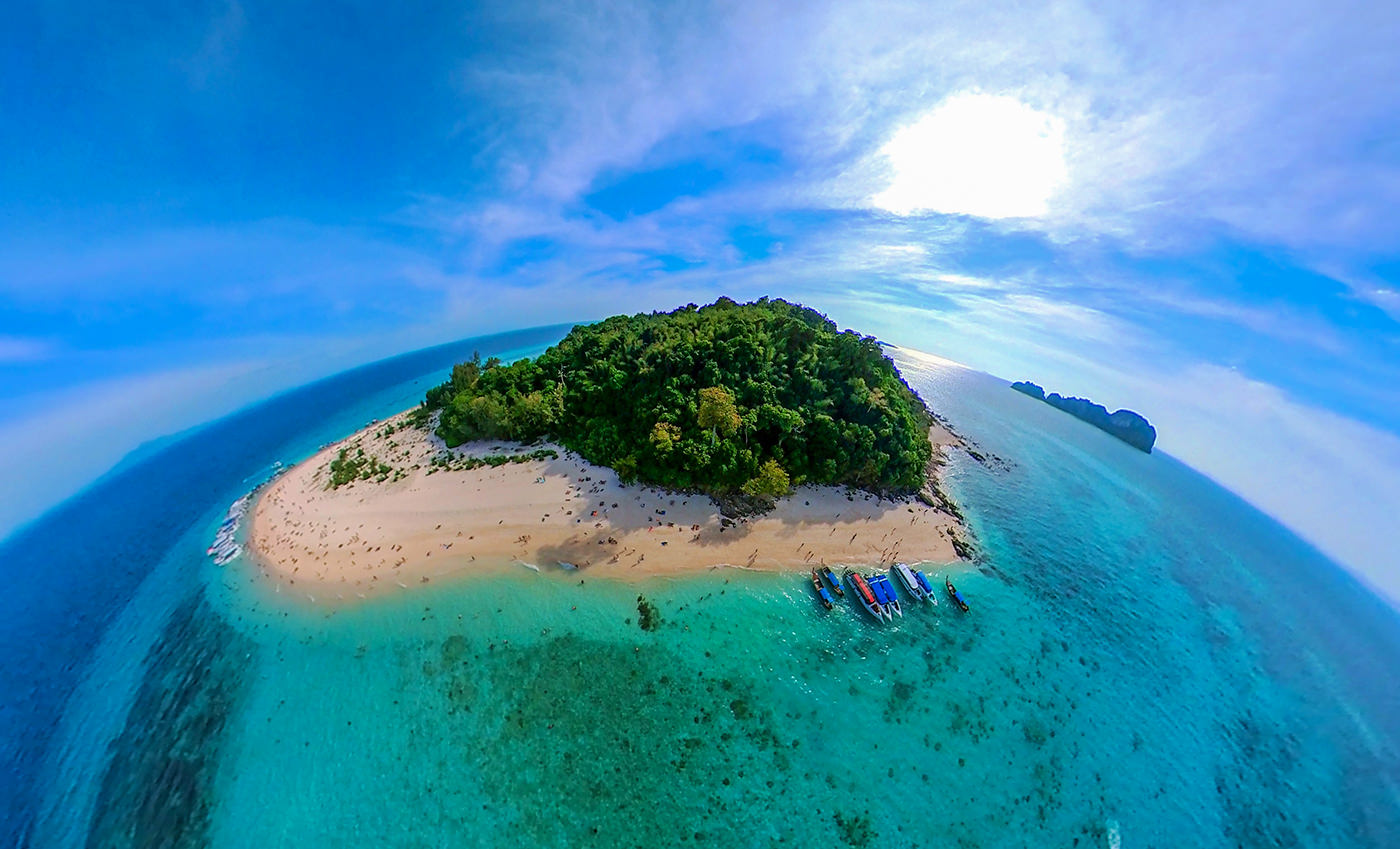
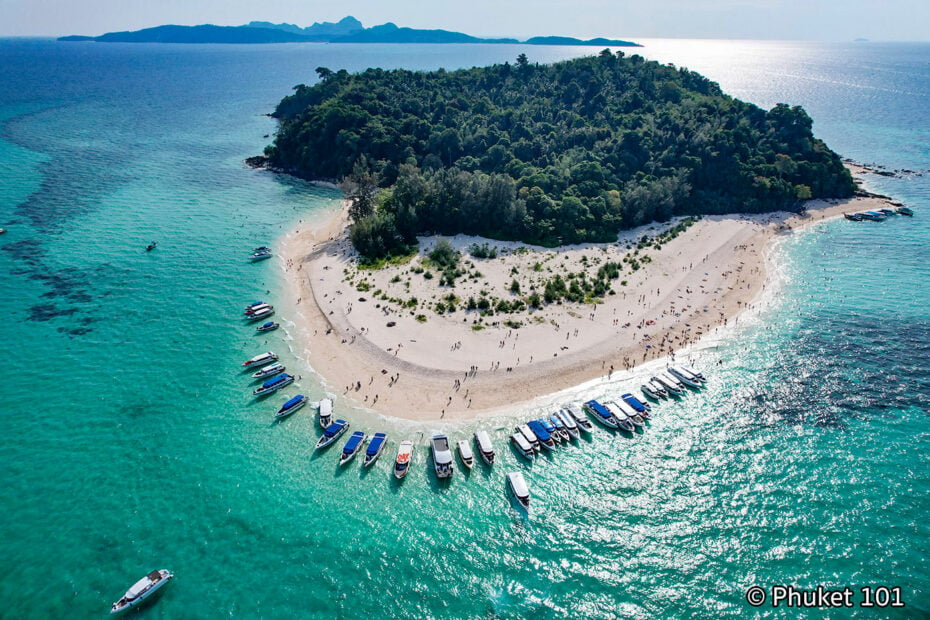
Bamboo Island is a small, uninhabited island about 8 km northeast of the main Phi Phi island. It has white sand beaches, clear water and good snorkelling. Coral reefs surround the island, and there is a small bamboo forest inland, which is where the name comes from.
The beach is wide, and the sand is soft, but don’t expect to have it to yourself. Like almost everywhere on Phi Phi, speedboats arrive all day to drop off passengers. Most tours include Bamboo Island as the last stop after a day around the archipelago, so by the time you get here, you’re usually tired, salty, and ready to just sit on the sand for a while. Some people walk around and explore a bit inland, but there is not much to see beyond the beach. It’s a nice place to wind down before heading back to Tonsai Bay or Phuket.
Loh Dalum Bay
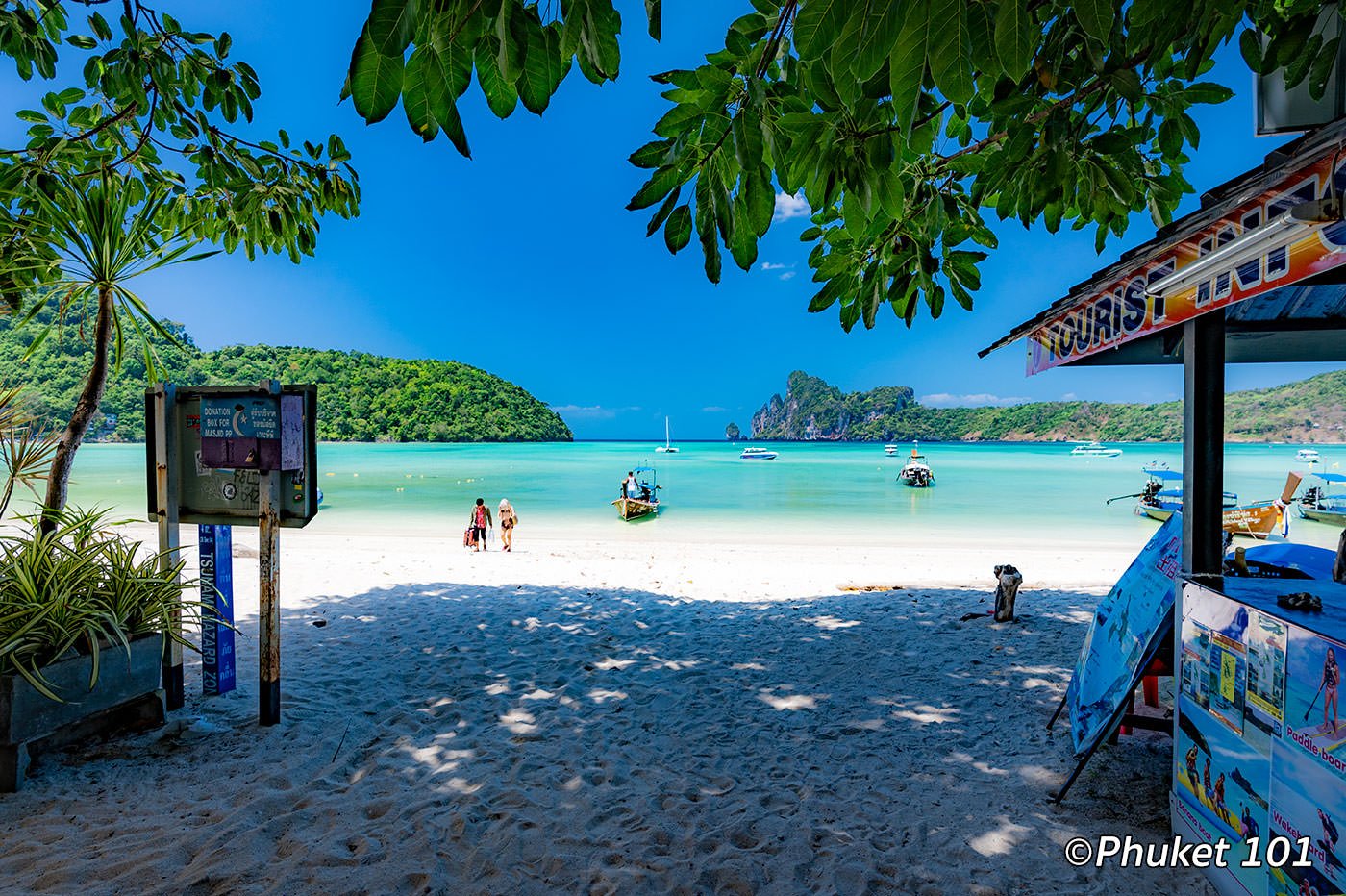
Loh Dalum is a stunningly beautiful shallow bay located on the southern side of Phi Phi Island. It is easily recognisable as the wide expanse of turquoise water that is visible on the right-hand side of the famous panoramic photo taken from the viewpoint. Despite its size, Loh Dalum is a relatively narrow stretch of beach, measuring only 160 meters in width. You can actually walk from the main town of Tonsai to Loh Dalum in just a minute or two.
Loh Dalum is the bay you see in every Phi Phi postcard, and it looks just as good in real life. The water is shallow and incredibly blue, especially around midday when the sun hits the bay directly. In the morning, the surrounding cliffs cast long shadows, so the colours are not as vivid. It’s a great spot to hang out during the day, rent a kayak, or just sit on the sand and take it all in. At night, it transforms completely. The bars along the beach come alive with fire shows, loud music, and crowds. If you like to party, this is your beach. If you don’t, you might want to stay on the Tonsai side after dark.
Phi Phi Viewpoint
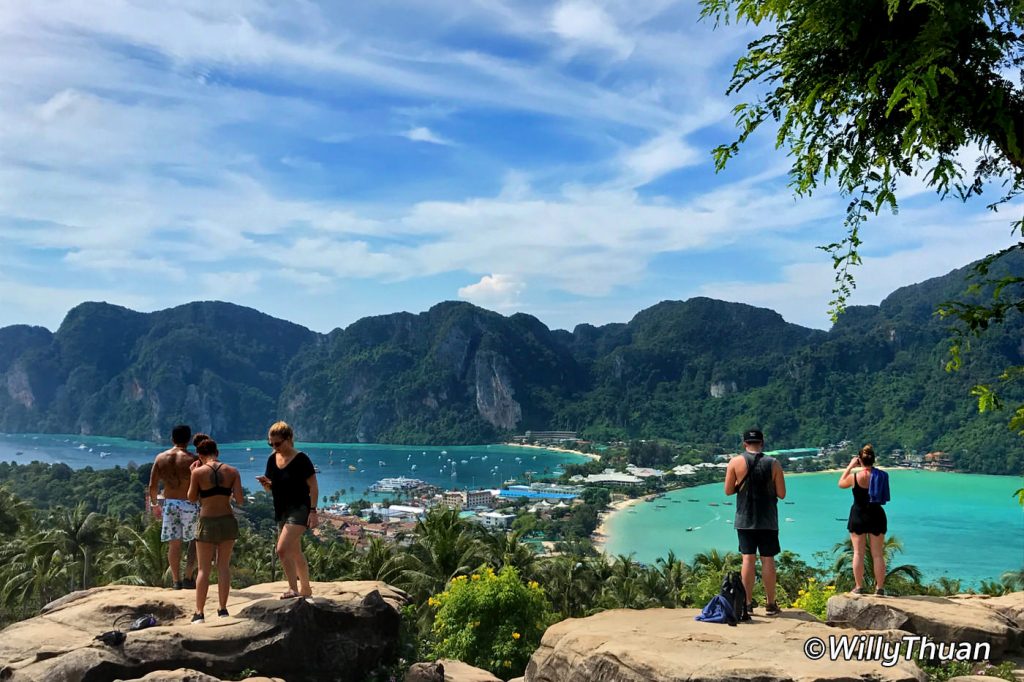
Reaching Phi Phi Viewpoint is a bit challenging, but it’s not too hard if you go at your own pace. Expect to sweat, and expect to get bitten by mosquitoes each time you stop to catch your breath in the shade of a tree. Mosquitoes here are smart. They ambush you at those exact spots where everyone pauses to rest. At the end of the first long flight of stairs, you reach Viewpoint Number 1 and the ticket counter. It costs 30 baht from that point on.
The view from up there is worth the climb. If, like me, you have been to Phi Phi Island in the 90s, you will realise how much it has changed. What was a small village tucked between two iconic bays has become a true town.
Scuba Diving

Phi Phi has over 20 dive sites, and the water clarity here is hard to beat. The dive sites are close to the island, usually just 15 to 30 minutes by boat. You can expect to see blacktip reef sharks, turtles, barracuda, lionfish, and colourful coral gardens. Around half moon days, conditions are often at their best, with weaker currents and better visibility. Hin Bida is one of the highlight sites, known for leopard shark sightings.
There are several well-established dive centres on the island, including Princess Divers (the longest-running, open since 2001), Phi Phi Scuba Diving Center (the largest, with the biggest fleet of boats), Blue View Divers, Barakuda, and several others. Most offer courses in multiple languages.
If you have never experienced diving before, just remember that there is a very cool option called ‘Discover Scuba Diving’. It doesn’t require any training, just a briefing usually given on the deck of the boat on the way to the dive sites. I did it, and it was fantastic. You go down with an experienced instructor, and within minutes, you are surrounded by reef fish and coral. It’s one of those things you remember long after you leave Phi Phi.
Where to Stay on Phi Phi Islands?
Phi Phi Island hotels come in a surprisingly wide range to fit different budgets and preferences. Some of the best hotels on Phi Phi Island cater to those seeking luxury and privacy with all-villa beachfront resorts that offer breathtaking views and modern facilities.
PP Princess Resort
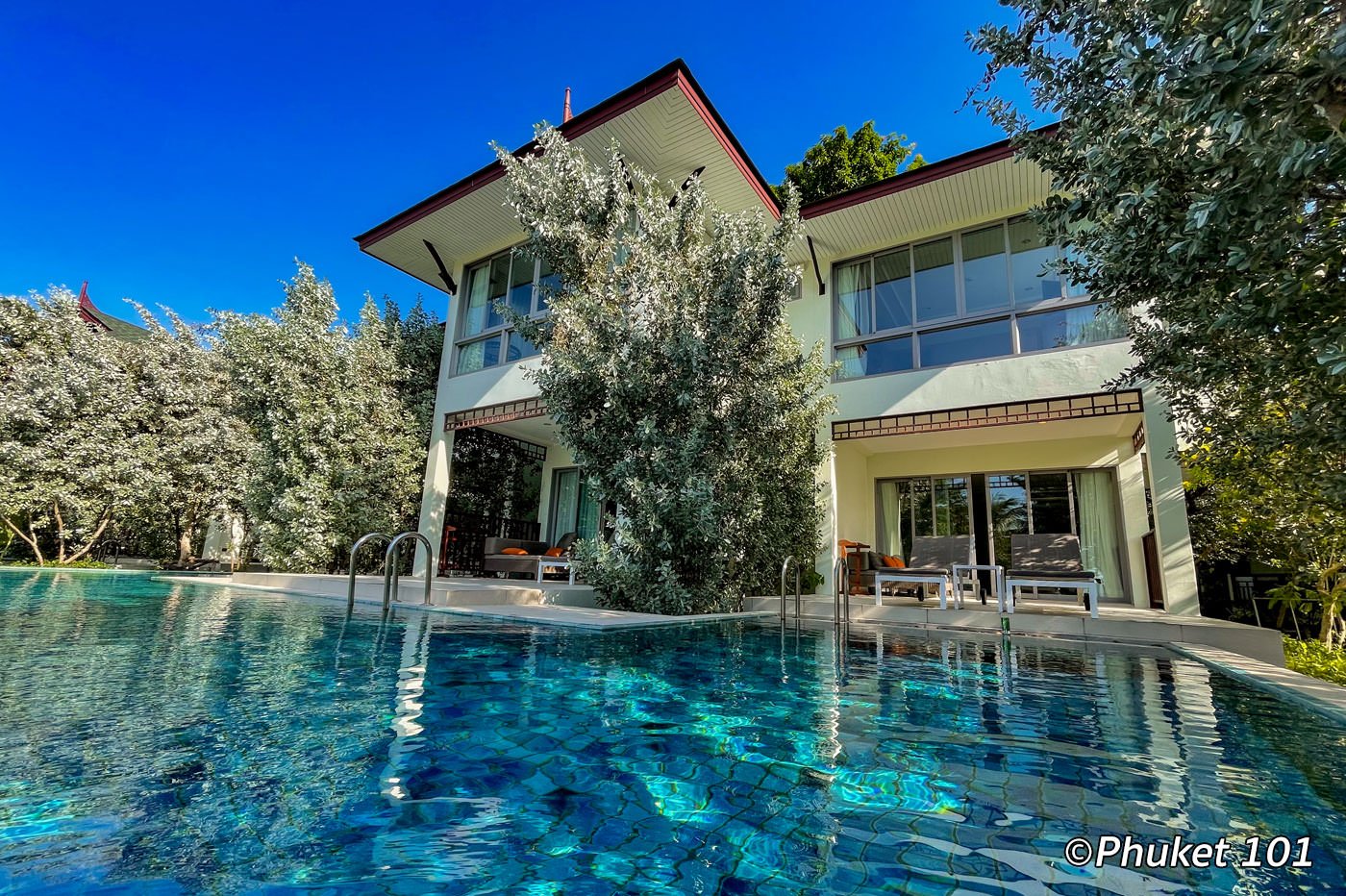
I stayed at PP Princess Resort, and the location is what makes it special. The hotel sits right between Loh Dalum Bay and Tonsai town, so you get both. Walk out the front and you’re on a superb beach that doesn’t get as crowded as you’d expect. Walk out the back, and you step straight into the busy life of Tonsai, with shops, restaurants, and massage places everywhere around you. The pool villas are well designed and worth the upgrade. It’s a great spot if you want to be somewhere lively and convenient without giving up a good beach. One thing to know: the street at the back can get really busy during high season. Read more about PP Princess Resort.
Location: Tonsai Bay
Range: 4-star
Swimming pools: 1
Restaurants and bars: 2
Distance to the beach: across the garden to reach the superb Loh Dalum Bay
Distance to Phi Phi centre: 500 m
SAii Phi Phi Island Village
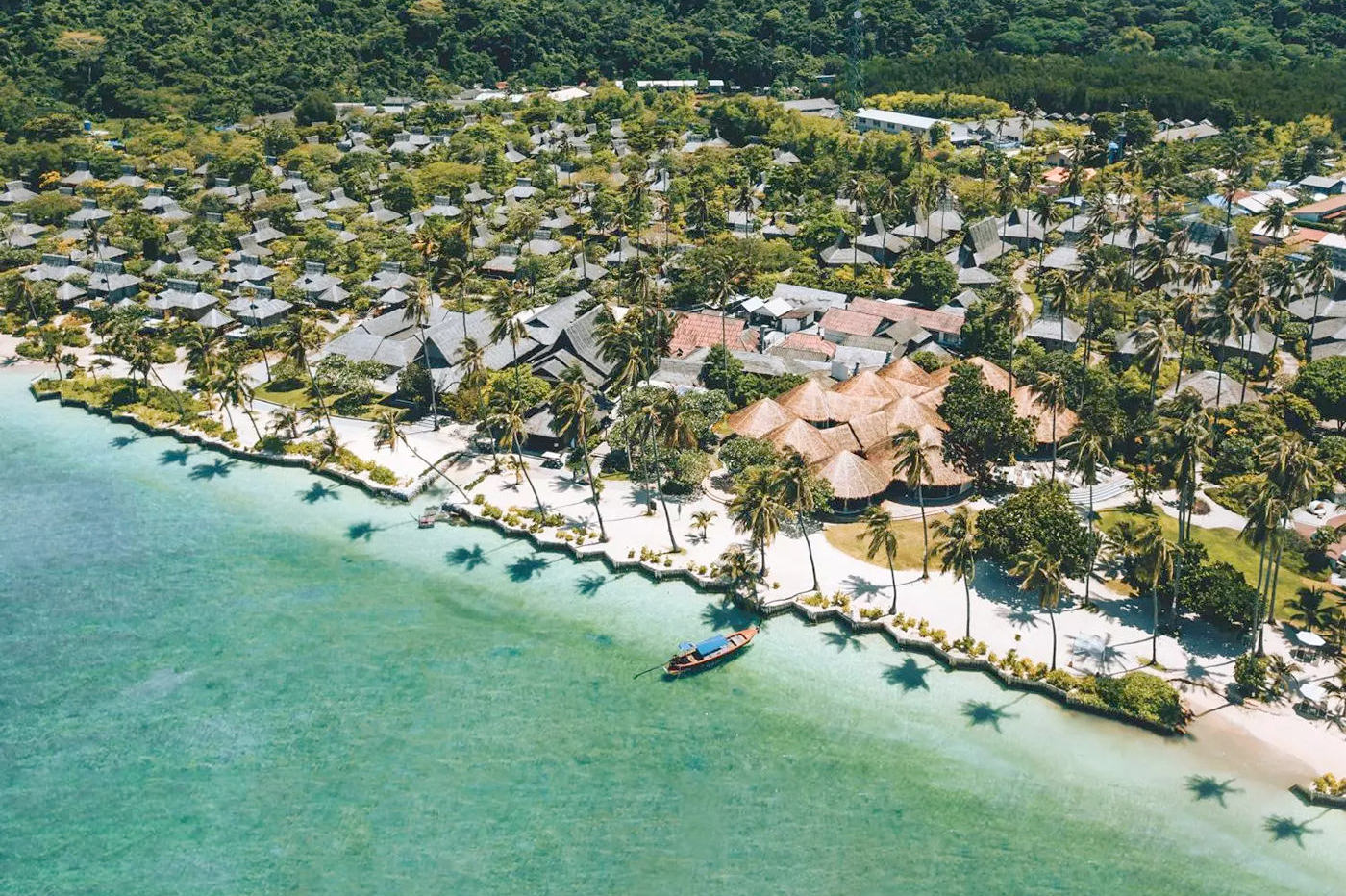
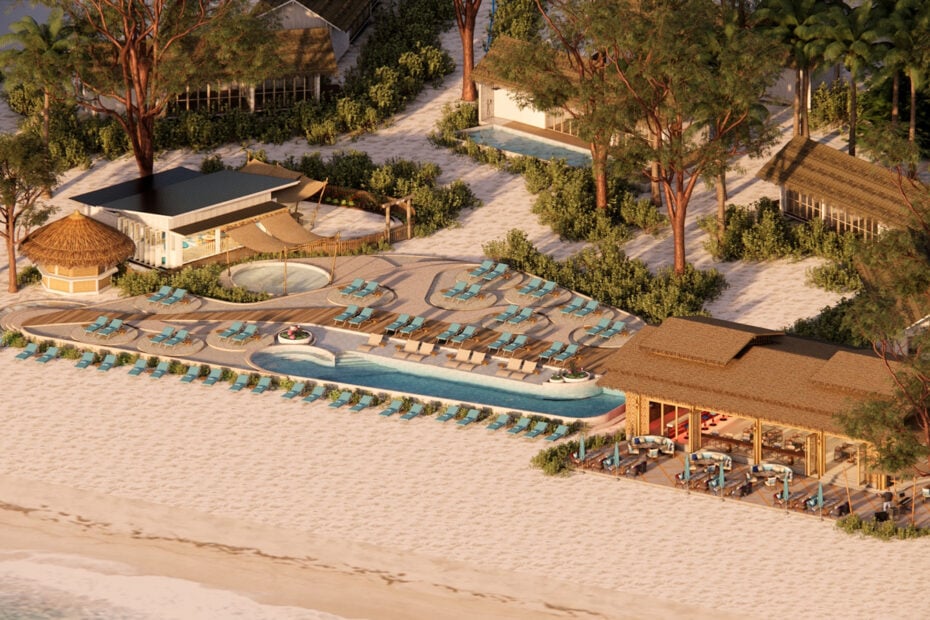
SAii Phi Phi Island Village is one of the few proper luxury resorts on Phi Phi. It’s on Loh Ba Kao Beach, 2.5 km from Tonsai town, which means you’re away from the noise and the party crowd. That distance is either a positive or a negative depending on what you want. If you’re looking for peace and a good beach, this is probably the best option on the island. The resort has 201 rooms and villas spread across the beachfront. It’s a 5-star property with two pools, a spa, and a fitness centre. Not the place for backpackers or party-goers, but families and couples looking for something quieter on Phi Phi will appreciate the separation from the chaos of Tonsai.Read more about SAii Phi Phi Island Village.
Location: Loh Ba Kao Beach
Range: 5-star
Swimming pools: 2
Restaurants and bars: 1
Facilities: Fitness centre, Spa
Distance to the beach: Beachfront
Distance to Phi Phi centre: 2.5 km
Check the rates
Phi Phi CoCo Beach Resort

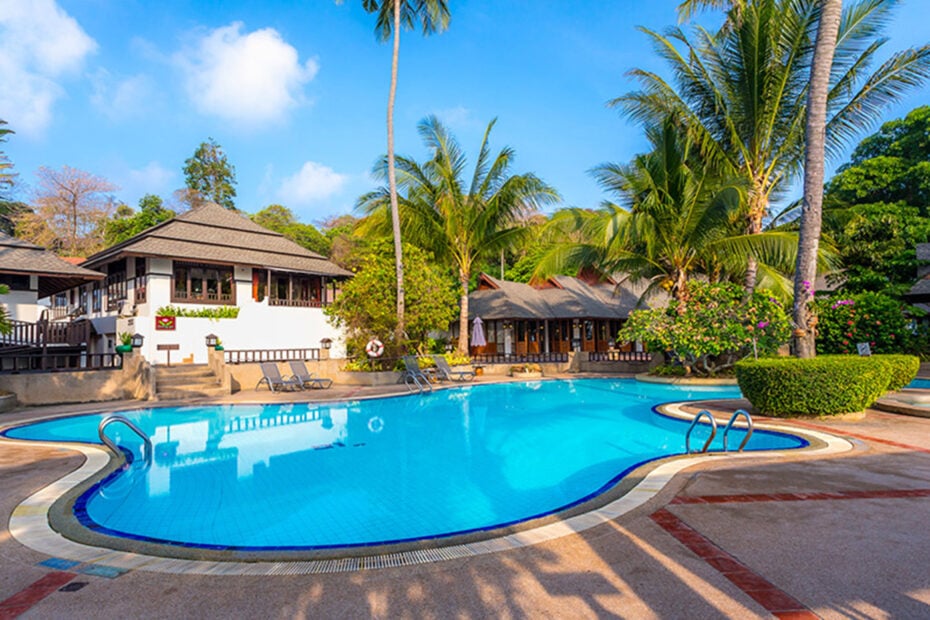
Phi Phi CoCo Beach is a smaller 4-star resort with 48 rooms, including bungalows and villas in a traditional Thai style. It sits on the western end of Loh Dalum Beach, about 1 km from Tonsai centre. That’s a 10-minute walk along the beach or through the village, far enough to escape the loudest bars at night but close enough to reach everything on foot. Loh Dalum is the main beach on Phi Phi, and this end of it tends to be a bit calmer than the section closer to the fire show bars. One pool, one restaurant, and a fitness centre. It’s a good middle ground between the party hotels in town and the isolated resorts further out.Read more about Phi Phi CoCo Beach Resort.
Location: Loh Dalum Beach
Range: 4-star
Swimming pools: 1
Restaurants and bars: 1
Facilities: Fitness centre
Distance to the beach: Beachfront
Distance to Phi Phi centre: 1 km
Check the rates
The Islands of Phi Phi Archipelago
In case you didn’t know, Phi Phi consists of several islands, but you can only stay on one. You will notice that many islands’ names start with ‘Koh, ‘ which means ‘Island’ in Thai. So you will sometimes hear ‘Koh Phi Phi’ or ‘Phi Phi Island’, but for an apparent reason, rarely ‘Koh Phi Phi Island’.
Koh Phi Phi Leh
Koh Phi Phi Leh is the smaller, uninhabited island of the archipelago. No one is allowed to live there, which is why it hasn’t changed as much as Phi Phi Don. The landscape is still stunning, with towering limestone cliffs, Maya Bay, and Pi Leh Lagoon. What has changed a lot is the traffic. Speedboats and longtail boats come and go nonstop. It’s a non-stop ballet of boats all day long.
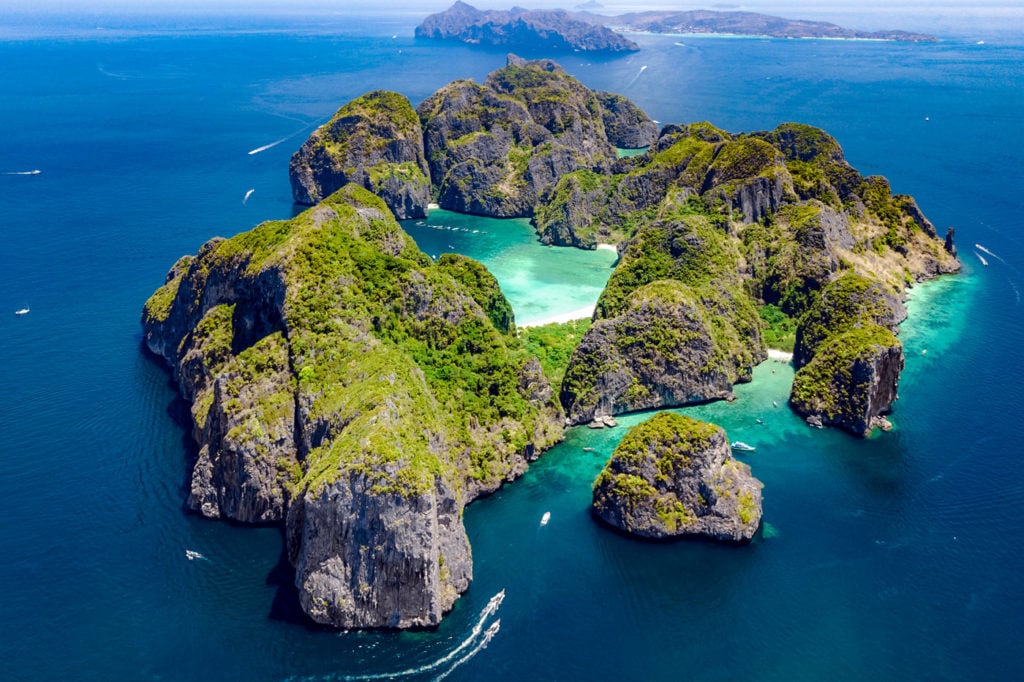
I had the chance to explore Phi Phi Leh back in 1990, and the highlight was the Viking Cave. The cave is locally called Tham Phaya Nak, but it got the name “Viking Cave” because of old paintings on the walls that look like Scandinavian longships, probably drawn by sea gypsies or sailors sheltering from storms. What I remember most is how immense it was. Local collectors were climbing precarious bamboo ladders high up inside the cave to harvest swallow nests, which are used to make bird’s nest soup, a prized delicacy in Chinese cuisine. The climb looked incredibly dangerous. Access to the cave was closed to visitors a few years later, and today boats just slow down to let you look from the water.
Phi Phi Don
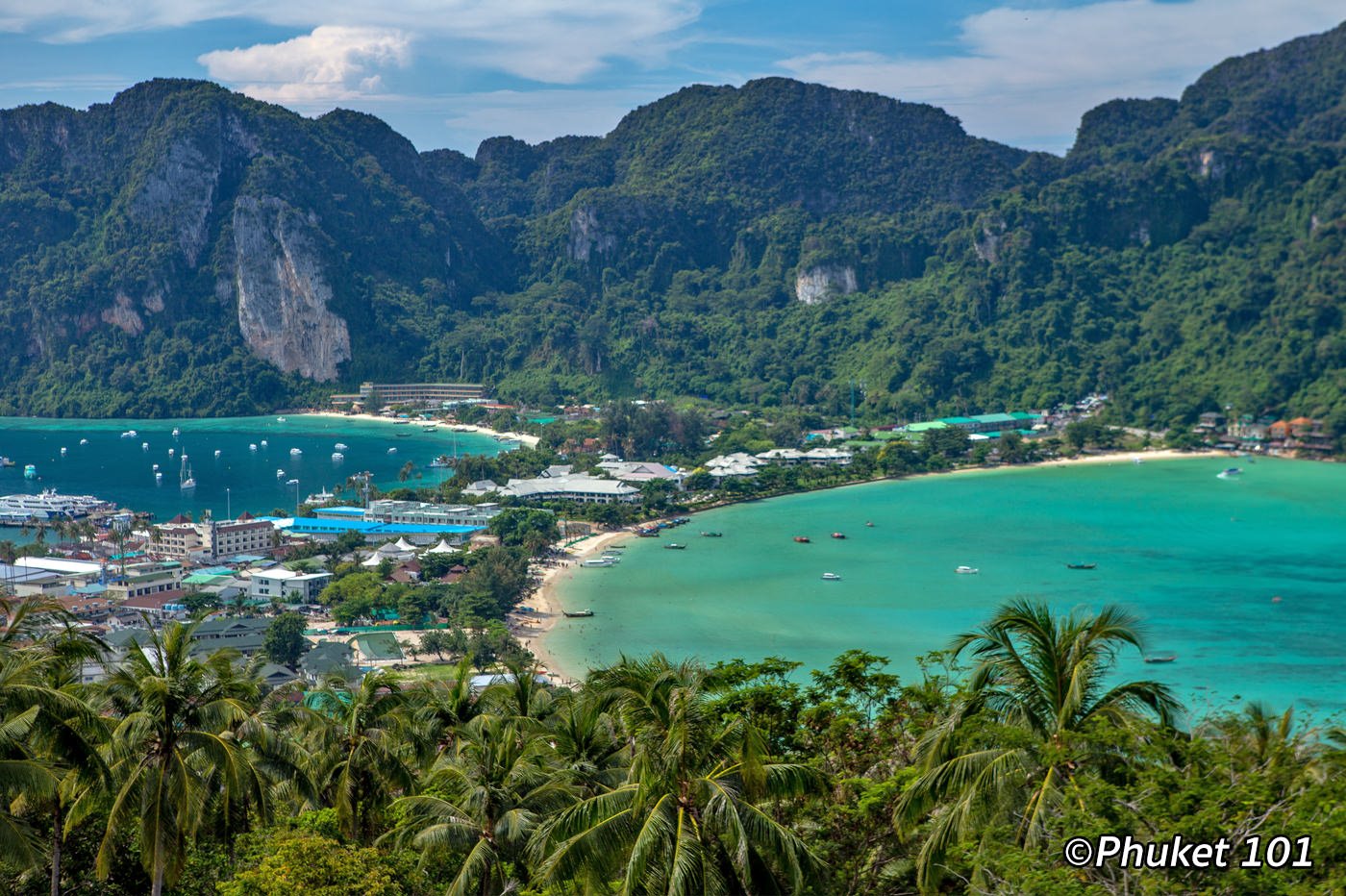
Phi Phi Don is the largest and only inhabited island in the archipelago. It’s where all the hotels, restaurants, and bars are. No cars, just narrow walkways packed with shops and tattoo parlours.
Phi Phi Don is nowhere like what people may expect from the movie “The Beach”. Far from that. It has become a real town, mostly catering to young travellers. You can expect to find a lot of bars, tattoo shops, and beach parties, and you will frequently encounter a strong cannabis smell. If you came looking for a quiet tropical paradise, Tonsai is not it.
That said, the island still has appeal, mainly in the northern part. Beaches like Long Beach, Loh Ba Kao, and Laem Thong feel like a different world compared to the buzzing centre. The scenery around Phi Phi Don is still beautiful. The cliffs, the bays, the water. It’s just that the village itself has changed a lot since I first came here in the 90s.
Tonsai Bay – Phi Phi Central Area
Tonsai Bay is where the ferries and speedboats drop you off. Step off the pier, and you are immediately in the middle of it all. The bay faces east, and behind it, just a minute’s walk through narrow alleys, is Loh Dalum Bay on the other side. The whole town sits on a flat strip of land between these two bays.
The layout feels like a maze. Picture this: a T-shirt shop, a tattoo parlour, a bar, a dive centre, another tattoo parlour, a fast food place, another bar, a travel agency, a massage place. Repeat that pattern for every walkway. I’ve never seen so many tattoo shops per square metre. I’ve never seen so many cats, either.

Most shops don’t open in the morning. The reason is simple. Half the island is out on boats exploring, and the other half is still in bed recovering from cheap whiskey buckets that seemed like a great idea the night before. Things pick up after lunch, and by evening, the walkways are packed.
There is now a McDonald’s and a Burger King on the main street. A 7-Eleven is never far away. The town has ATMs, a clinic, pharmacies, and a decent phone signal. You won’t be stuck for anything practical.
Tonsai is not a quiet place. It is loud, busy, and commercial. But it is also the only real base if you want to walk to everything, catch a longtail boat on short notice, or join the beach parties on Loh Dalum after dark. If you prefer something calmer, stay at Long Beach or Loh Ba Kao and come to Tonsai when you feel like it.
Long Beach
Long Beach is a superb sandy bay located just next to Tonsai Bay, and you can easily reach it by walking along the coast. It’s one of my favourite spots on Phi Phi because it feels a lot quieter than the main village, even though it’s only a short walk away. The beach is long enough to find your own space, and the sand is soft and clean. The water is clear, and the snorkelling just off the beach is surprisingly good.
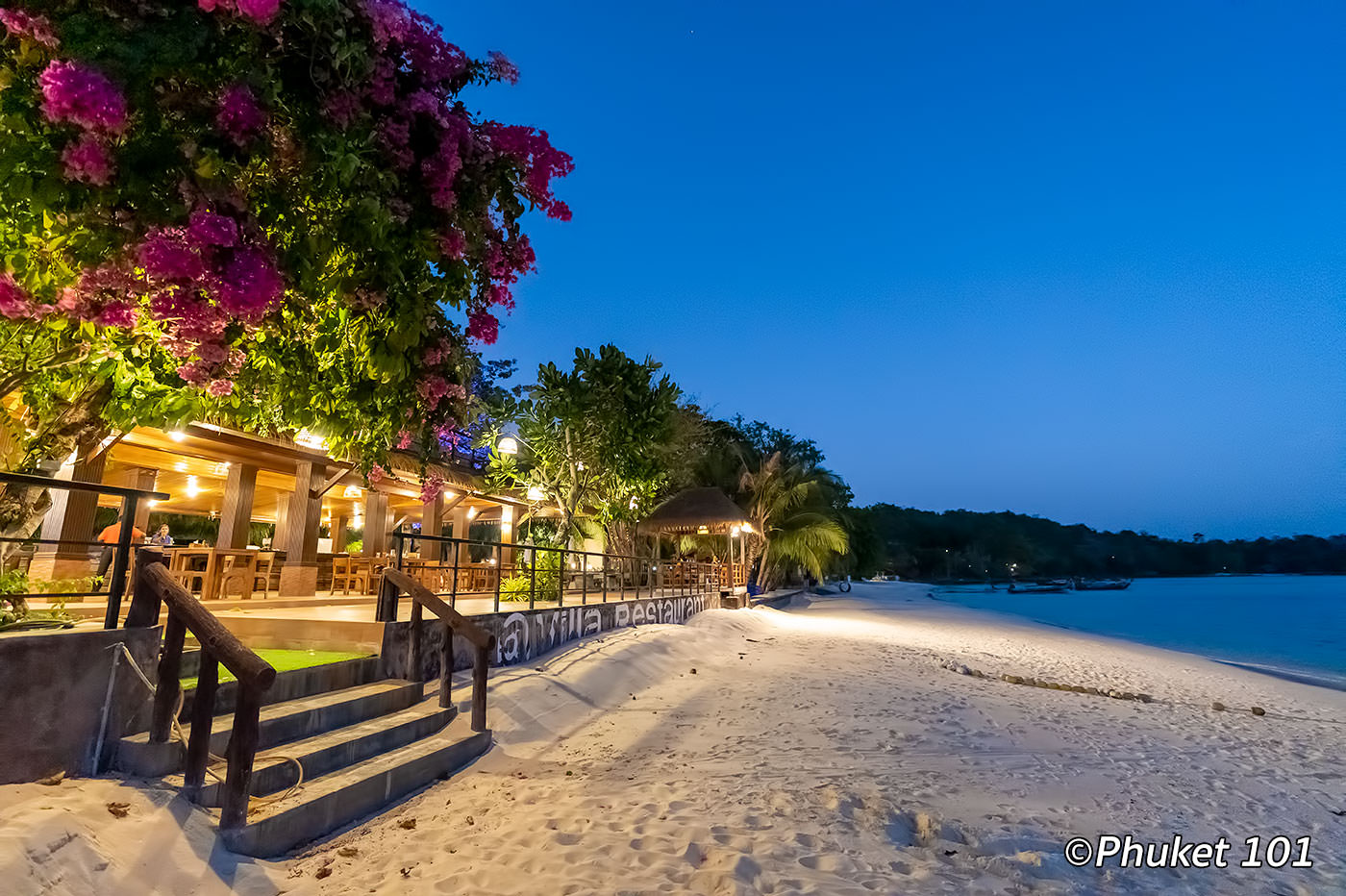
The place is home to some excellent hotels and bungalows like Phi Phi Villa Resort. If you want to enjoy Phi Phi without the constant noise of Tonsai, Long Beach is where I would stay.
Laem Thong Beach

Laem Thong Beach is on the northern tip of Phi Phi Island, far from Tonsai and the crowds. It’s one of the few places on Phi Phi that hasn’t changed too much, because it is isolated and only the guests of the nearby hotels really get to enjoy it. The beach has clear turquoise water, soft white sand, and good snorkelling. Holiday Inn Resort Phi Phi Island and Phi Phi Island Village Beach Resort are both here. It really feels special at the end of the day, when the boats have gone and you have the beach almost to yourself.
Loh Ba Kao Beach
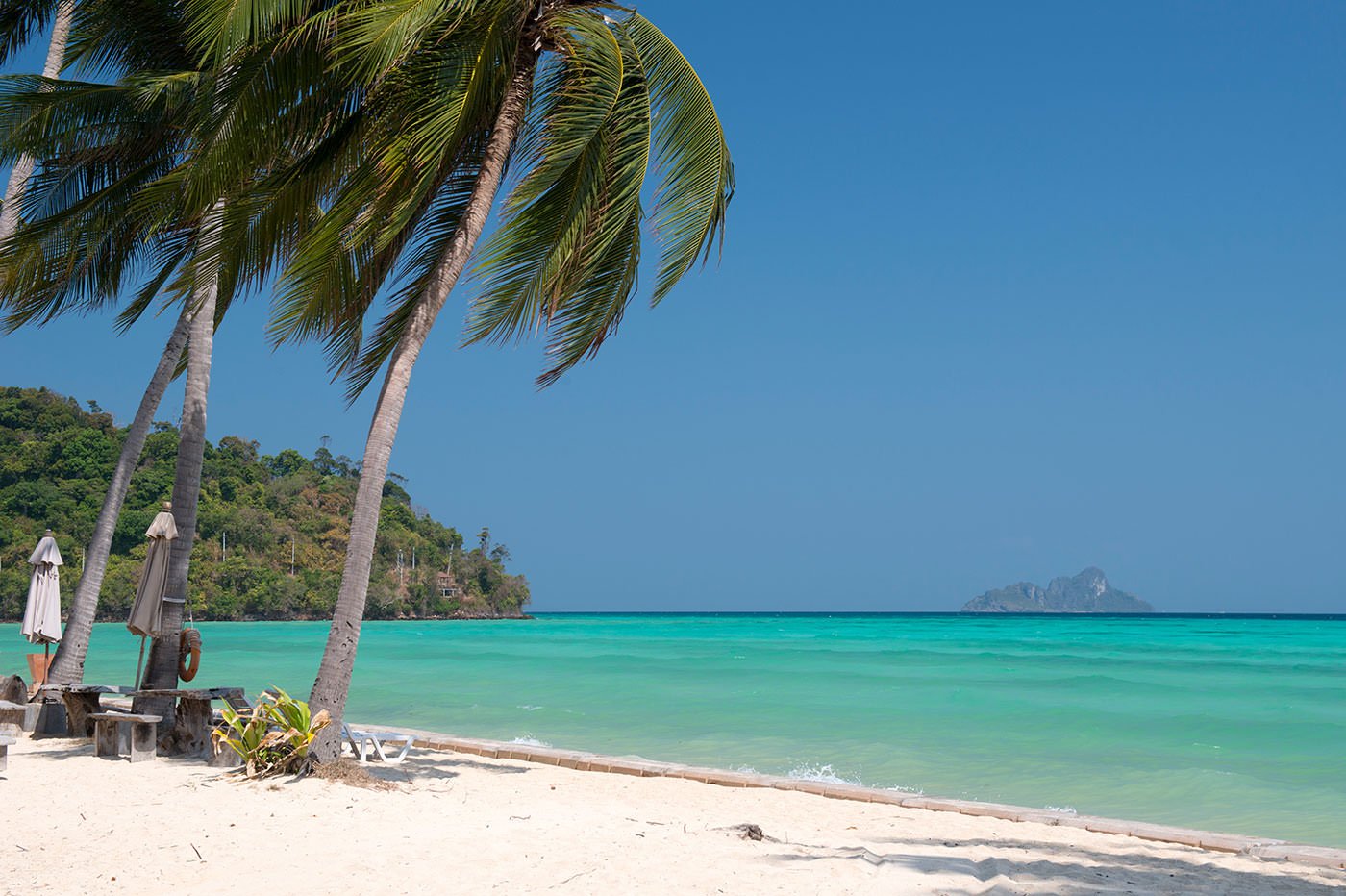
Loh Ba Kao, often pronounced and spelt ‘Loh Bagao’, is a long and wide bay on the northeast coast of Phi Phi Don. It’s about 800 metres wide and far from the noise of Tonsai. Most people reach it by longtail boat, which takes about 20 to 30 minutes from Tonsai Pier. You can also walk, but it takes over an hour. The SAii Phi Phi Island Village Resort sits on the beachfront, and the Villa 360 Resort & Spa is at the southern end. The beach is lined with coconut trees, and Thai-style bungalows are scattered along the sand.
At the northern end of the beach, there is a small river leading to a mangrove forest and a quiet village with a few bars, restaurants, and budget bungalows. A small bridge crosses the mangrove, and from the other side, you can walk further north towards Laem Thong Beach. It’s one of the parts of Phi Phi that still feels like a discovery rather than a tourist stop.
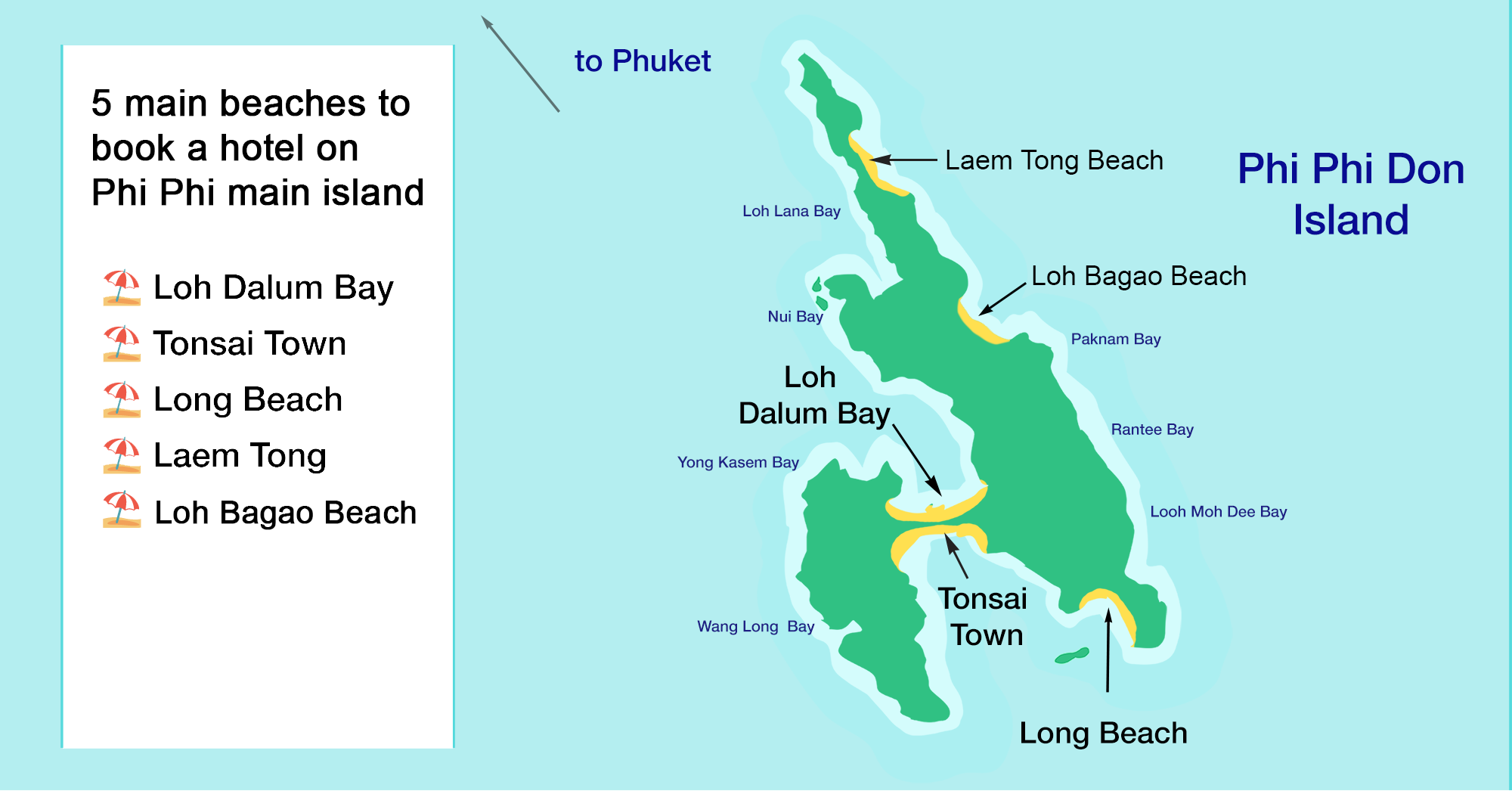
All around Phi Phi Don, there are other beaches of different sizes (see map at the end of the page).
Where to Party in Phi Phi?
The beach party and the street party are easy to join. Walk from one bar to another and follow the music, the crowd, and the atmosphere.
Slinky
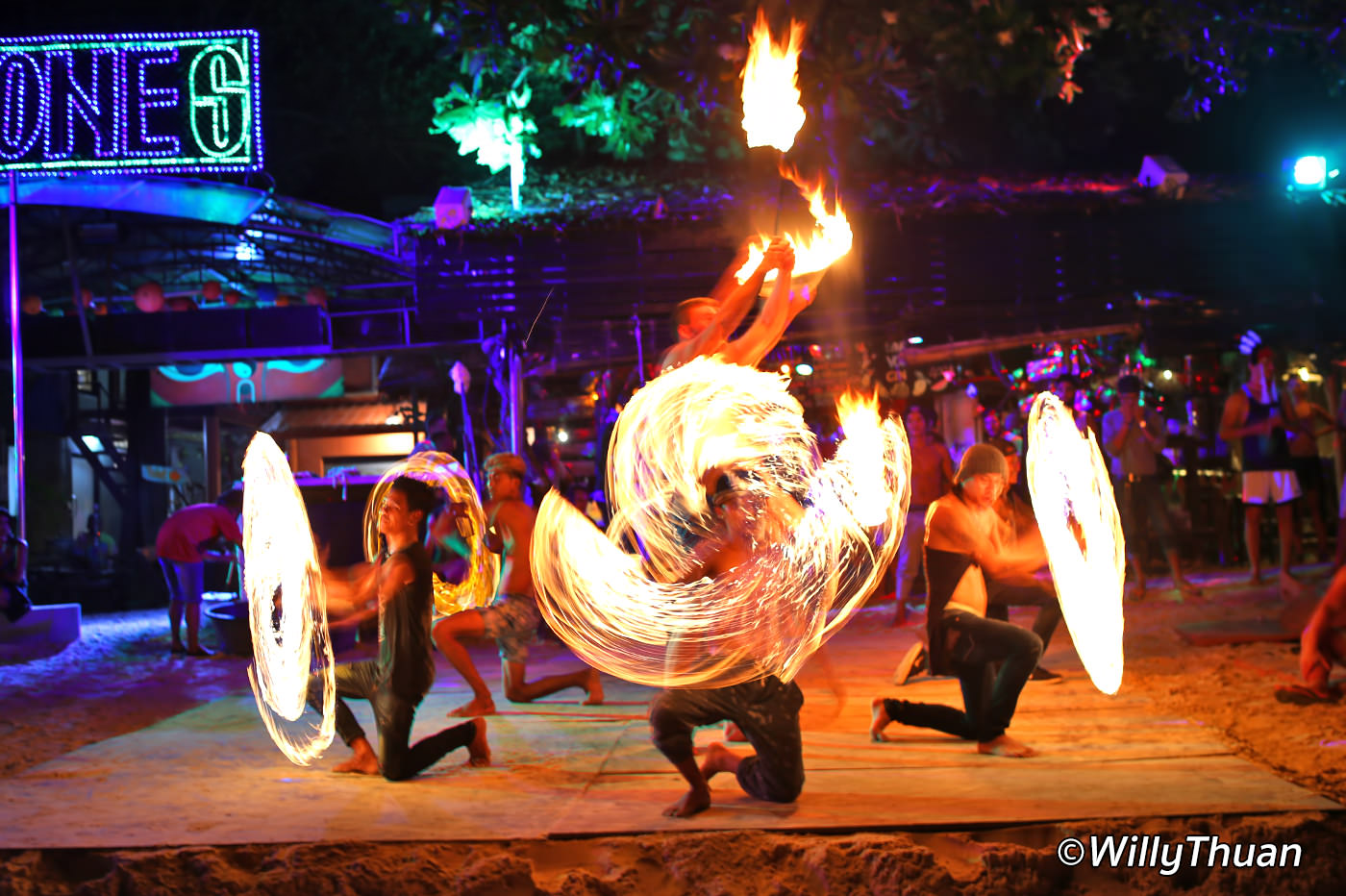
Slinky Bar is the biggest beach bar on Phi Phi, right on Loh Dalum Beach. It’s an open-air setup with a large stage area on the sand, fire shows starting around 8.30 to 10 pm, free body paint, mechanical bull, and cheap buckets. Full moon parties, half moon parties, themed nights. The music is loud, the crowd is young, and if you are anywhere near Loh Dalum after dark, you will hear it. It’s the kind of place where nobody sits still for long.
Stones Bar
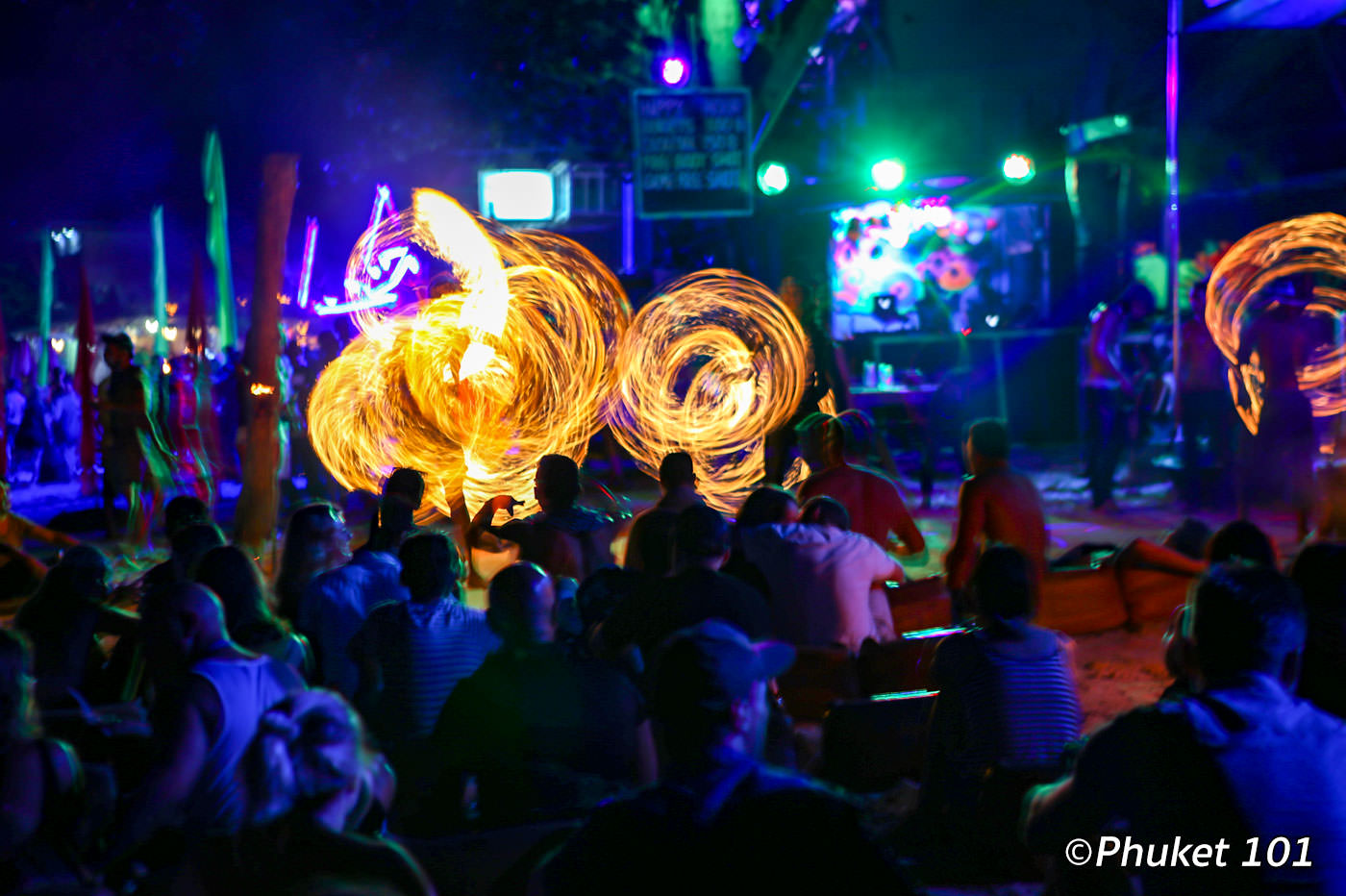
Stones Bar is one of the oldest bars on the island, right in the middle of Loh Dalum Beach. The music leans more towards drum and bass, which sets it apart from the other beach bars. The decor has a fluorescent cave theme with driftwood and neon lights. Fire dancers perform around 9 pm. It’s also the only beachfront bar that is openly weed-friendly, which fits the general direction Phi Phi has taken. Stones stays open later than most, often until 2.30 am, so people drift here when everywhere else has closed.
Reggae Bar

Reggae Bar is one of the longest-running bars on Phi Phi, tucked away in central Tonsai between the two bays. The main attraction is the Muay Thai boxing ring in the middle of the venue. There are organised matches between local fighters, some of them quite serious, and then tourists get invited into the ring to spar for a chance to win a whiskey bucket. It gets loud and chaotic. You need to buy a drink to enter, and some visitors have reported being charged an entry fee on top of that, so check before you go. There are pool tables, big screens showing sports, and five bars inside the venue. Don’t expect actual reggae music.
Phi Phi Backpacker Bar

Phi Phi Backpackers Bar, formerly known as Stockholm Syndrome, sits in the heart of Tonsai Village. The name changed, but not much else. It’s the go-to spot for beer pong, cheap drinks, and meeting other travellers. The real nightlife is down at the beach bars, but this is where people warm up before heading to Loh Dalum. It’s tucked down a narrow alley, close to the Rolling Stoned Bar, which is one of the few places on the island with live rock music and pool tables.
Other popular places to party in Phi Phi
Dojo Bar has recently moved to a new location near Carlito’s, overlooking the sea. Good spot for a few beers and house music from a resident DJ.
Carlito’s Bar is on the eastern end of Tonsai Bay with fire shows and a more comfortable lounge setup than the beach bars.
Kong Siam Live Bar is Phi Phi’s most popular live music bar. The husband covers songs from every genre and decade, and the small venue fills up fast, with crowds often spilling out into the street, singing along. If the bar is too packed to order a drink, the Paddy Shack next door sells the cheapest (and strongest) buckets on the island.
The Sports Bar (formerly Dubliners Irish Pub) has reopened and is the best place to watch live Premier League coverage.
What’s a ‘Bucket’?

Buckets are extremely popular in Phi Phi, and you can find them everywhere after sunset. Usually, a cheap mix of local whiskey (Sang Som), a Red Bull (you know what), a mixer and ice in a small plastic bucket, and a couple of straws. You can take this around as you party. As it’s sweet and cold and often uses cheap local alcohol, you don’t feel you are drinking much, and the Red Bull boosts you. Most people get drunk much faster and more than they think. Fun.
Where to get a tattoo in Phi Phi?
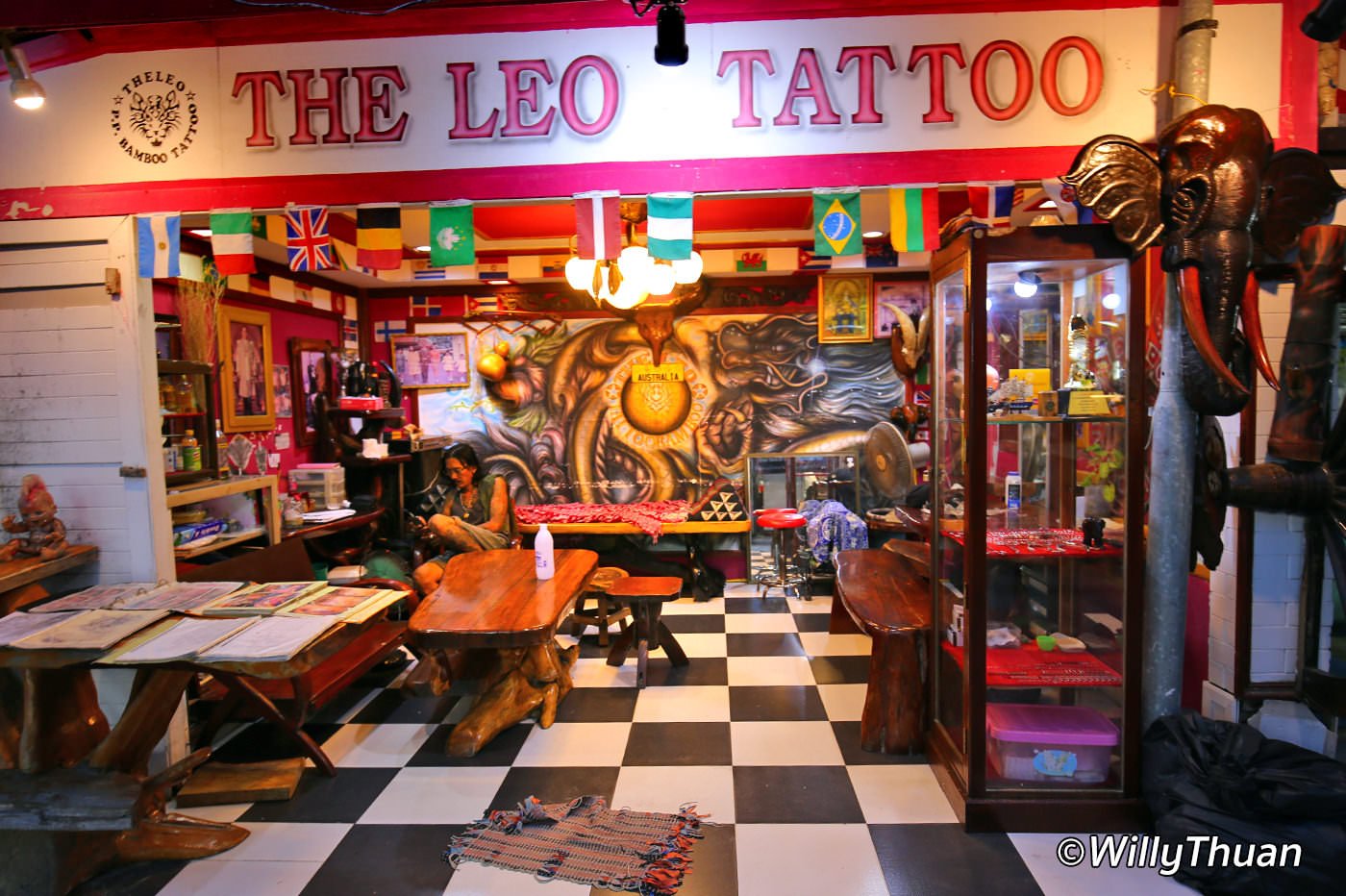
That’s a tough one; they are everywhere, and they all claim the same thing: a sterile environment and a new needle for each customer. Bamboo tattoos are also available. So, follow your instincts, but let us know if you can recommend one shop. I looked at a couple of standard-size tattoos; they cost between 5,000 and 10,000 baht and take 3 to 6 hours to execute.
Where to Eat on Phi Phi Island?
There are hundreds of places to choose from on Phi Phi Island. Walk along the few pedestrian walkways, and you can pick as you go. It’s a lucky draw. It’s more fun by the waterfront, but this is just us, so we tried the following: they were quite good.
Tonsai Seafood
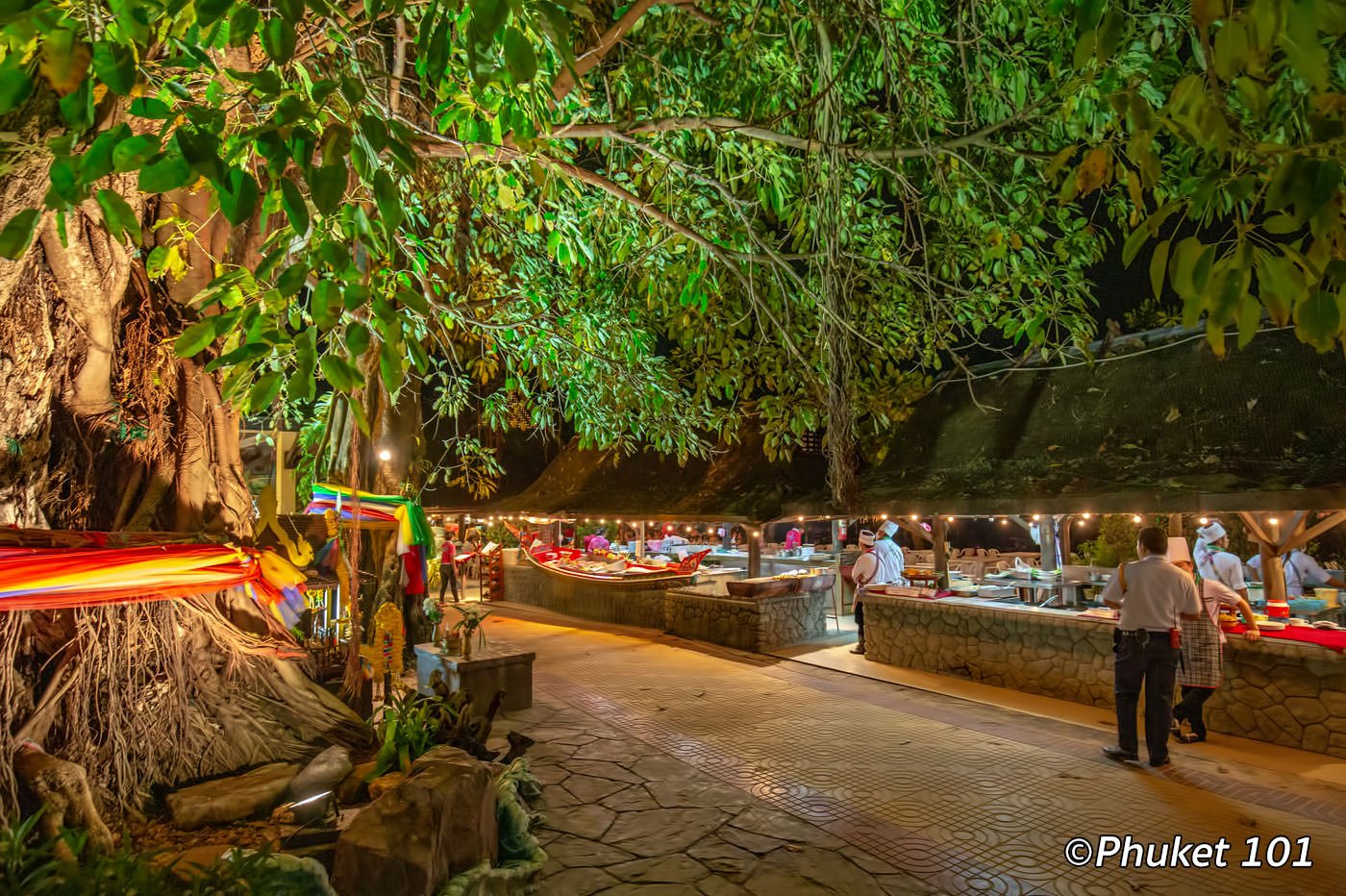
Tonsai Seafood sits right on the beachfront in Tonsai Bay, Phi Phi Island, directly across from Phi Phi Banyan Villa. The restaurant is not only a popular spot for fresh seafood and Thai dishes, but it is also the beachfront restaurant of the Phi Phi Banyan Villa hotel. Guests staying at the hotel enjoy breakfast here, and the restaurant is open to everyone for lunch and dinner.
The connection means you can expect a steady flow of hotel guests, especially in the mornings, but the place remains busy throughout the day, particularly at sunset. The menu features grilled fish, lobsters, and other classic Thai dishes, making it a convenient choice for both hotel guests and visitors looking for casual seaside dining.


Garlic 1992 has been around since 1992, which is before some of today’s backpackers were born. It has become something of a viral sensation on social media, and there is almost always a queue outside. The menu focuses on authentic Thai dishes like khao soi, massaman curry, and green papaya salad. The food is fresh, portions are generous, and the staff are famously friendly. The setting is basic, just plastic chairs and simple tables, but people come for the food, not the decor. Arrive early if you want to avoid waiting. Cash only.
Papaya serves a mix of Thai and Indian dishes with big portions. The pad thai is reliable, the curries have a decent kick, and the fruit shakes are a good way to cool down. The restaurant is in Tonsai Village, easy to find near the Reggae Bar. Service is quick, and it’s a good option when you’re hungry and don’t want to walk around looking for somewhere to eat.
Pirates House is near the pier and offers two separate menus: Thai and Indian. You could visit twice and have completely different meals. The green curry and massaman are both good, and the Indian dishes like butter chicken are better than you’d expect on a small island. They also have live music in the evenings, which adds a nice atmosphere. The staff are friendly, and it’s a good spot for families or groups who can’t agree on what to eat.
The Mango Garden is a small cafe that specialises in mango everything. The mango sticky rice is the main draw, served fresh and not too sweet. They also do smoothies, fresh juices, and all-day breakfast. It’s not a dinner spot, more of an afternoon treat or a breakfast stop.
Oasis Bar & Restaurant is away from the main tourist area, in Loh Bagao village, behind the Phi Phi Island Village Resort. The setting is rustic, built from bamboo and driftwood, and the atmosphere is more relaxed than anything in Tonsai. Seafood is the speciality here, especially the prawn tempura. It’s a good option if you’re staying on the quieter side of the island or want to escape the crowds for a meal.
Shopping on Phi Phi Island
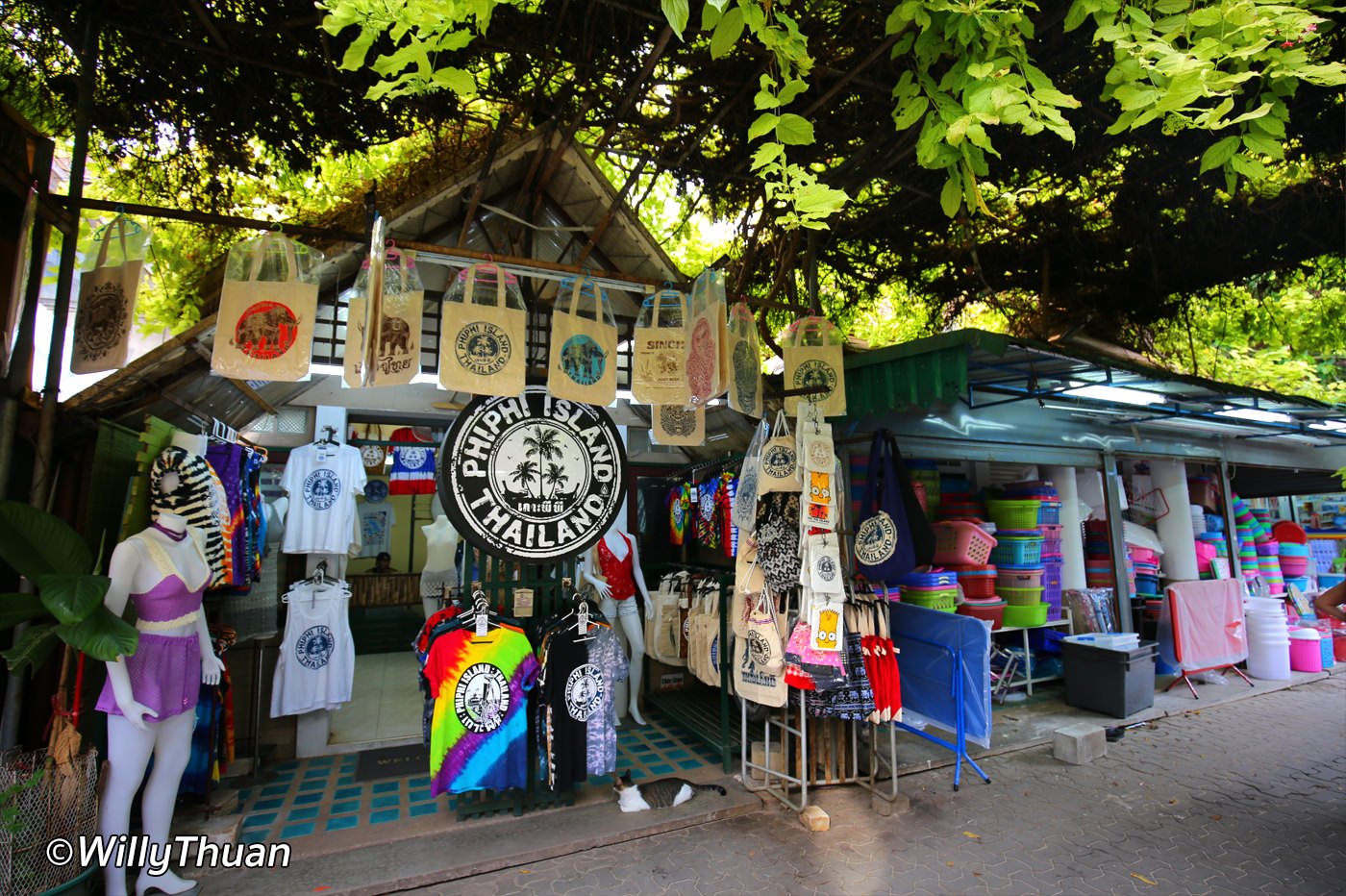
The famous expression “Same Same but Different” was probably coined here. Phi Phi island tee shirts, short pants, light skirts, swimsuits, bags… everything you need for a holiday on a small island. Don’t expect much originality, but browsing is always fun, especially when there is not much to do. The elephant pants are one of the most popular items on sale in Phi Phi, and they really fit the island mood. They are light, look very tropical, and they are back in fashion even in Bangkok. Best of all, they make great pyjamas once you are back home.
Phi Phi Islands in 1990: My First Visit and Many After That
I first set foot on Phi Phi Island in 1990. Back then, there were no proper hotels on the island, just a handful of basic bungalows and camping spots. Tourism was barely a thing. A few backpackers and dive fans knew about it, word of mouth mostly, and that was it.
The view from the top of the viewpoint was something I will never forget. Two bays curving around a narrow strip of green land, with a massive limestone cliff rising behind it. It looked untouched. Today, the geography is the same, but that strip of land between the bays is now covered with an incredible number of buildings.
Maya Bay was unknown to the outside world. The movie “The Beach” with Leonardo DiCaprio would not be released until February 2000, a full decade later. So when I swam there with friends, we had the bay to ourselves. Soft sand, clear water, no boats, no crowds. It was, quite literally, like being in the movie before the movie existed.

But the highlight of that first visit was the Viking Cave on Phi Phi Leh. At the time, the cave was open to the public. The longtail boat dropped us on a precarious wooden pier, and we walked straight in. Everyone went silent. It was as if the entire limestone cliff were hollow. The scale of it was jaw-dropping. Everywhere I looked, bamboo ladders climbed high up the walls to reach swallow nests, which are collected for bird’s nest soup, a prized Chinese delicacy. I tasted it once, and it was not really to my liking, so I never tried again. Natural openings at the top of the cave let shafts of light through, which made the whole place feel like a cathedral. The cave has been closed to visitors for years now, and boats just slow down to let you look from the water.
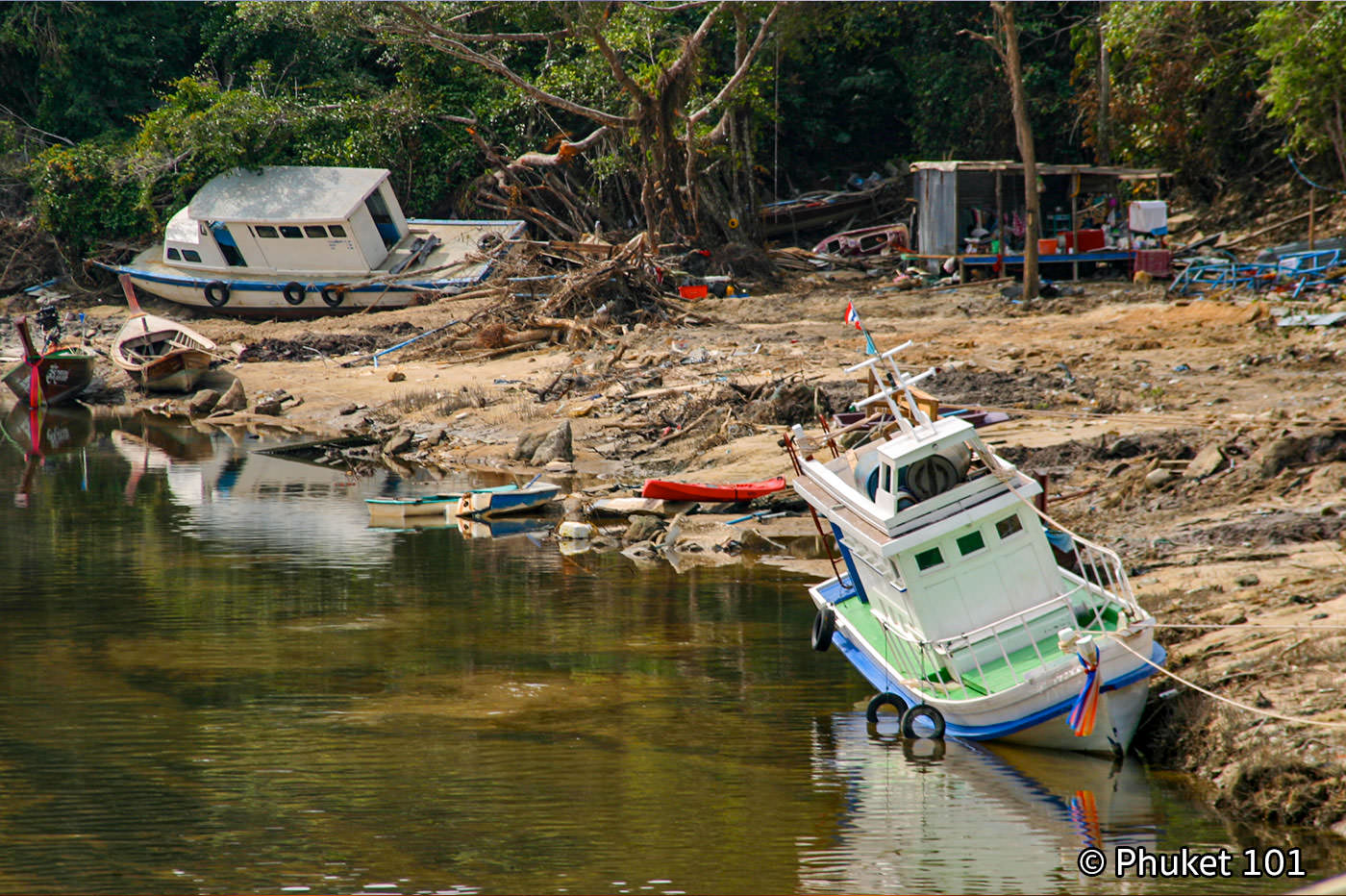
I went back to Phi Phi many times after that and watched it change fast. But one visit will never leave me. After the 2004 tsunami, I went to Phi Phi with a French TV crew. I had been documenting the tsunami recovery for my readers, and the crew heard about it and asked if they could follow me and film. What I saw was devastating. The Phi Phi I knew was wrecked. Debris everywhere, buildings flattened, and the people still living there were in shock. I know the documentary was broadcast live on French television, but I have never watched it. The tsunami was a hard chapter in my life, and in the lives of everyone who lived through it in this part of Thailand.
Phi Phi Islands Photos


Phi Phi Island Map
Useful information about Phi Phi
▷ There are many convenience stores, banks, ATMs, and pharmacies everywhere. There is a hospital and a large modern clinic, so you know you won’t have to worry about these. ▷ There are no cars on Phi Phi, but you will hear “Peep-Peeeep!” a dozen times as locals try to push carts loaded with all kinds of stuff. ▷ Phone signal coverage is surprisingly good from Phuket to Phi Phi! But Wi-Fi in hotels is useless.
| 📷 Main attraction: | Maya Bay |
| ⛱️ Main beach: | Loh Dalum Beach |
| 🏝️ Nearby island: | Bamboo Island |
| 🛎️ Best luxury hotel: | Zeavola Resort |
| 🧳 Best mid-range hotel: | SAii Phi Phi Resort |
| 🛌 Best budget hotel: | Phi Phi Banyan Villa |
| 🛥️ Time by speedboat: | 50 mn (900 baht) |
| ⛴️ Time by ferry: | 2 hours (400 baht) |
| ✈️ Distance from Phuket International Airport: | 40 km |
Video of Phi Phi Islands
Popular Ways to Discover Phi Phi Island
Your Phi Phi Travel Guide



FAQs About Phi Phi Islands