

Saturday Buddha Posture and Its Story

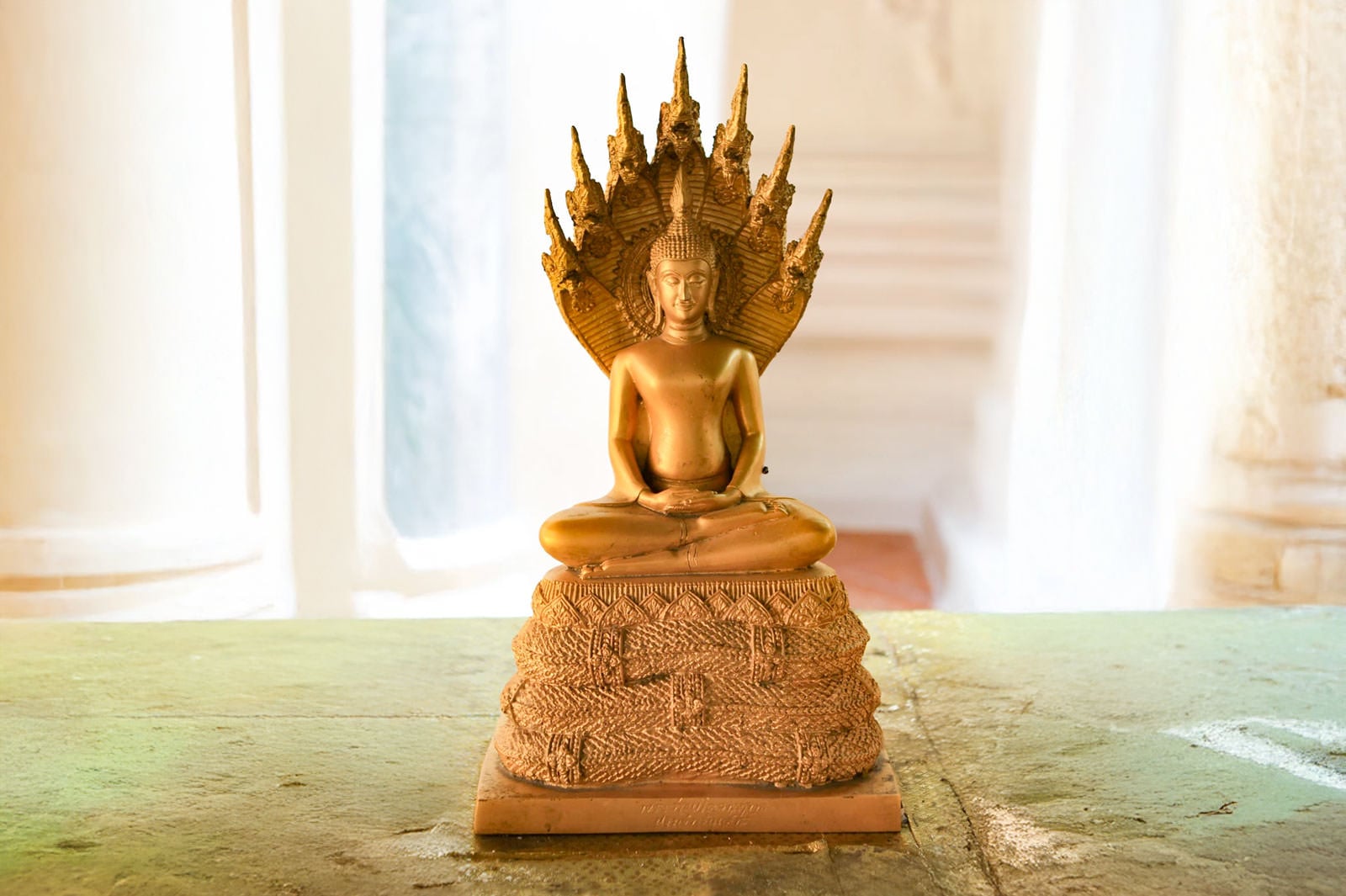
If you were born on a Saturday, your Buddha posture shows something unusual: the Buddha isn’t alone. A giant serpent coils beneath him, and a many-headed hood rises behind his shoulders like an umbrella. This is Pang Nak Prok, the posture of the naga king’s protection, and it tells one of Buddhism’s most striking stories about finding calm in the middle of a storm.
>What the Saturday Buddha looks like
The Saturday posture is easy to spot in temples. The Buddha sits in full lotus position with both legs crossed and the soles of both feet visible, resting on opposite thighs. His hands lie in his lap, palms facing up, with the right hand placed gently on top of the left. The thumbs often touch, forming the classic meditation gesture.
But what makes this posture unique is the naga beneath and behind him. The serpent’s body coils seven times to form a seat, and from behind the Buddha’s shoulders, seven (sometimes nine) naga heads fan out like a hood. The naga isn’t attacking: it’s sheltering the Buddha from what’s happening around him.
In Thai, this attitude is called “Pang Nak Prok” (ปางนาคปรก), which means “posture of the naga covering.” You’ll also hear it called “Phra Nak Prok” when people talk about amulets or specific temple images. The pronunciation is roughly “paang nâak pròk,” with a long “aa” sound in “naga” and a short, stopped “k” at the end.
The story of Mucalinda’s protection
The story comes from ancient Buddhist texts, specifically the Muccalinda Sutta. Shortly after the Buddha reached enlightenment, he sat meditating under a tree, experiencing the bliss of liberation. He’d been sitting cross-legged for days, completely absorbed in meditation.
Then an unseasonal storm rolled in. For seven days straight, cold wind and heavy rain battered the area. The Buddha didn’t move. He stayed in meditation, unbothered by what was happening around him.
A naga king named Mucalinda lived nearby. Nagas in Buddhist tradition are serpent beings who can take human form. When Mucalinda saw the storm threatening the Buddha, he emerged from his dwelling. He coiled his body seven times around the Buddha to lift him above the flooding water, then spread his great hood over the Buddha’s head to protect him from the rain, wind, sun, insects, and anything else that might disturb his meditation.
When the sky finally cleared and the storm ended, Mucalinda withdrew his coils. He transformed into the form of a young man, paid his respects to the Buddha, and returned to his home. The Buddha continued his meditation undisturbed.
What does this posture mean
For tourists visiting temples, the Saturday Buddha represents protection and stability when life gets difficult. The image shows someone staying calm and focused even when everything around them is chaotic. The naga’s shelter is practical: it keeps out rain, wind, and pests. But it also represents spiritual protection during times of trouble.
Thai interpretations often emphasise resilience. The Buddha doesn’t fight the storm or try to escape it. He simply continues what he’s doing whilst Mucalinda handles the external threats. Temple signage in English usually labels this posture as “Protected by the Naga King” or simply “Protection.”
The seven coils have meaning, too. Seven is significant in Buddhist cosmology, appearing in multiple stories and temple designs. Here, the seven coils mirror the seven days of the storm, and some interpretations link them to the seven weeks the Buddha spent near the Bodhi tree after enlightenment.
The Saturday birth belief
Modern Thai culture links Pang Nak Prok specifically to people born on Saturday. If you know a Thai person who was born on a Saturday, they’ll often have a special connection to this image. They might keep a small Phra Nak Prok amulet, donate to temples that display this posture, or make merit on Saturdays by offering flowers or gold leaf to Saturday Buddha statues.
This practice isn’t an ancient Buddhist doctrine: it’s a Thai cultural layer added much later. But it’s widely observed today, and you’ll see it reflected in how temples organise their Buddha images and how amulet sellers describe their wares.
The belief is straightforward: your birth day determines which Buddha posture represents you. For Saturday-born people, Mucalinda’s protection is meant to offer spiritual shelter throughout their lives, just as it did for the Buddha during the storm.
Where to see Pang Nak Prok in Phuket
Wat Chalong is your best option in Phuket for seeing the complete set of daily Buddha postures, including Saturday’s Pang Nak Prok. The temple’s main chedi (the tall, pointed tower) has multiple floors displaying Buddha statues in different poses. The lower floors specifically show the seven postures representing each day of the week, plus the extra Wednesday night image.
The Saturday posture here appears as a seated Buddha on the coiled naga with the characteristic multi-headed hood. Many of these statues are covered in gold leaf applied by devotees, which can make details harder to photograph, but it shows you which images receive the most attention from worshippers.
Wat Chalong is open daily from 07:00 to 17:00. Entry is free, but dress respectfully: shoulders and knees must be covered, and remove your shoes before entering any building. The temple is located in Chalong subdistrict, about 8 kilometres south of Phuket Town. Most tourists visit mid-morning to avoid tour bus crowds.

If you’re interested in seeing how Bangkok temples display Pang Nak Prok, Wat Pho and Wat Benchamabophit both have naga-protected Buddhas in their collections. Wat Pho’s west assembly hall has a famous Phra Naga Prok from Lopburi with a seven-headed naga built behind it. Wat Benchamabophit’s cloister contains 52 Buddha statues representing different mudras and attitudes, including Naga Prok images used in teaching about daily postures. But for practical Phuket travel, Wat Chalong is the most accessible option.
Understanding what you’re seeing
When you visit these temples, look at how the naga and Buddha relate to each other. The serpent isn’t threatening: it’s providing service. The Buddha’s meditation posture is identical to other seated images, but the naga transforms the scene from a simple meditation into a story about protection.
Thai Buddhism layers multiple meanings onto these images. Tourists can appreciate them as art and cultural artefacts. Buddhist practitioners see them as representations of spiritual teachings. And for Thai people born on Saturday, they’re personal symbols of protection and identity.
The Saturday Buddha is one of Thailand’s most photographed postures because of its dramatic visual: the fanned hood and coiled body create an instantly recognisable silhouette. But the image is more than just photogenic. It’s a reminder that sometimes the best response to a storm isn’t to fight it, but to stay grounded while something bigger than you handles the external chaos.
The Buddha Postures for the Days of the Week