

Island-Wide Art Exhibition Until April 2026

Thailand Biennale Phuket 2025 is a national contemporary art biennial set across Phuket, featuring Thai and international artists under the theme “Eternal [Kalpa],” which explores long-timescale relations between humans and nature and encourages sustainable cultural tourism. The edition is scheduled to run from November 2025 to April 2026, with program activity across multiple districts and outdoor/indoor venues on the island.
Origins and History of Biennales
The biennale format originated in 1895 with the Venice Biennale, established as the “International Art Exhibition of the City of Venice”. Mayor Riccardo Selvatico conceived this exhibition to honour the silver anniversary of King Umberto I and Queen Margherita of Savoy. The inaugural event attracted over 224,000 visitors and featured artists from 14 countries.
The term “biennale” derives from the Italian word meaning “every two years”. Venice’s success established the biennial format as the standard for recurring international contemporary art exhibitions. The exhibition became increasingly international during the early 20th century, with Belgium installing the first national pavilion in 1907.
The Venice model inspired global proliferation of biennales throughout the 20th century. Major exhibitions emerge,d including the São Paulo Biennial (1951) and documenta in Kassel (1955). Today, hundreds of biennales operate worldwide, forming the structural foundation of contemporary art’s international exhibition system.
Thailand Biennale: Rotating International Contemporary Art Exhibition
The Thailand Biennale stands as the country’s premier international contemporary art exhibition. The Office of Contemporary Art and Culture under Thailand’s Ministry of Culture organises this rotating festival that moves between different provinces for each edition.
Thailand’s approach differs from traditional biennials by changing locations rather than staying in one city. Previous editions took place in Krabi (2018) under the theme “Edge of the Wonderland,” Nakhon Ratchasima (2021) with “Butterflies Frolicking on the Mud,” and Chiang Rai (2023) featuring “The Open World. Each edition attracted millions of visitors and generated substantial economic benefits.
The fourth edition, Thailand Biennale Phuket 2025, runs from November 2025 to April 2026 under the theme “Eternal Kalpa”.
Theme and Direction
- Theme: Eternal [Kalpa] — focusing on human, nature relationships, technology, resource use, and the consequences of human-centric systems.
- Aim: Promote art and sustainable tourism; position Phuket as a city of art alongside its UNESCO Creative City of Gastronomy status.
- Leadership: Artistic direction cites David Teh, with curatorial perspectives addressing ecology, technology, and coexistence.
Dates and Duration - Public program timeframe: November 2025–April 2026.
- Social announcement: 29 Nov 2025–30 Apr 2026.
Venues and Areas – Where to See the Art in Phuket
Thailand Biennale Phuket runs from 29 November 2025 to 30 April 2026. The fourth edition of this contemporary art exhibition features over 60 artists across historic, natural, and civic spaces around the island. The theme is “Eternal [Kalpa],” exploring relationships between humans and nature through installations, sculptures, performances, and interactive works.

The Thailand Biennale is organised by the Office of Contemporary Art and Culture. Previous editions took place in Krabi (2018), Nakhon Ratchasima (2021), and Chiang Rai (2023). The 2025 Phuket edition spreads across multiple districts, with 19 venues around the island.
The theme “Eternal [Kalpa]” draws from Hindu-Buddhist concepts of cosmic time. Artistic directors Arin Rungjang and David Teh, with curators Marisa Phandharakrajadej and Hera Chan, commissioned 50 new works for this edition.
Venues We Visited
Not all venues are created equal. Some are quick stops, while others take half a day. There are 19 venues scattered across the island, and we’re visiting them gradually. Below are the ones we’ve seen so far, and we’ll add more as we go.
Sukko Pavilion – Four-Region Sala
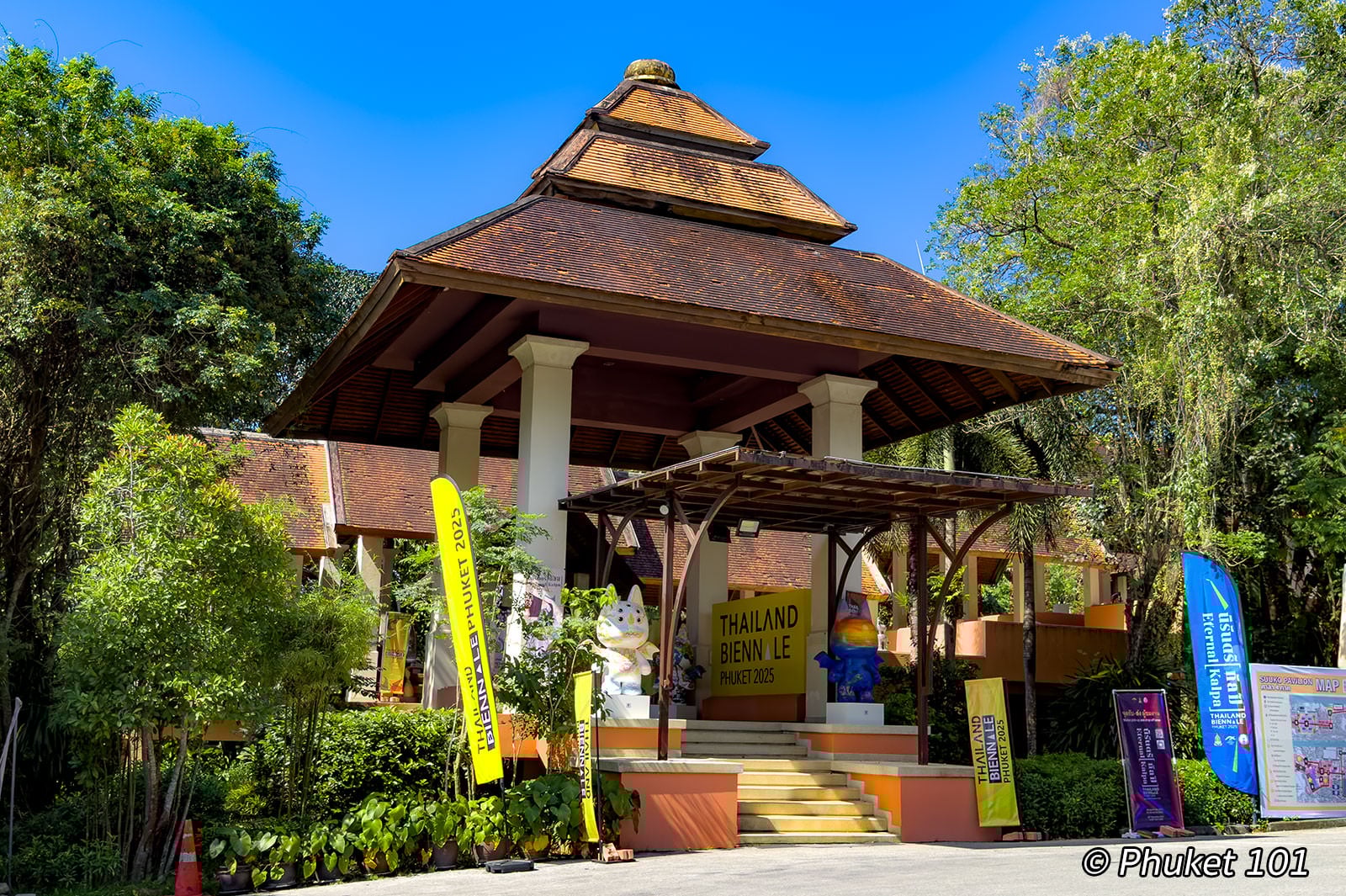
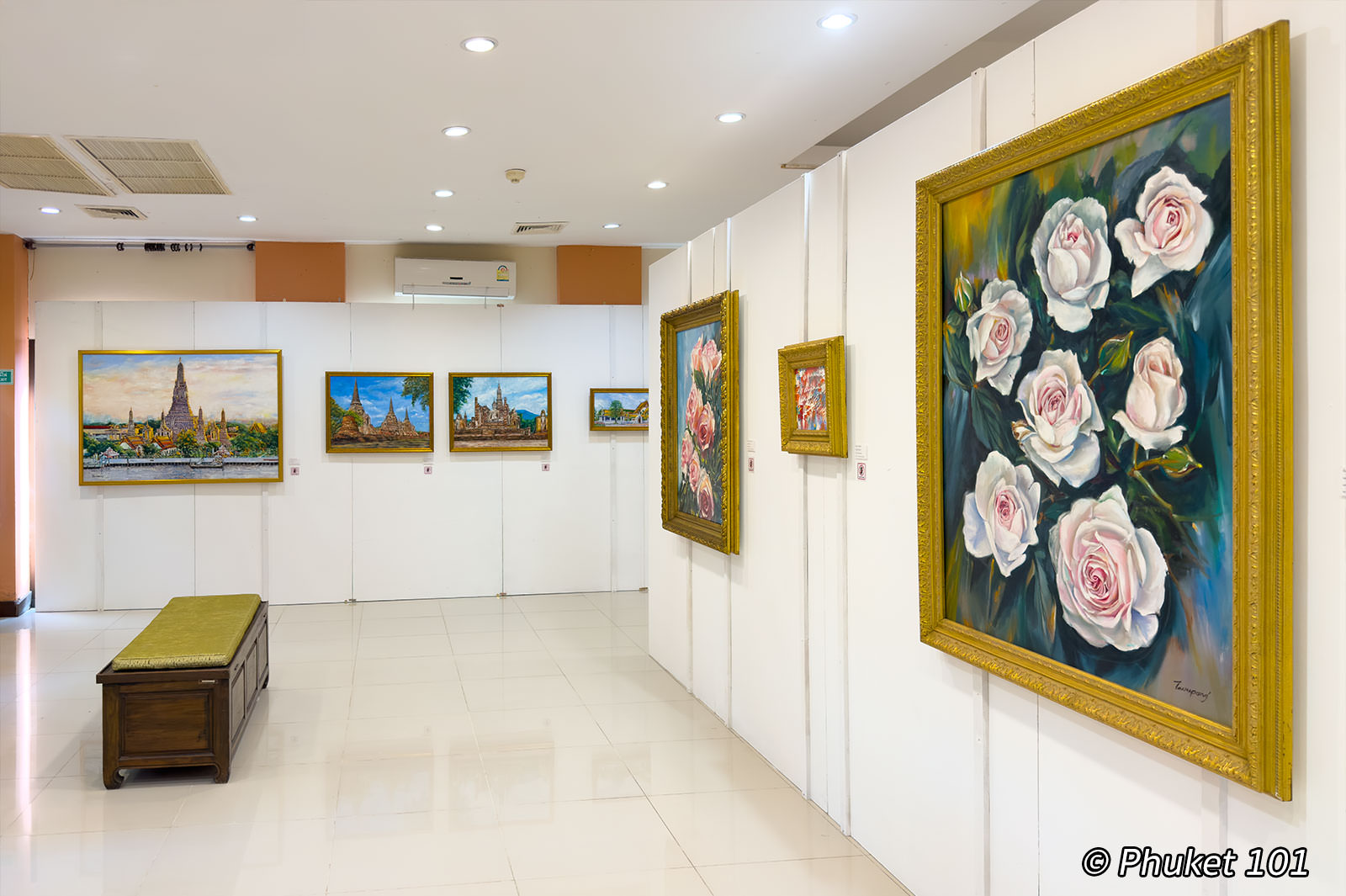
Sukko Pavilion is the largest of the 19 Thailand Biennale venues, set within the grounds of Suuko Wellness & Spa Resort in Chalong. The resort sits on 20 acres of forested hillside, and the Biennale has transformed its traditional Thai pavilions and halls into a sprawling exhibition space. The Phuket Art Association organised the exhibitions here, with Anchalee Vanich Teppabutra as president and Asst. Prof. Worraphop Tantinanthakul as curator. The venue holds over 100 artworks across five distinct areas, making it easily a half-day visit.
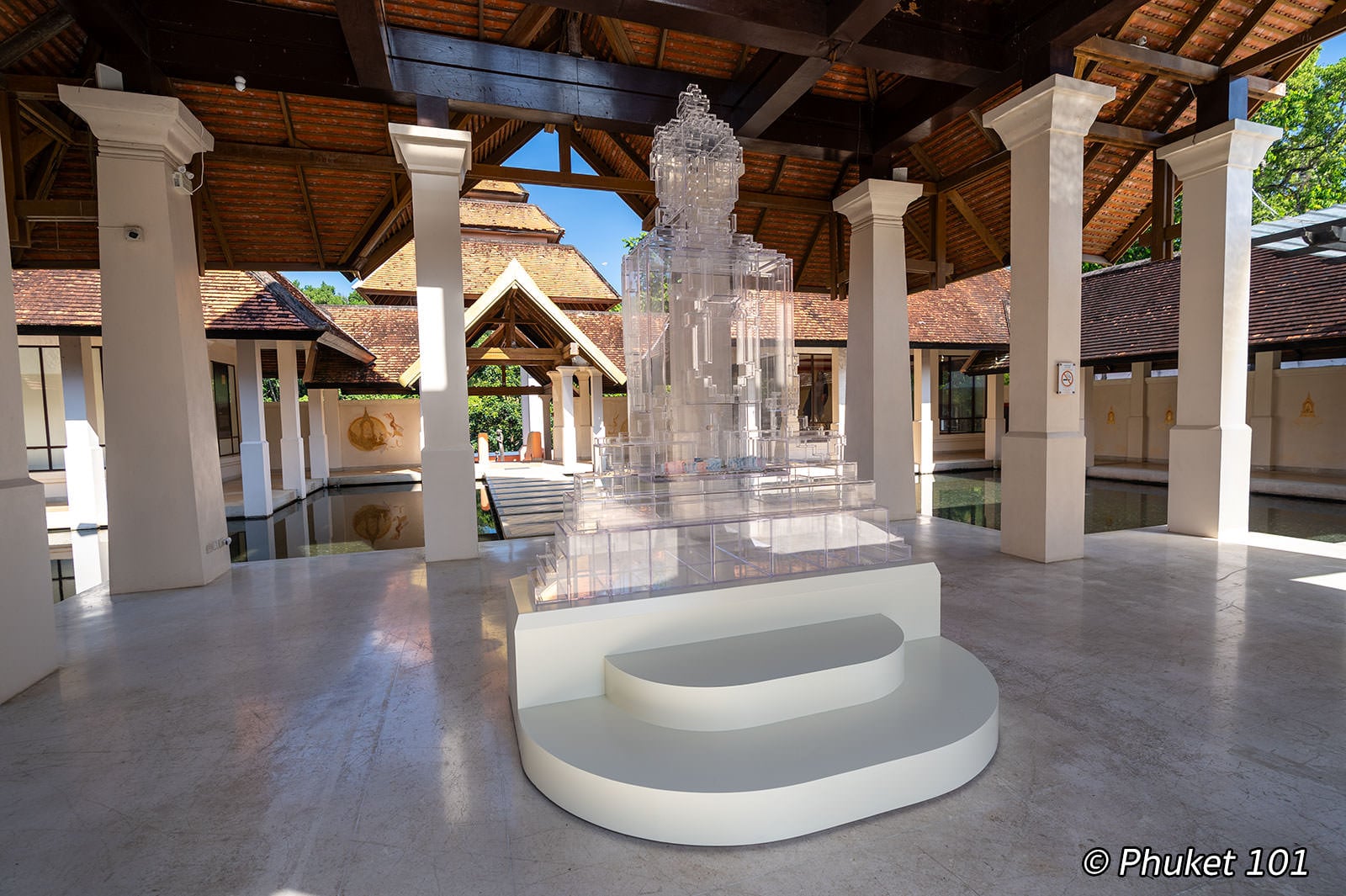
The centrepiece is Sukko Hall, a grand Thai-style building with columns, pointed gables, and a reflecting pool. Inside, “The Wheel of Eternal Serenity” brings together works by some of Thailand’s most respected artists, including National Artists such as Dr Kamol Tassananchalee, Panya Vijinthanasarn, and Thongchai Rakpatoom. The works range from large gold-leaf paintings to polished metallic sculptures and a striking transparent acrylic Buddhist stupa that catches the light in the central pavilion.
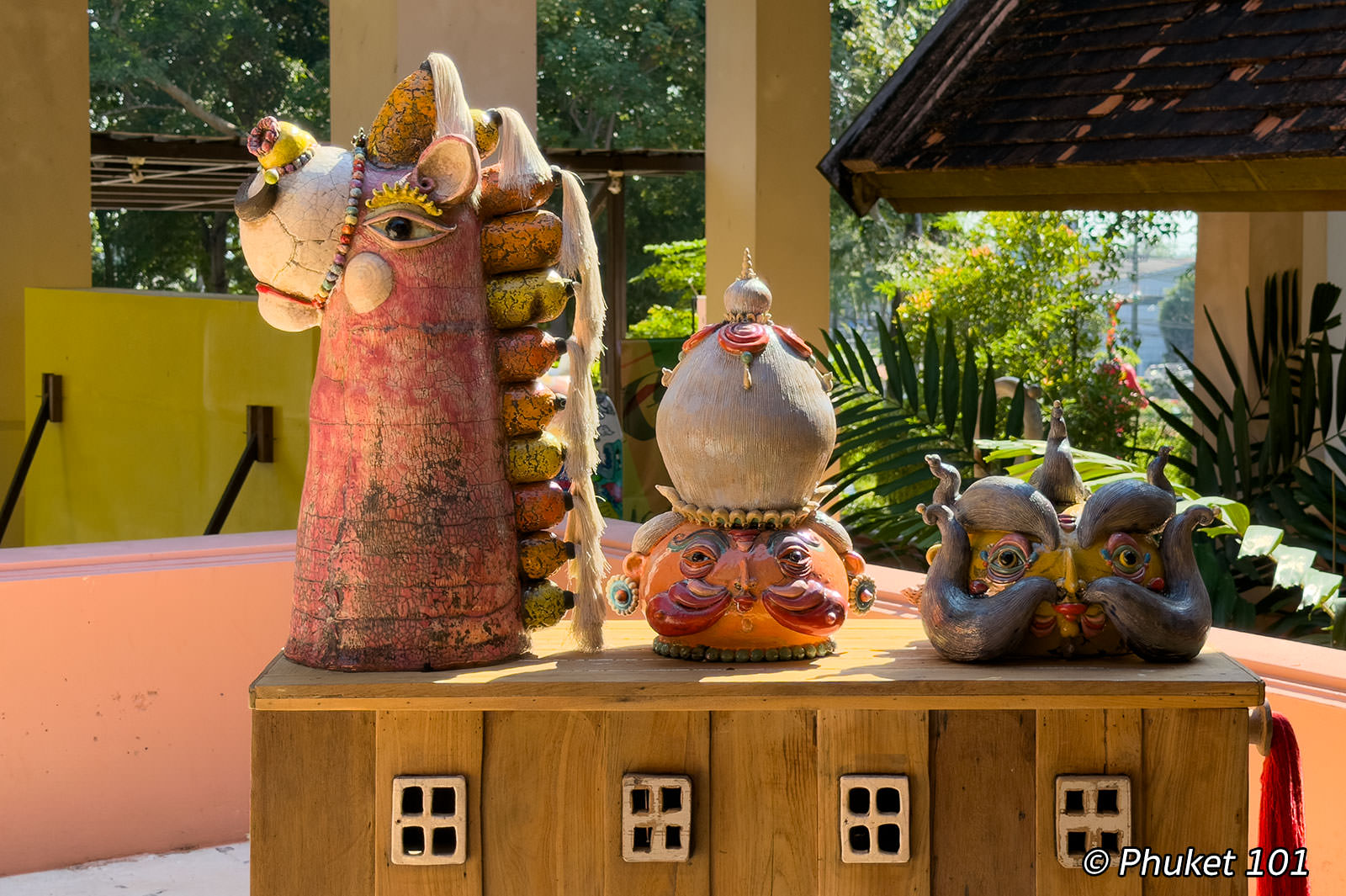
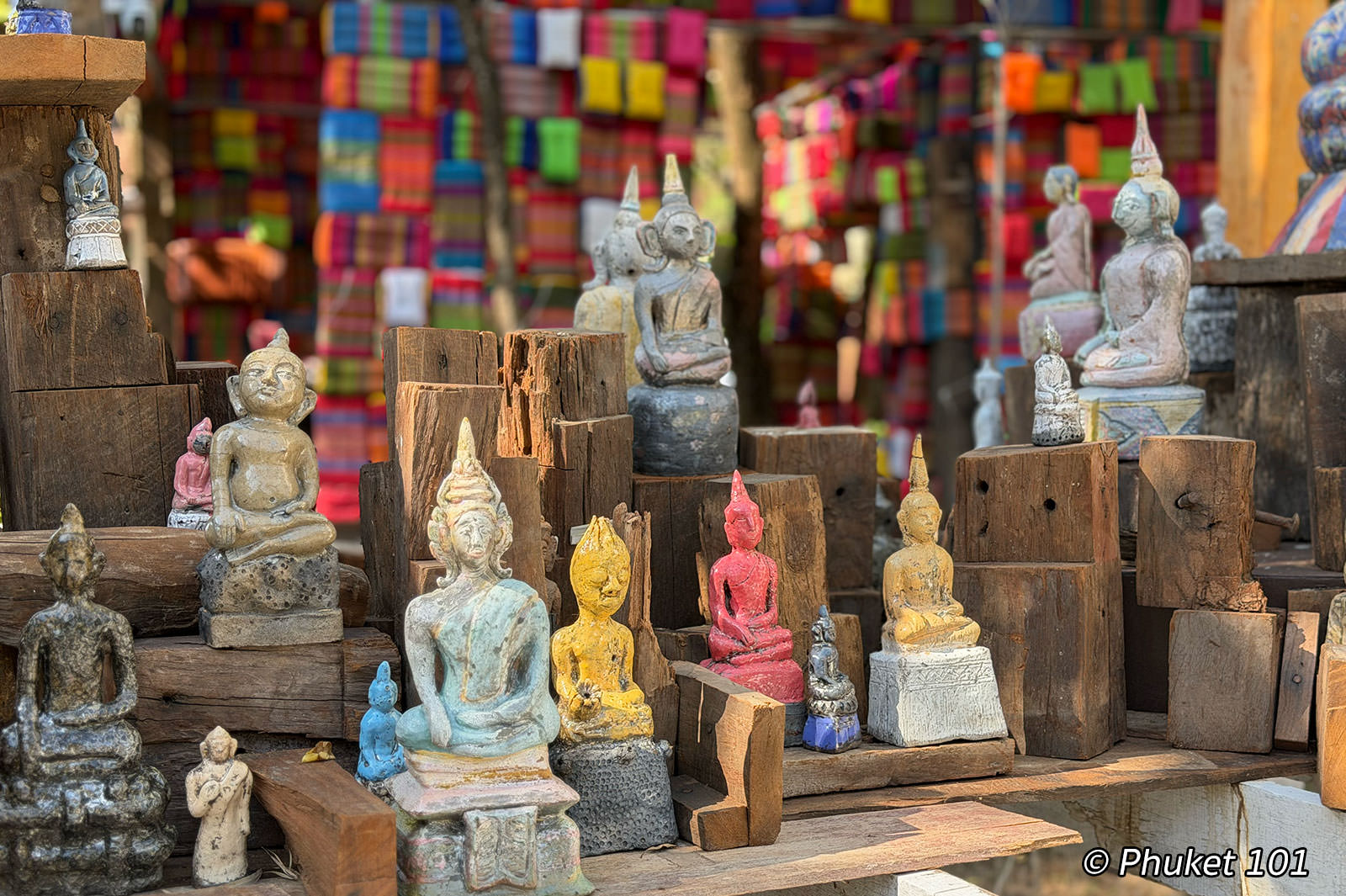
Four open-air salas surround the main hall, each representing one of Thailand’s regions. The Sala Lanna (North) was organised by Khua Silapa, a prominent art collective from Chiang Rai, and features over 100 works of its own, including traditional tung phra bot (Lanna Buddhist banners). The Sala Isan Orklay (Northeast) showcases artists from the Isan Artists Association, with installations using colourful woven textiles typical of the region. The Sala Andaman (South) features artists from the Andaman coast provinces, while the Sala Gulf of Thailand presents 32 artists under the theme “Sound Waves from the Gulf Shore to Stories from the Edge of the Land.”
Scattered throughout the walkways and entrances are painted Fufu figurines, the Biennale’s bat mascot designed by Asst. Prof. Dr Phanuwat Sengiam of Phuket Rajabhat University. Each one has been painted by a different artist, some with Lanna patterns in gold, others with Andaman seascapes or playful pop art. They have become one of the most photographed features of the entire Biennale. Of all the venues, this one requires the most time but rewards the effort.


Jee Teng Complex
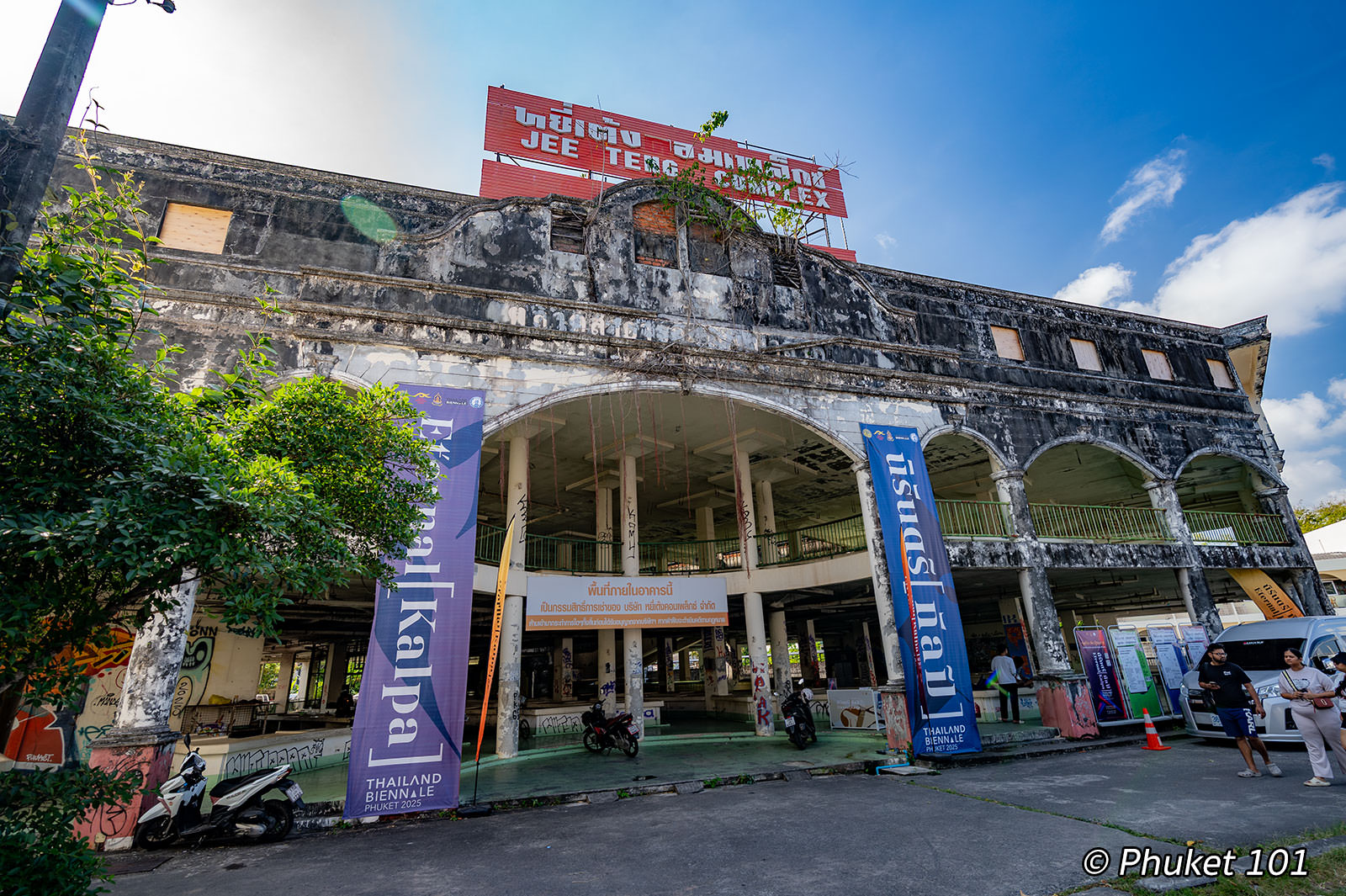
Jee Teng Complex on Bangkok Road is one of the most unusual Biennale venues. It’s an abandoned market building that’s been empty for years. The roof is gone in places, trees grow out of the concrete, and graffiti covers the stairwells. Walking through it feels a bit eerie, and there’s a reason for that.


The complex was built near the site of a building destroyed by fire on 30 January 1985. It was a brothel, and five of the thirteen women forced to work there were chained to their beds. They couldn’t escape and died in the blaze. The land was never properly redeveloped after that.


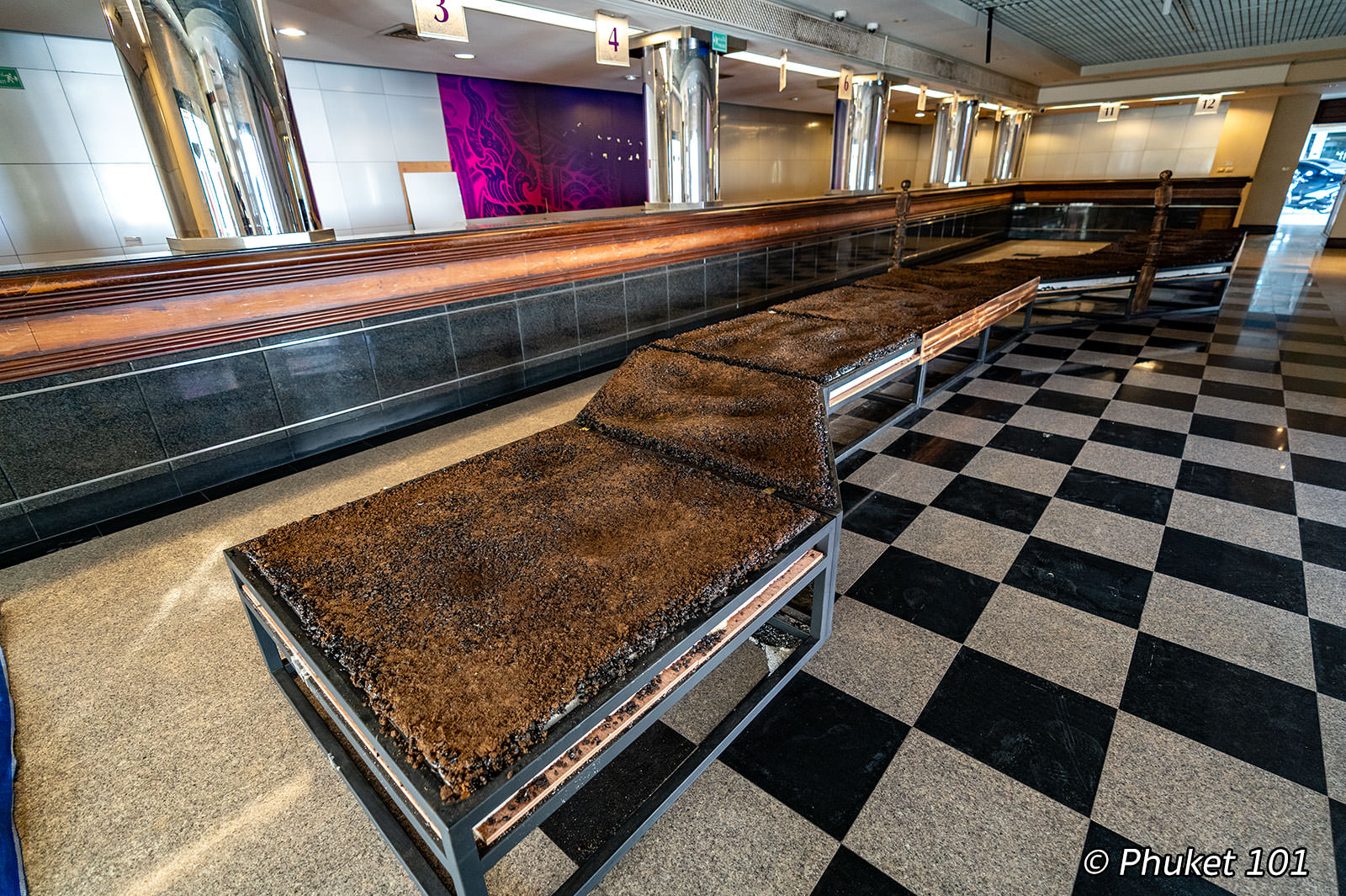
For the Biennale, Thai artist Pratchaya Phinthong created watercopyair~streak, a two-part sound installation. On the ground floor, an LCD screen on a mattress plays underwater footage with coral reef sounds recorded by a marine biologist. Upstairs, wooden structures have been fixed to the ceiling to encourage swallows to nest inside the building. Speakers play bird calls to attract them. Photographs from the old market days are displayed on the original concrete vendor counters, a smart use of the building’s past life.


It’s not a comfortable visit. But it’s one of the most memorable Biennale stops.
Saphan Hin Park & Mangrove Walkway
Saphan Hin Park is the main outdoor venue and the site where the Biennale officially opened on 29 November 2025. This waterfront park on the east side of Phuket Town has been transformed into an open-air sculpture trail, with large-scale works spread across the lawns, the promenade, and out to the tip of the cape. Three of the installations here are permanent. They will remain as public landmarks long after the Biennale ends.
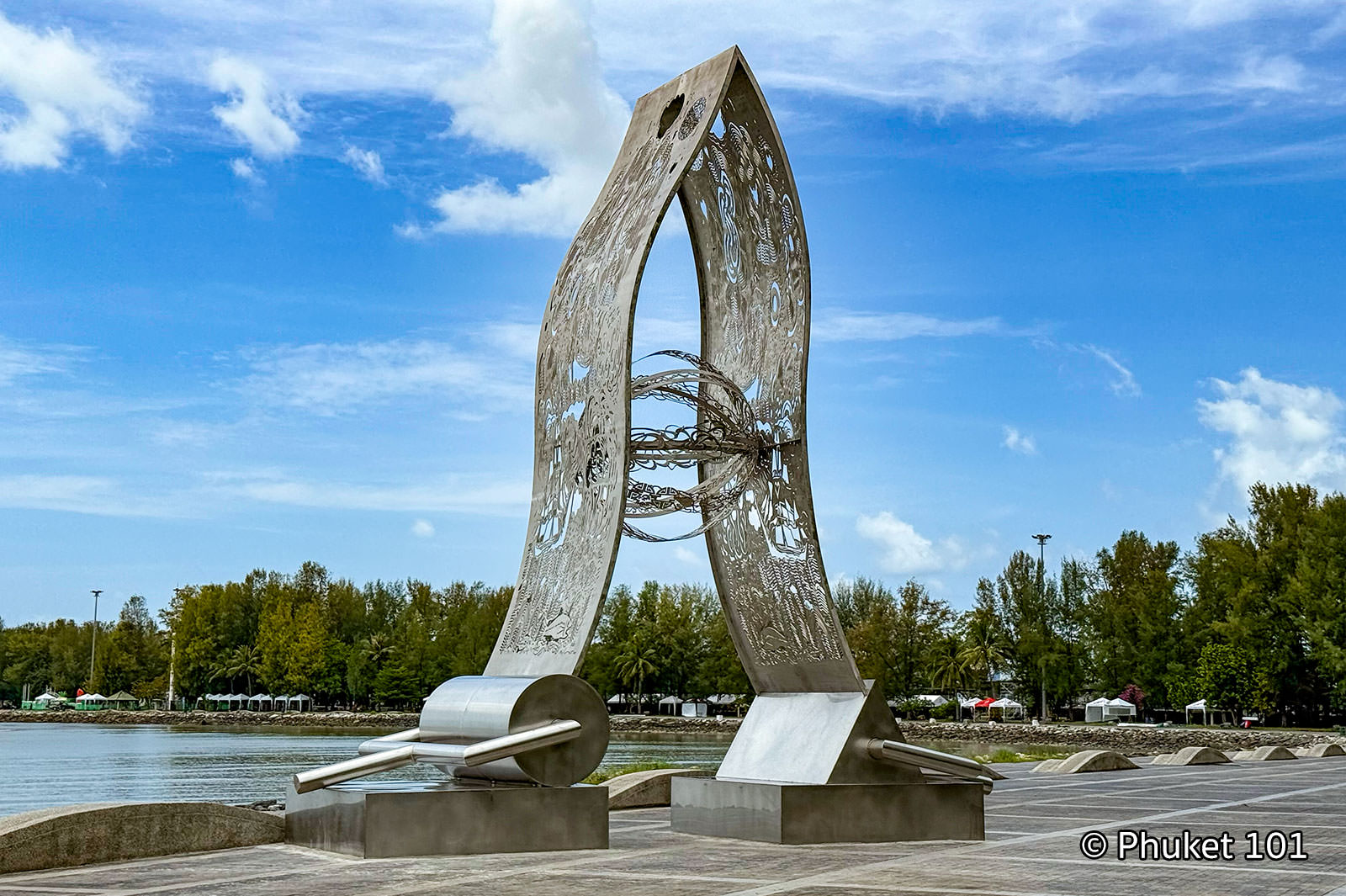
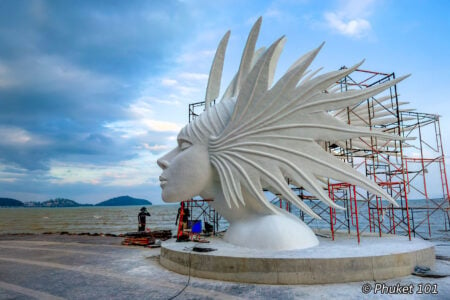
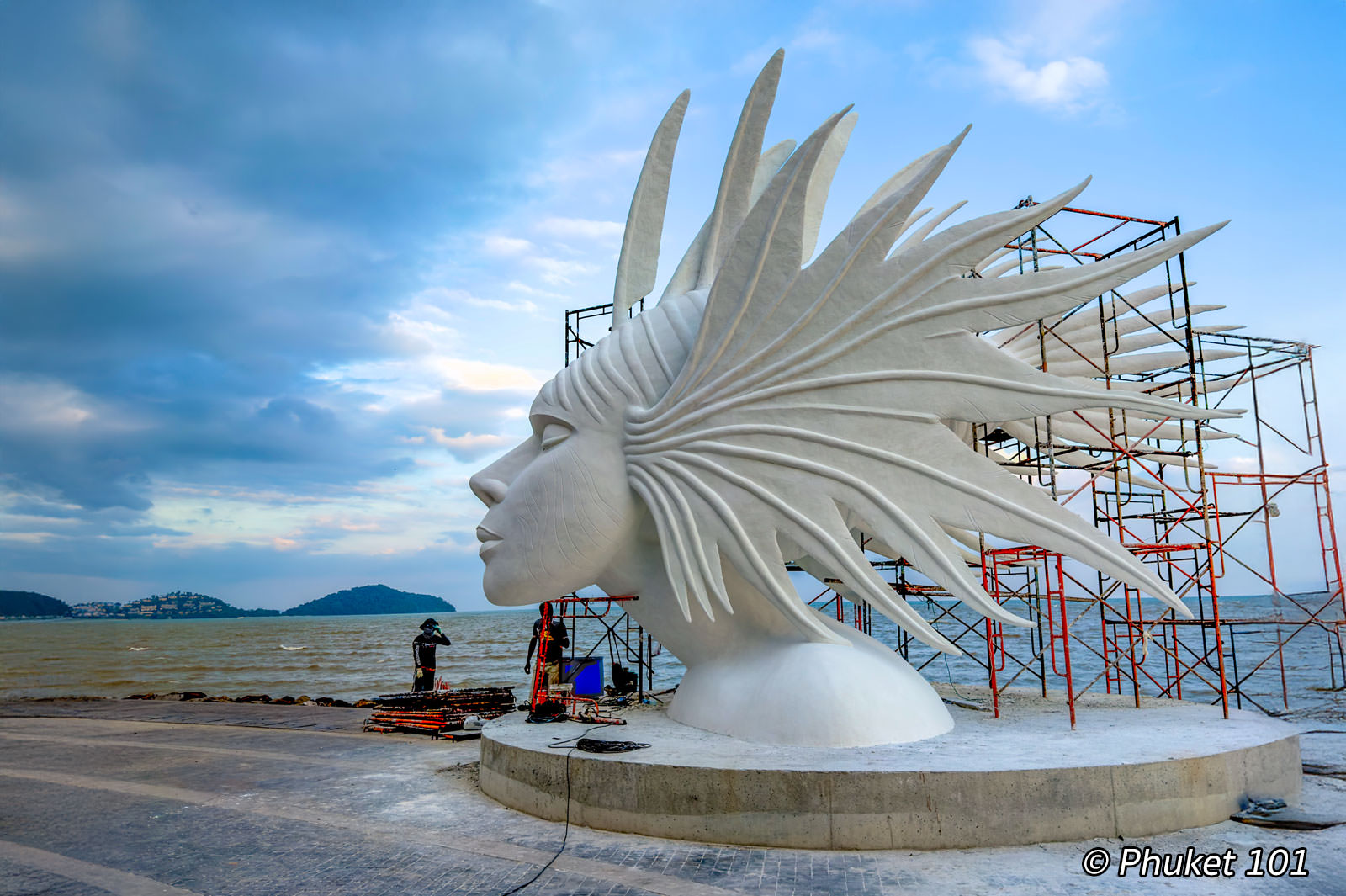
The most striking is “Dheveena,” a monumental white sculpture of a sea goddess by Professor Aree Kongpol, installed at the very end of the cape. The figure faces the open water, her hair streaming into long blade-like fins, representing a guardian spirit of the Andaman Sea. Nearby, “Richest Roller” by National Artist Dr Kamol Tassananchalee is a tall stainless steel arch with intricate cutwork panels resting on cylindrical roller bases, symbolising Phuket’s prosperity and tin mining heritage. “The Labyrinth #2” by Pitupong Chaowakul is harder to miss. A towering red grid structure lit from within at dusk, it draws visitors inside to explore reflections, shadows, and shifting perspectives.
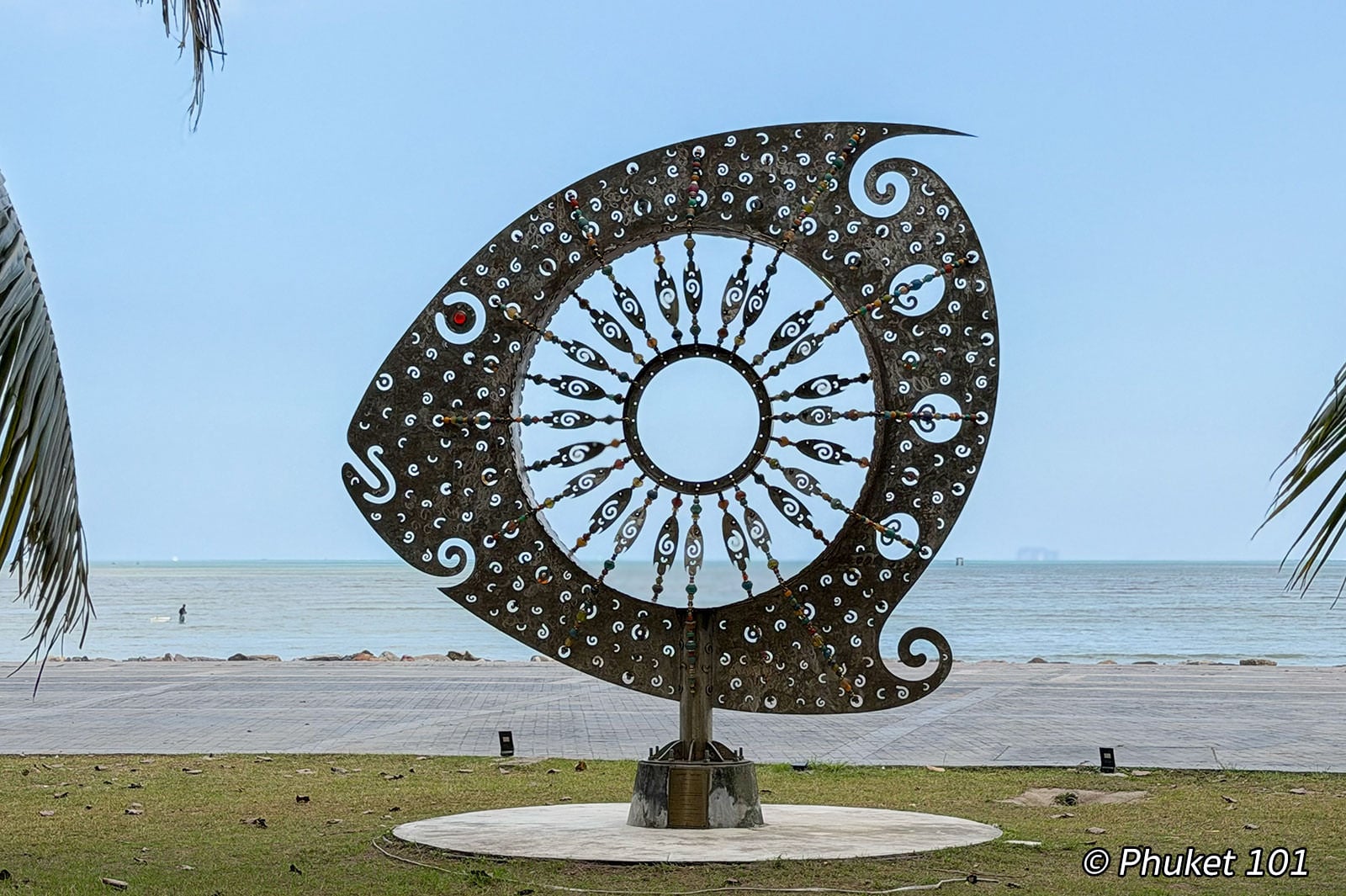
Among the temporary works, look for an installation of wooden stakes topped with clusters of oyster shells by Australian Aboriginal artist Megan Cope, whose Quandamooka heritage centres on the cultural significance of oyster reefs. Next to the park, the Saphan Hin Mangrove Walkway leads through a shaded forest on a raised wooden path. The artworks here are smaller and more subtle, blending with the roots and water. The two areas together form one coastal venue. Walk the sculpture trail by the sea first, then continue into the mangroves for a quieter, more reflective contrast. Late afternoon is the best time, when the light on Dheveena is at its most dramatic.


Napas Art Gallery
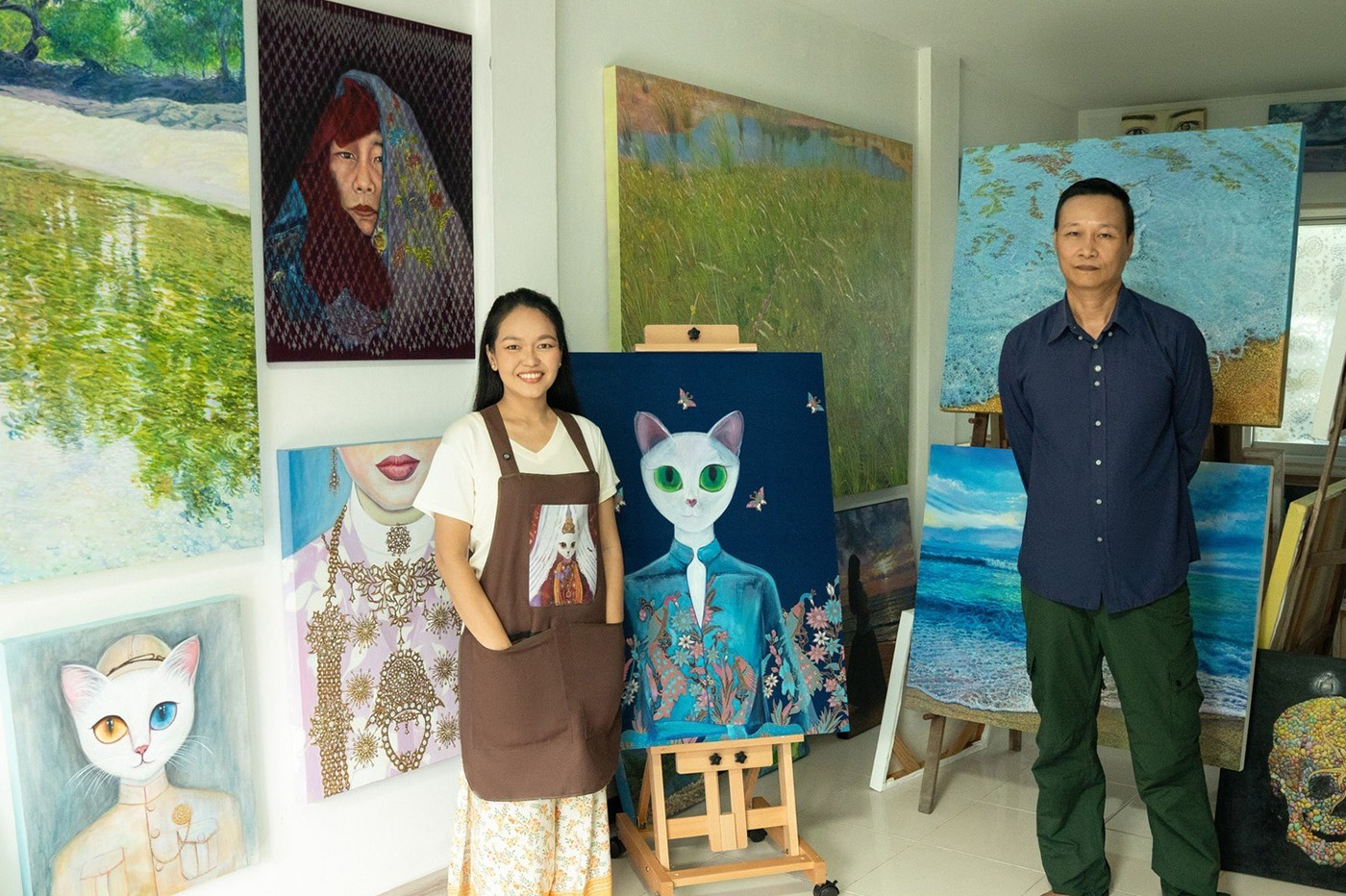
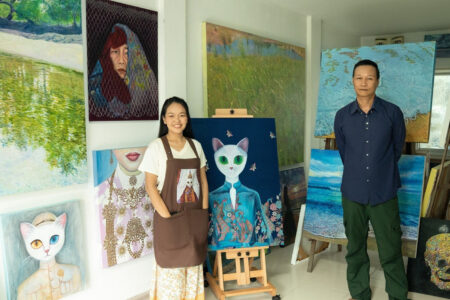
Established in 2013 by Phuket-based artists Soon Papan and Juffy Joob. A small studio and gallery space with original paintings and sculptures. You can often meet and talk with the artists directly.


Kathu Shrine
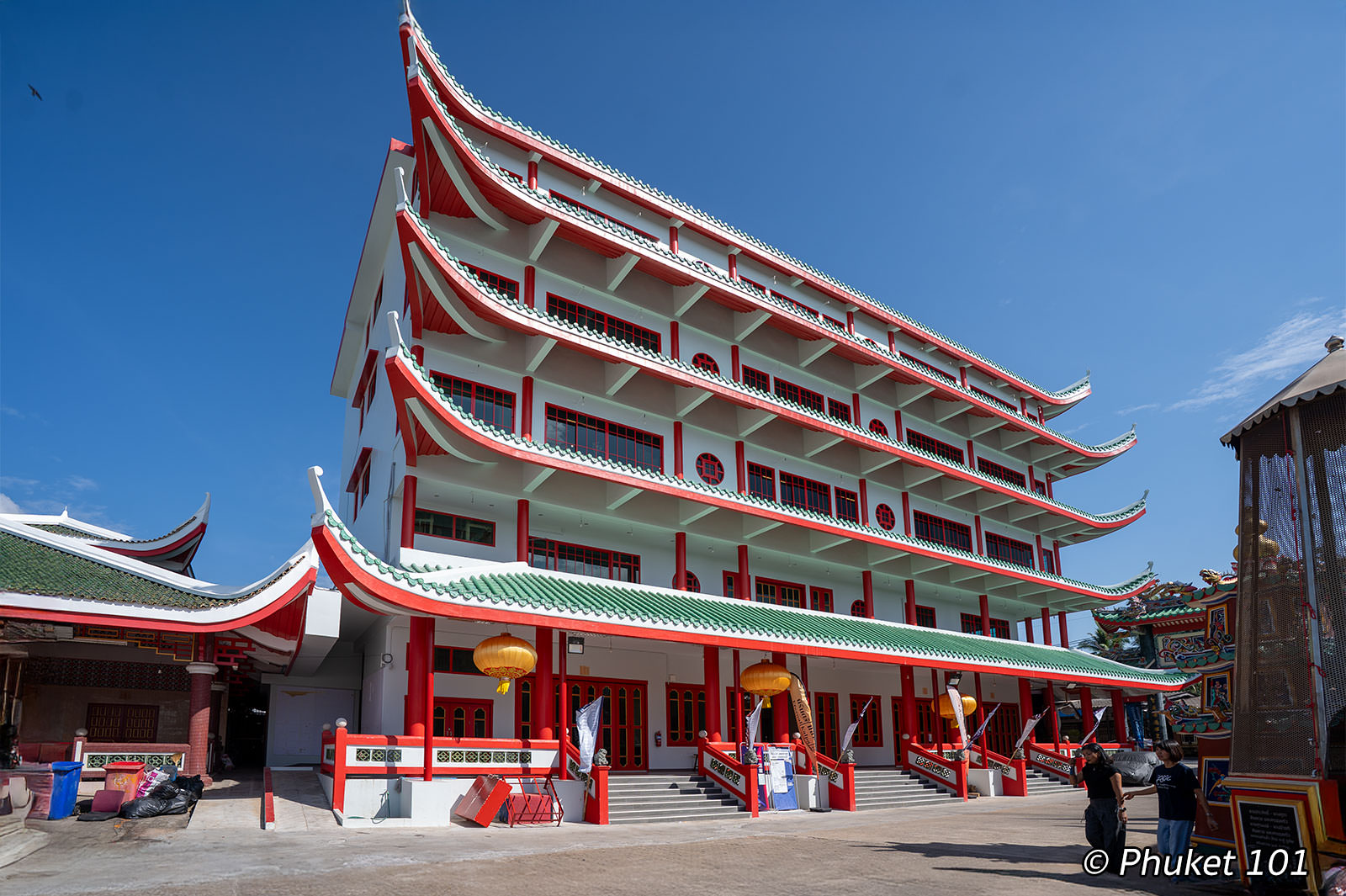
Kathu Shrine is one of 19 venues for the Thailand Biennale Phuket 2025, the fourth edition of Thailand’s national contemporary art biennial, running from 29 November 2025 to 30 April 2026 under the theme “Eternal [Kalpa]”. The shrine and the nearby former Kathu Liquor Distillery form the Kathu cluster of Biennale venues, grouped together as “Sala 4 Kor Artland”.
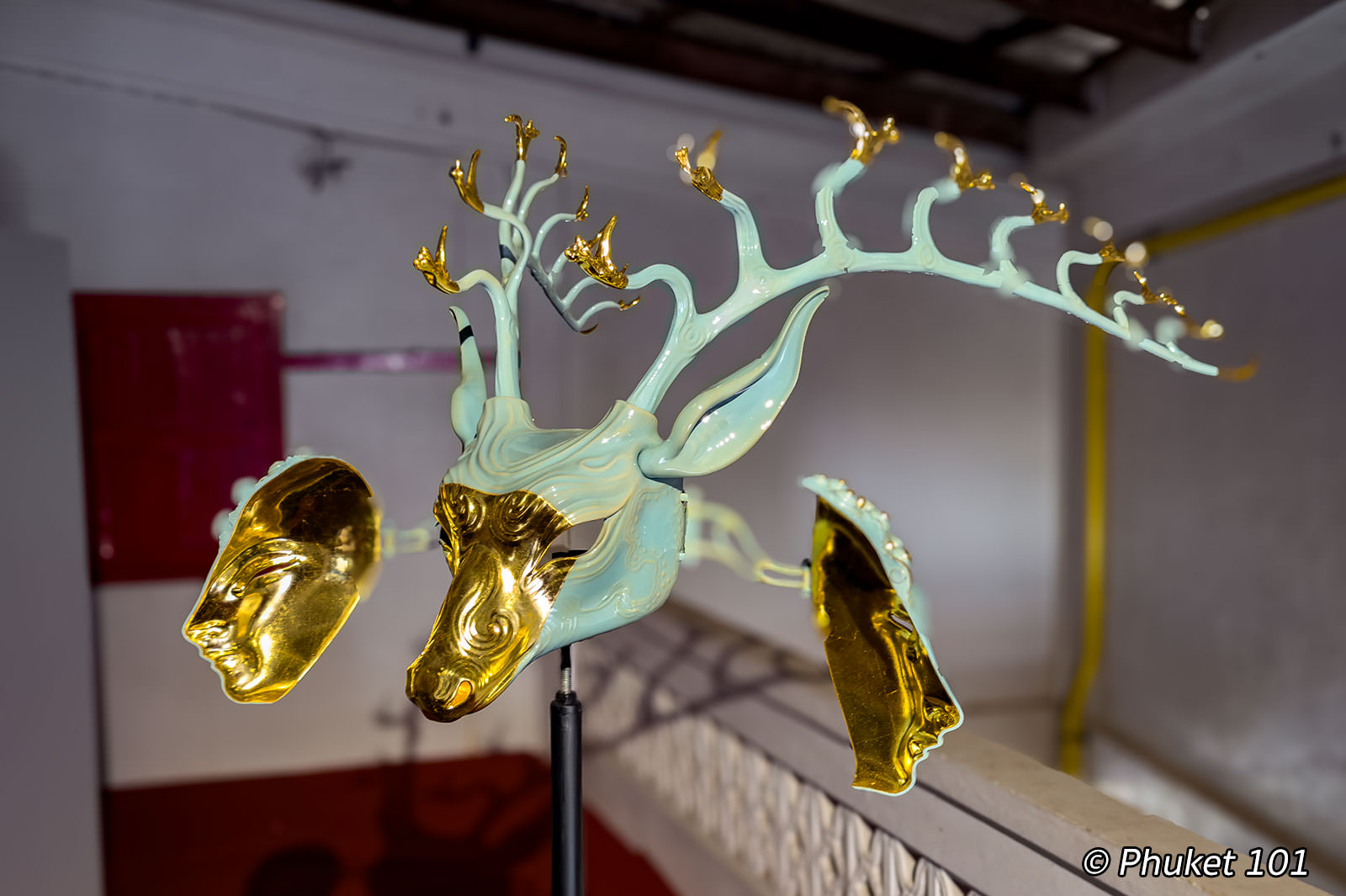
The installation at Kathu Shrine is ‘The Deer of Nine Colors’ (2025) by Chinese-American artist and filmmaker Andrew Thomas Huang (born 1984, based in Los Angeles). It is a two-channel video and sculpture installation co-produced with Onassis ONX, running approximately 25 minutes. The work draws from two very different source stories, one from ancient China, one from modern Thailand, both centred on a deer.
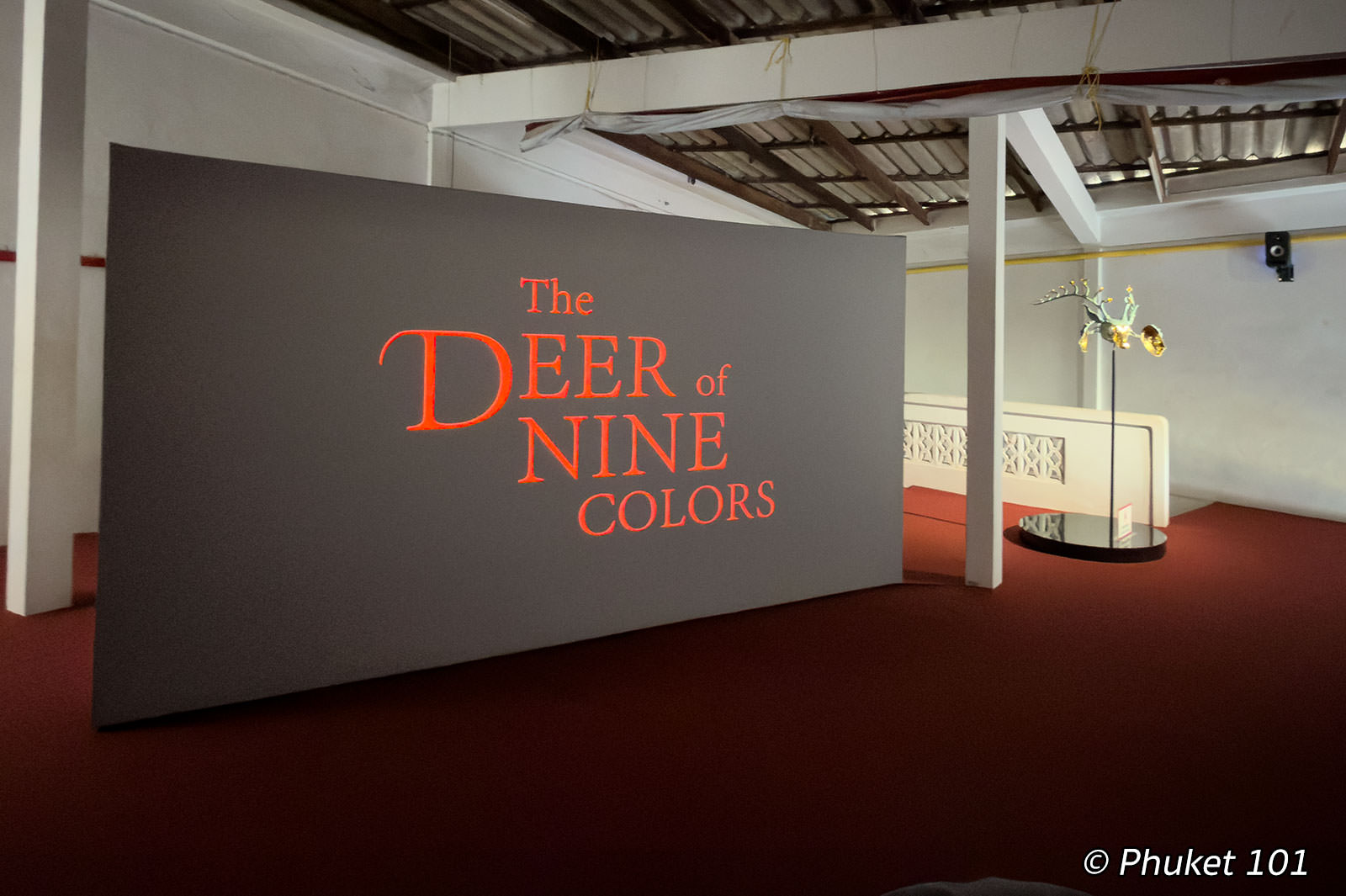
Huang is a Grammy-nominated filmmaker known for directing music videos for Björk, FKA twigs, and Thom Yorke. He studied Fine Art and Animation at the University of Southern California and has exhibited at MoMA in New York, the Barbican Centre in London, and the Biennale of Sydney. His practice blends puppetry, visual effects, and animation to explore themes of Asian mythology, queer identity, and transformation.
The first source of inspiration is the Buddhist Jataka tale of the Nine-Coloured Deer, depicted in a famous fresco inside Cave 257 of the Mogao Caves at Dunhuang, China, dating to the Northern Wei dynasty (386–534 AD). The story tells of a beautiful deer that rescues a drowning man, only to be betrayed by him when a queen offers a reward for its capture. The tale was adapted into a celebrated 1981 Chinese animated film that became a formative childhood memory for generations of viewers.
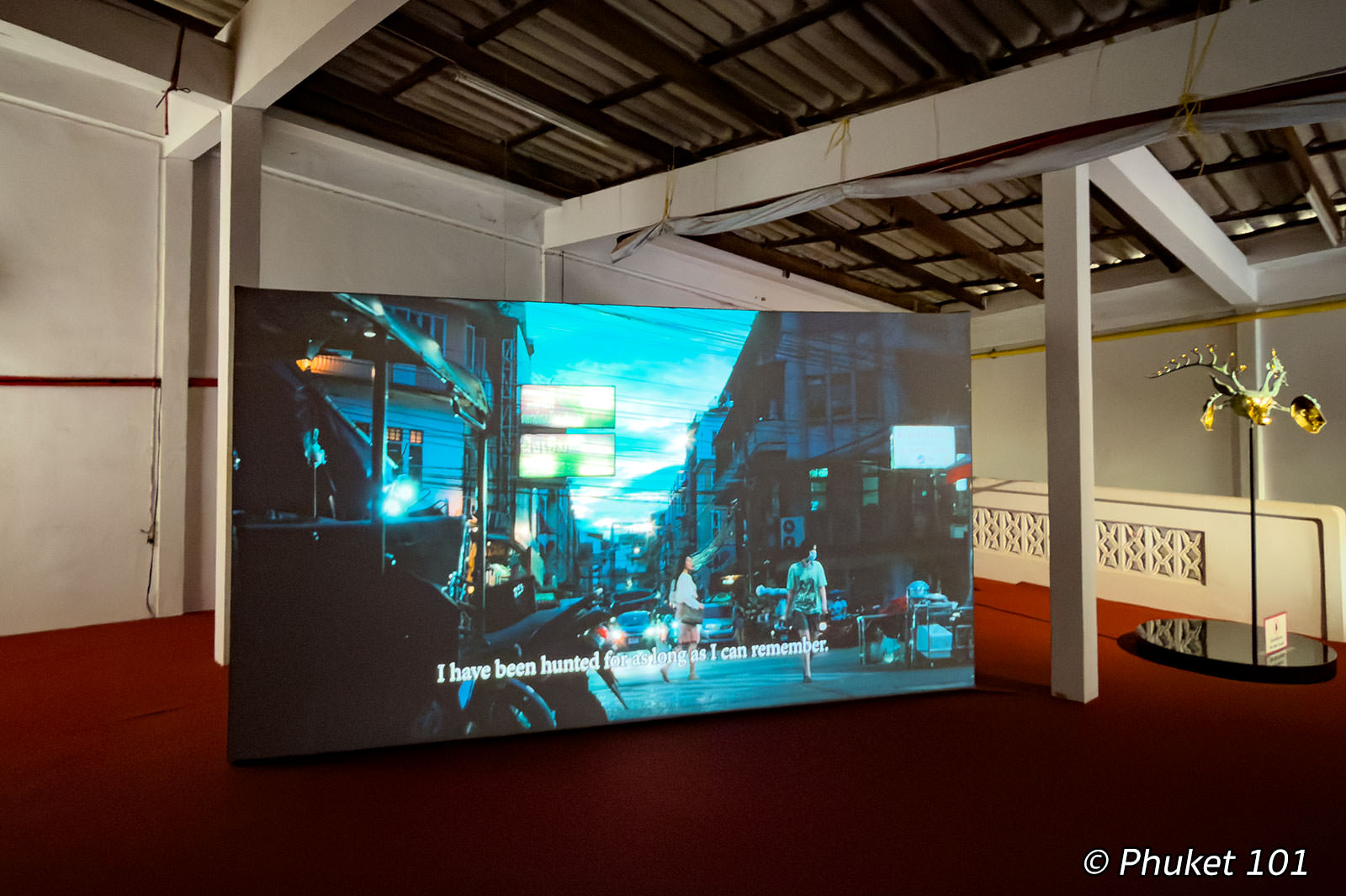
The second source is the real history of Thailand’s Schomburgk’s deer, a species once found across the swampy plains of central Thailand. Males had distinctive basket-shaped antlers with up to 33 points. Rice farming and railway expansion destroyed their habitat, and hunters would surround the deer on flood-season islands. The last wild Schomburgk’s deer was killed in 1932. The final captive individual, kept at a temple in Samut Sakhon, was beaten to death by a drunk man in 1938.
Huang’s film weaves these two stories together. It follows Nuan, a young Thai woman who discovers she is a reincarnation of a Schomburgk’s deer, the last of her kind. The film builds towards her transformation into the luminous Nine-Coloured Deer. Alongside the video, gold and resin sculptures of stag-like masks are displayed as both art objects and symbolic lenses into the perspective of the deer.
Of all the Biennale venues across Phuket, this was my favourite experience.
Kathu Museum
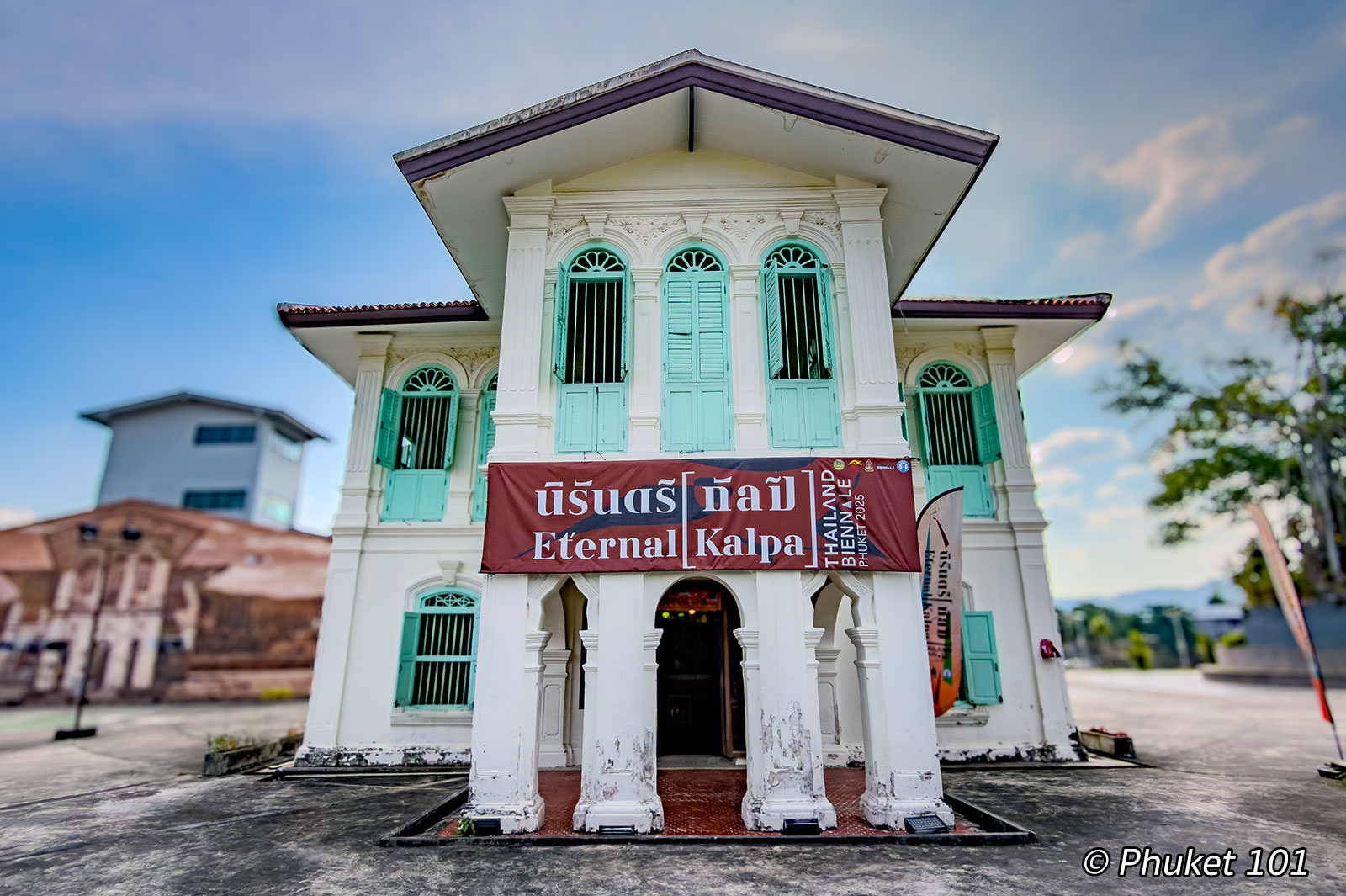
Kathu Museum occupies the former Kathu Liquor Distillery on Vichitsongkram Road, a compound of three Sino-European buildings originally built for Tan Lim Yong, a prominent Hokkien-Chinese mine owner. The heritage-listed main building has green shuttered windows and an arched portico, and by the small reservoir nearby stands a large banyan tree, said to be the domain of local spirits who cursed attempts to redevelop the site. For the Biennale, the distillery hosts works that examine the political, spiritual, and material cultures that formed around extractive industries like mining and forestry.
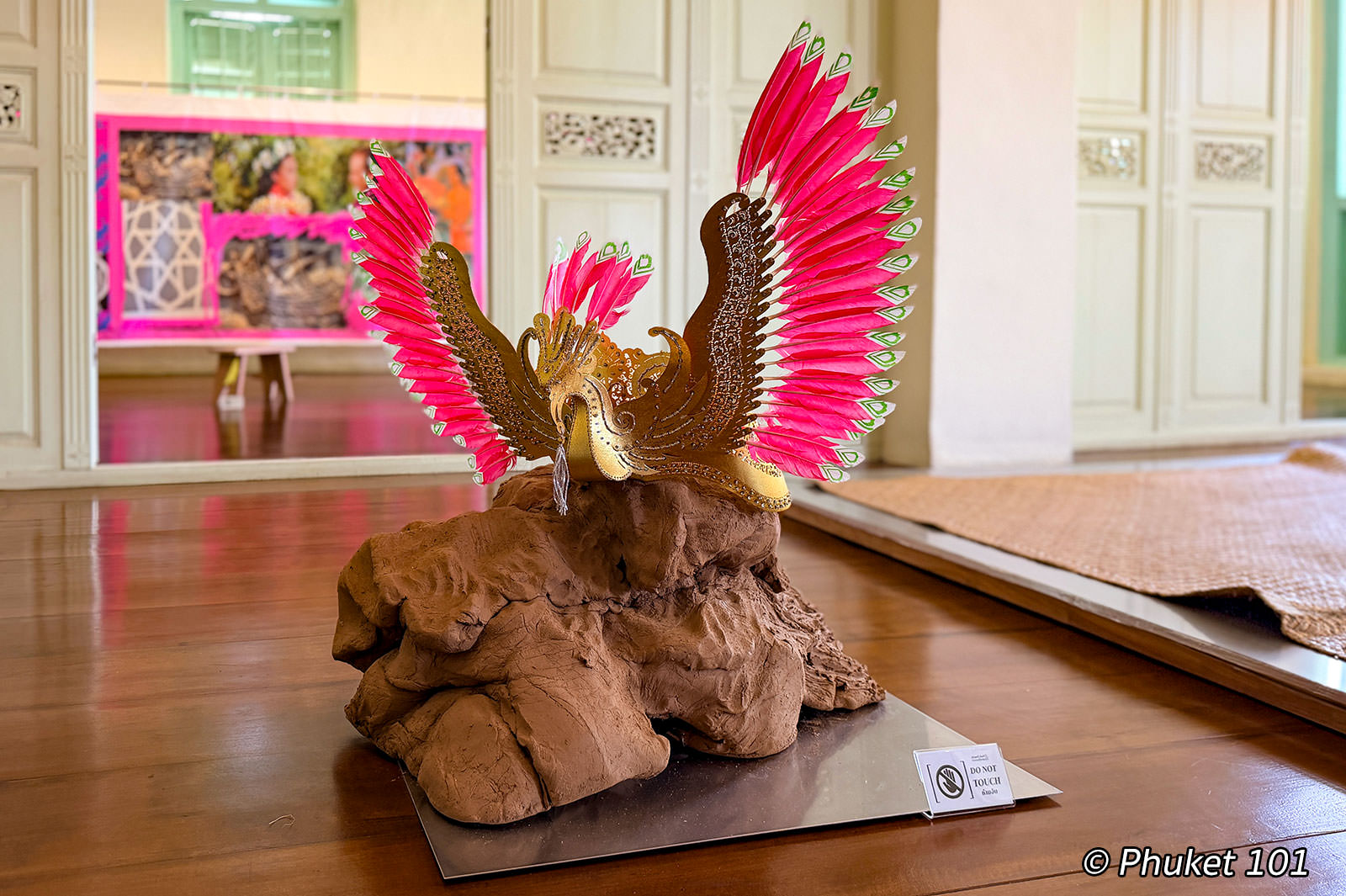
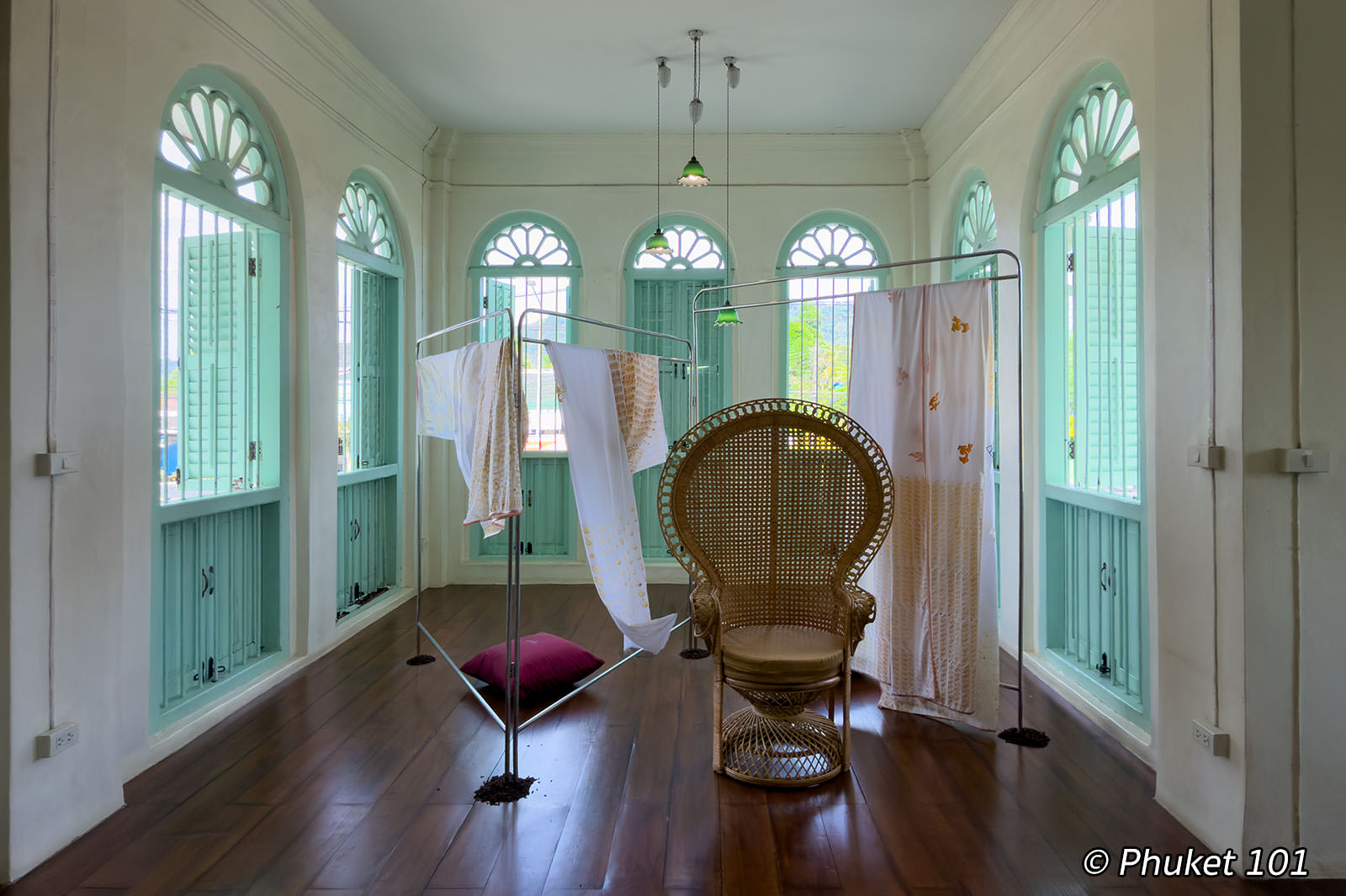
The standout installation is “The Throne and the Crown” by Nathalie Muchamad, a French artist of Javanese and Kanak (New Caledonian) heritage. Her work fills the upper rooms of the main building with what she calls “scenographies,” arrangements of objects that look elegant at first glance but carry a darker reading. Vivid blue and pink batik panels with bold yellow figures hang across the windows, a gilded garuda-like bird with bright pink feathers rises from a clay mound on the polished wood floor, and a rattan peacock chair sits nearby alongside translucent fabrics draped on metal racks. The gentle staging deliberately masks the reality of indentured labour and colonial displacement behind these seemingly decorative artefacts.
Taiwanese artist Wu Chi-Yu presents “Stories of Celluloid: The Exhibited Factory of Cinema,” a film and video installation tracing how camphor harvested in Taiwan became the raw material for early celluloid film stock. He weaves together archival footage, Hakka labour songs, and AI-generated faux-vintage imagery, drawing a line from colonial-era extraction in Taiwan to rubber tapping in Phuket. Indonesian artist Riar Rizaldi adds a film exploring how valuable minerals were historically located by tracking the diet of the near-extinct Javanese rhinoceros, questioning the relationship between scientific discovery and environmental destruction. Both video works fit naturally inside the old distillery, where the history of resource extraction is quite literally built into the walls.


Phra Aram Sakhonkhet Mansion

Phra Aram Sakhonkhet Mansion is one of the grandest Sino-Portuguese houses in Phuket Old Town, built in the late 19th century for one of the island’s wealthiest tin mining barons. The white facade is elaborately decorated with European-style stucco, arched portico, and columns. For decades it served as the Thai Airways ticketing office, which ironically helped preserve it while other heritage mansions fell into disrepair. The mansion sits at 78 Ranong Road, not far from Jui Tui Shrine.
The mansion itself is not open to the public, but two buildings on either side of it have been converted into Biennale exhibition spaces under the name “Baan Turtle Phuket.” The installations here explore Phuket’s transformation from an island built on extraction (tin, rubber, labour) to one built on tourism and the service economy.
In one building, Pattani-based artist Anuwat Apimukmongkon presents work centred on “BangLee,” a recurring figure in his art based on his bisexual best friend. Part of the installation is a pink mobile curry puff cart called “BangLee Pink Karee Puff” that roams the streets of Phuket selling actual curry puffs while live-streaming video back to a room inside the building. The name is a deliberate play on words. Inside, the room is filled with images of crowned figures set against a pink backdrop. The work blends food, performance, gender identity, and the realities of Thailand’s deep south into something provocative and unexpectedly personal.
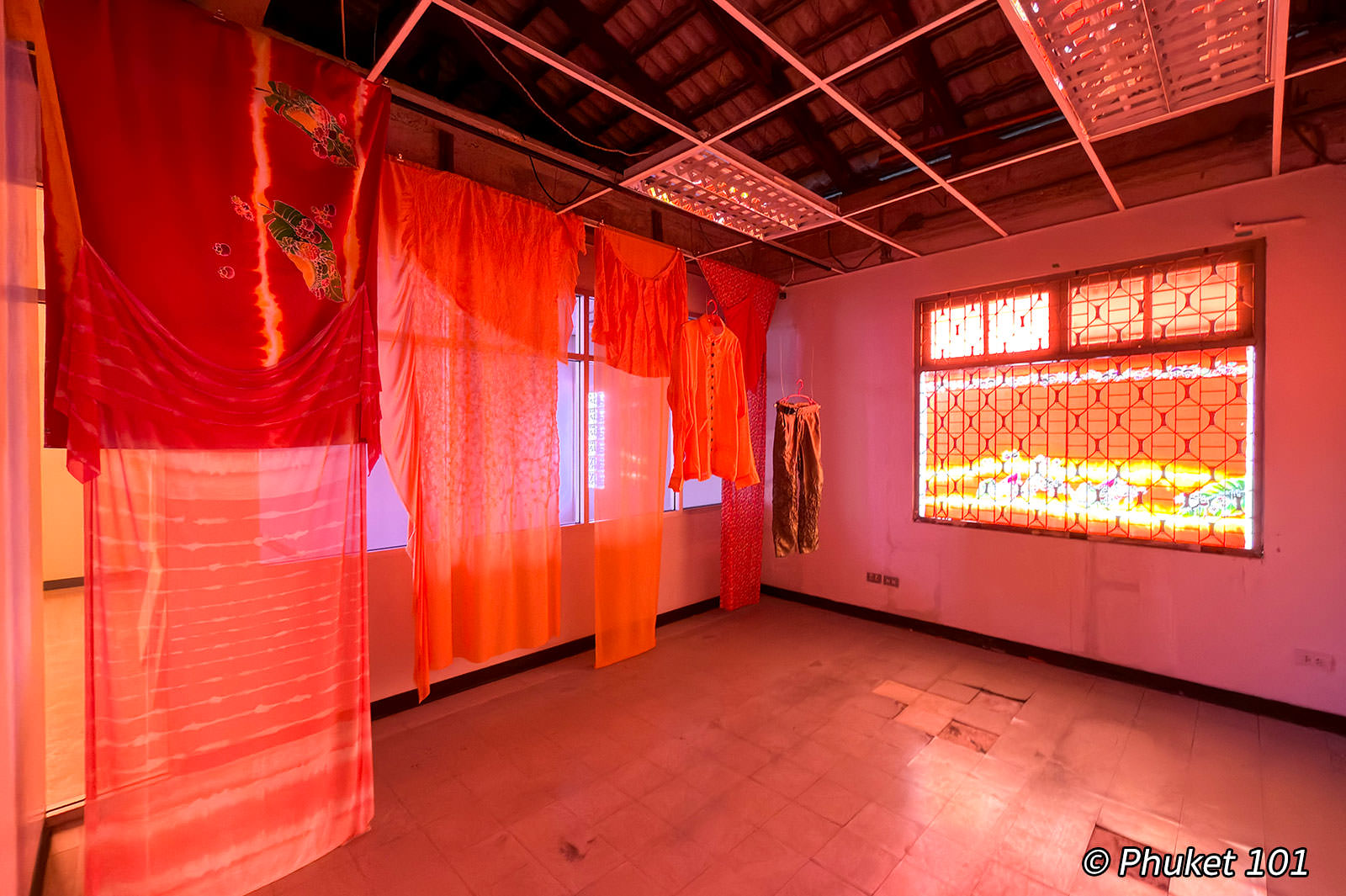
The other building holds a striking installation where red and orange textiles, garments, and translucent fabrics are suspended from the ceiling, filtering light through the old windows and bathing the room in a warm, almost sacred glow. The effect is somewhere between a temple offering and a domestic interior, with embroidered cloths and everyday clothing hanging side by side. The contrast between the brightly coloured installations and the worn walls of these old shophouse buildings is part of what makes this venue memorable. A quick stop, but worth walking through both buildings while exploring the Old Town Biennale circuit.
The Society

The Society is a lifestyle and community space near Bang Tao Beach with cafés, galleries, and small shops. Open layout with clean architecture.


For the Biennale, installations are placed both indoors and in outdoor areas. The displays tend to focus on modern life and design, giving this venue a lighter feel than the heritage sites in town. You can explore the artworks while moving between cafés. An easy stop if you’re staying in Bang Tao or Cherng Talay.
Thai Hua Museum

One of the most beautiful Sino-Portuguese buildings in Phuket Town. Once a Chinese-language school, now a museum about the island’s Chinese heritage. Bright white façade and airy interior.


For the Biennale, installations are placed in classrooms and galleries, often linking local history with the theme of time and memory. Quieter atmosphere than the outdoor venues. A good place to explore at an easy pace while seeing one of Phuket’s most important heritage buildings.
Central Phuket
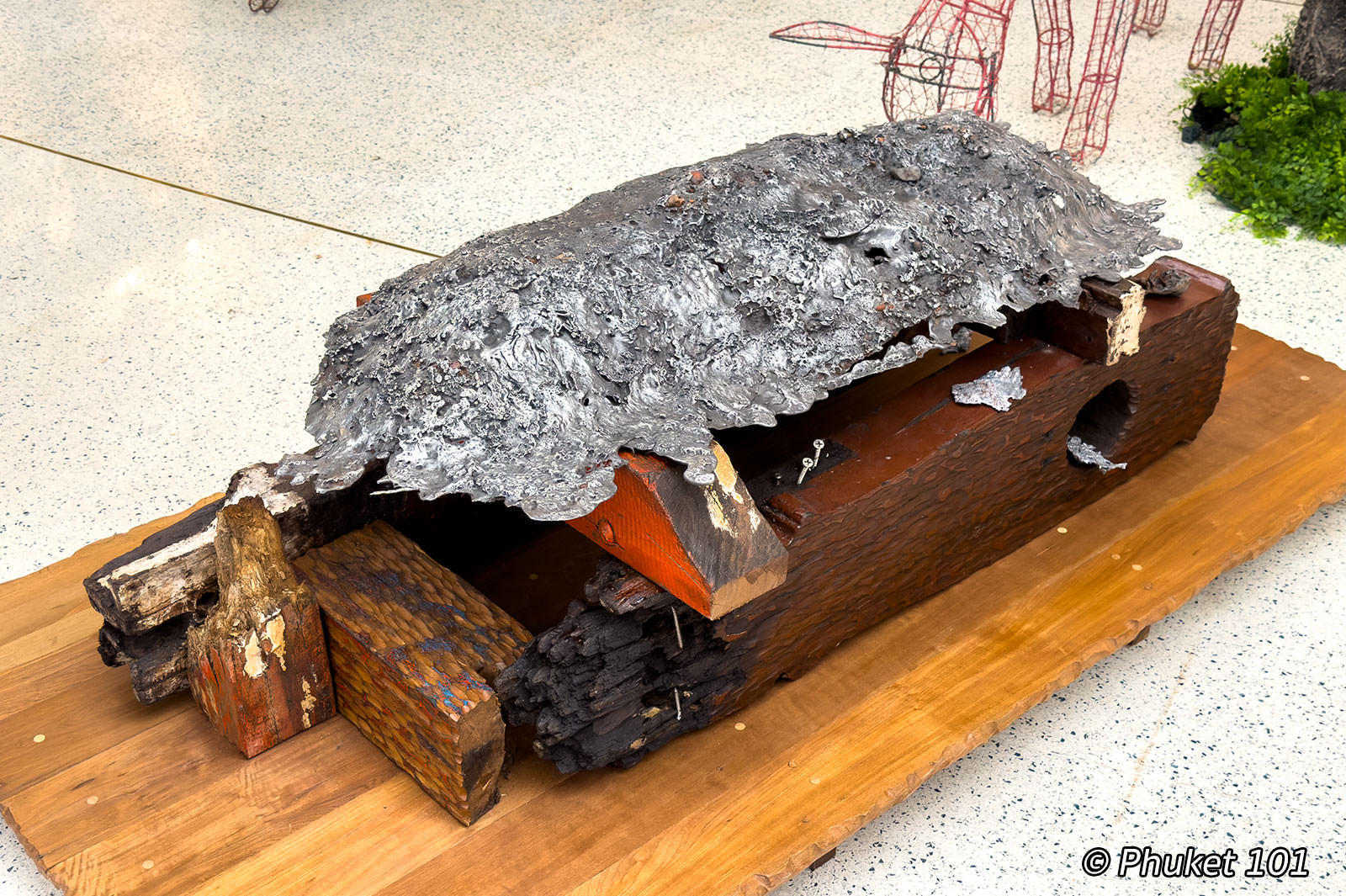
“Landfill brings viewers face-to-face with traces of transformation through industrial history, mining history, and Phuket’s tourism. The artist creates sculptural works assembled from recycled aluminium sheets cast from metal scrap, paired with stones from collapsed factories, formed into shapes resembling both ancient artefacts and fragments from a future world. Metal surfaces and stone bear the scars of resource extraction and consumption, yet still shimmer and reflect light. This signifies new birth amidst decay.”
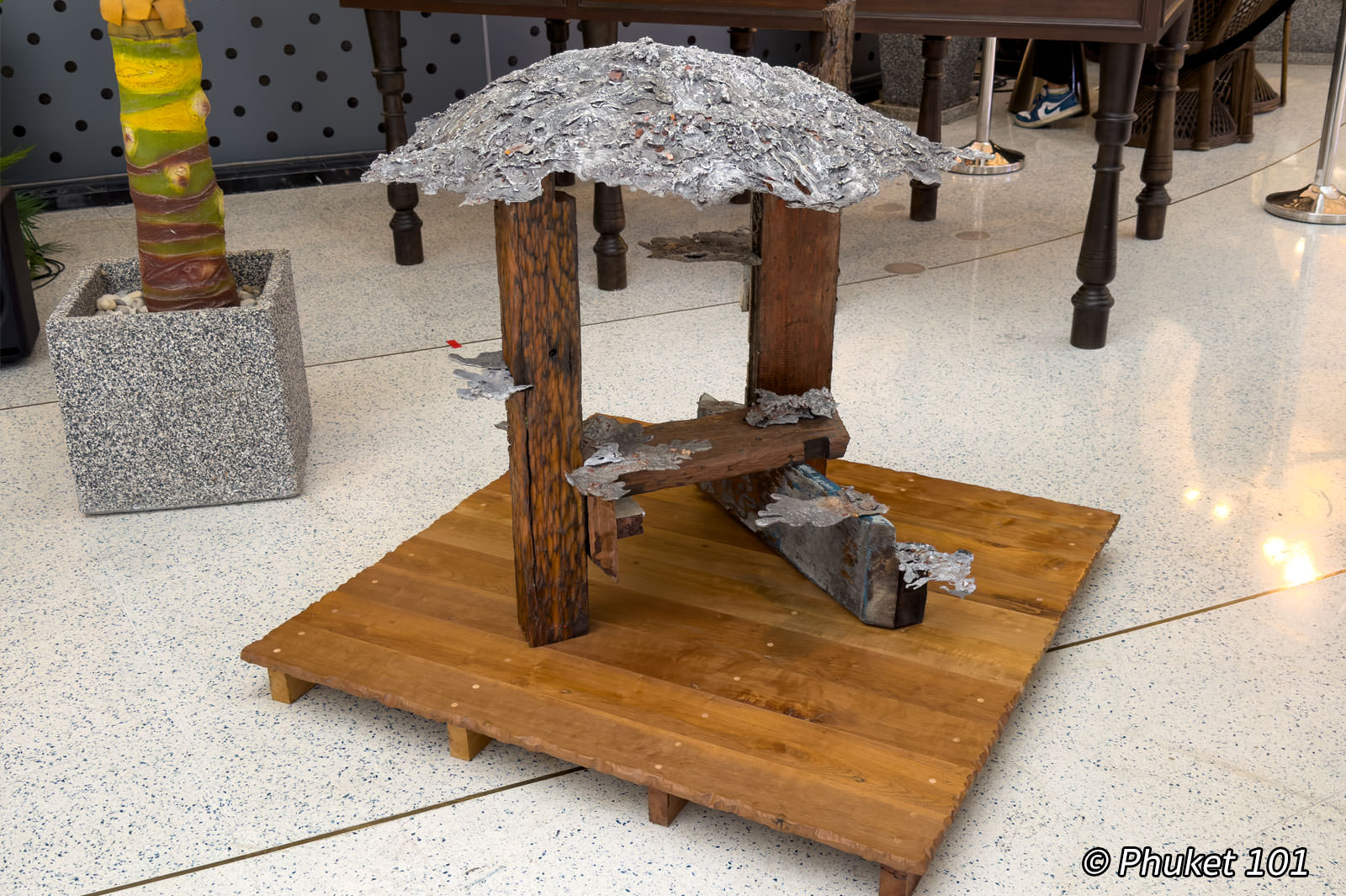
“The work reveals how these remnants exist in the viewer’s sight. Landfill becomes a doorway to history, layered and challenging the dream image of ‘Paradise Island’ that encompasses awareness about Phuket. The work is paired with a video documenting garbage at Saphan Hin, opening space for viewers to confront garbage piles, scars, and industrial wounds. It invites viewers to imagine the landscape and reflect on Phuket as a space caught between resources, labour, and today’s environmental crisis.”
Promthep Cape
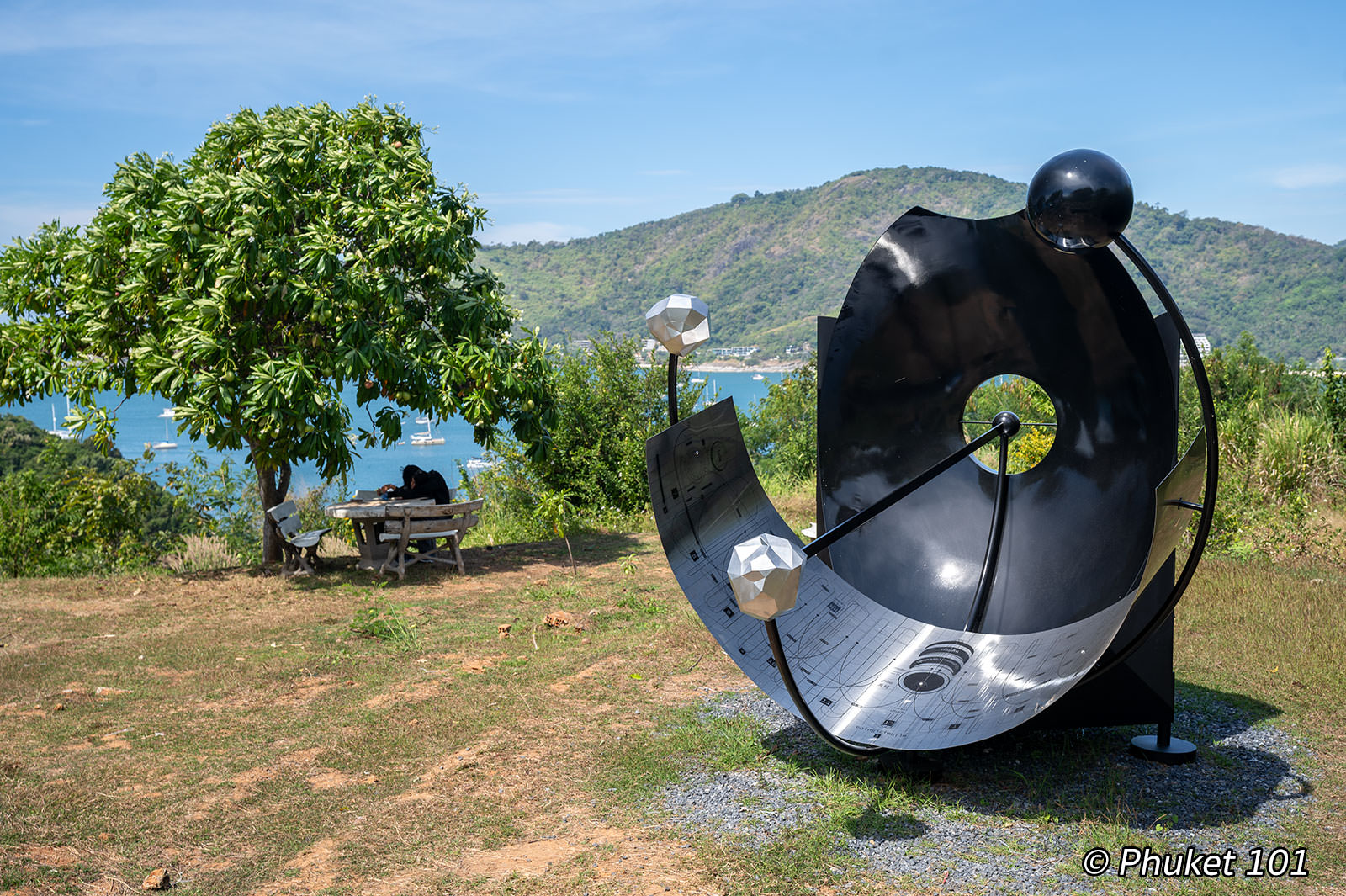
Promthep Cape is one of Phuket’s most visited viewpoints, famous for its sunsets over the Andaman Sea. For the Biennale, it hosts a single, striking sculpture by Nolan Oswald Dennis, a South African artist based in Johannesburg whose work sits at the intersection of architecture, cosmology, and decolonial thinking. He holds degrees in architecture from the University of the Witwatersrand and in art, culture, and technology from MIT.
The piece is a “moon dial,” a large curved structure in dark polished metal with geometric polyhedra mounted on thin arms radiating outward and a smooth black sphere at the top. It looks part astronomical instrument, part navigational device, and seems designed to track lunar cycles rather than solar time. Set on the grassy hillside overlooking the bay, it contrasts sharply with the familiar tourist backdrop of sea and mountains.
The Biennale classifies this as one of its “Timepieces,” works placed within Phuket’s natural or built environment that register traces of visitation and change, keeping time not as a linear count but as overlapping frequencies of past, present, and imagined futures. According to Koktail Magazine, the moon dial is intended to be permanently relocated to Surin Beach after the Biennale ends, making it one of the lasting legacies of the 2025 edition.
It is a quick stop, but the combination of the sculpture, the sea views, and the concept of tracking cosmic time at Phuket’s most famous sunset spot makes it one of the more memorable Biennale moments. Worth visiting in late afternoon when the light catches the metal.
Pop Form X Pop City at Sino Imperial Hotel
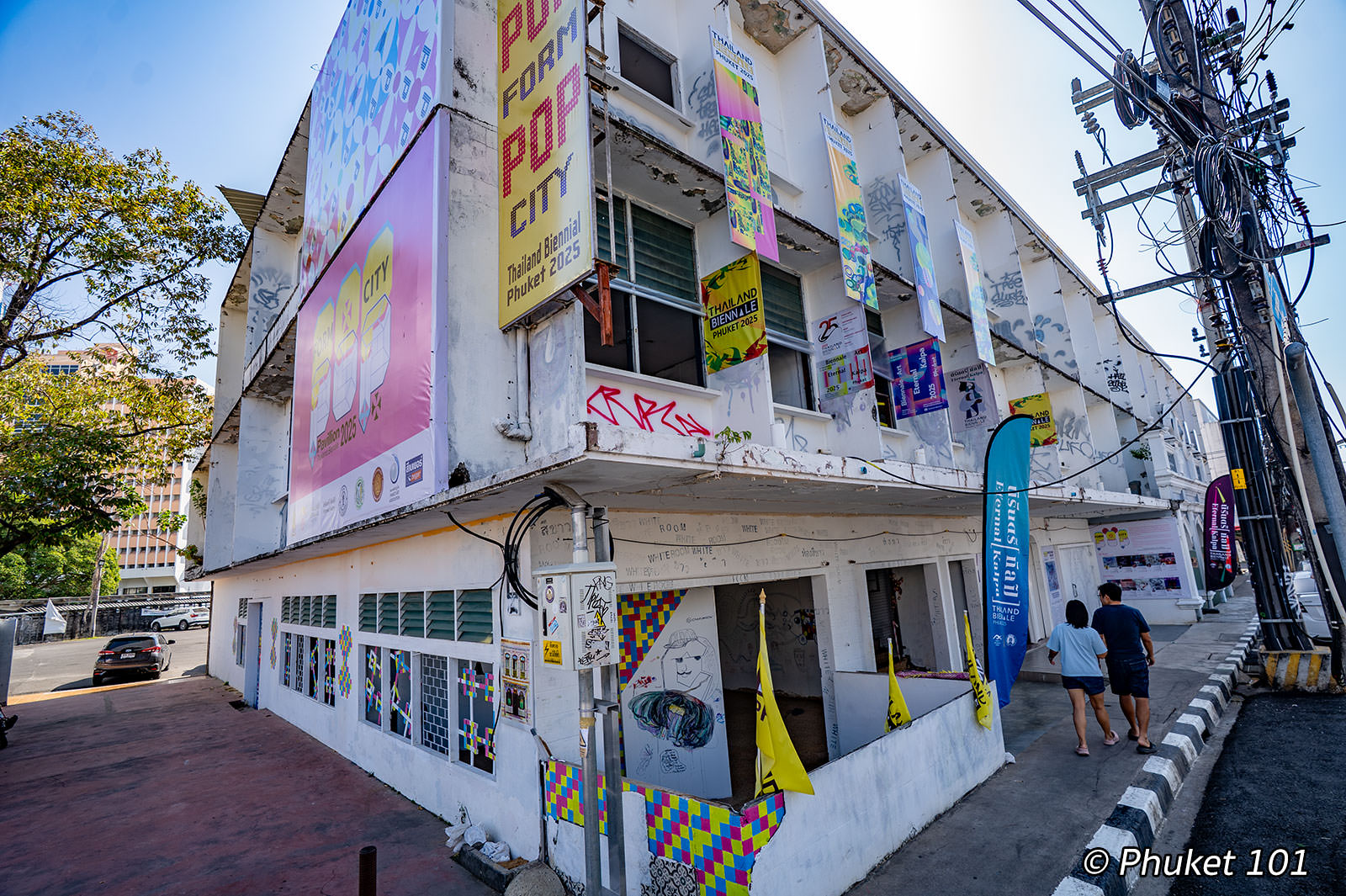
Pop Form x Pop City is one of the 13 independent Sala pavilions running alongside the main Thailand Biennale exhibition. It occupies an abandoned commercial building near Poon Phol Night Plaza in Phuket Town, a two-storey concrete shell that was empty long before the Biennale moved in. The raw, unfinished character of the building is very much part of the experience.
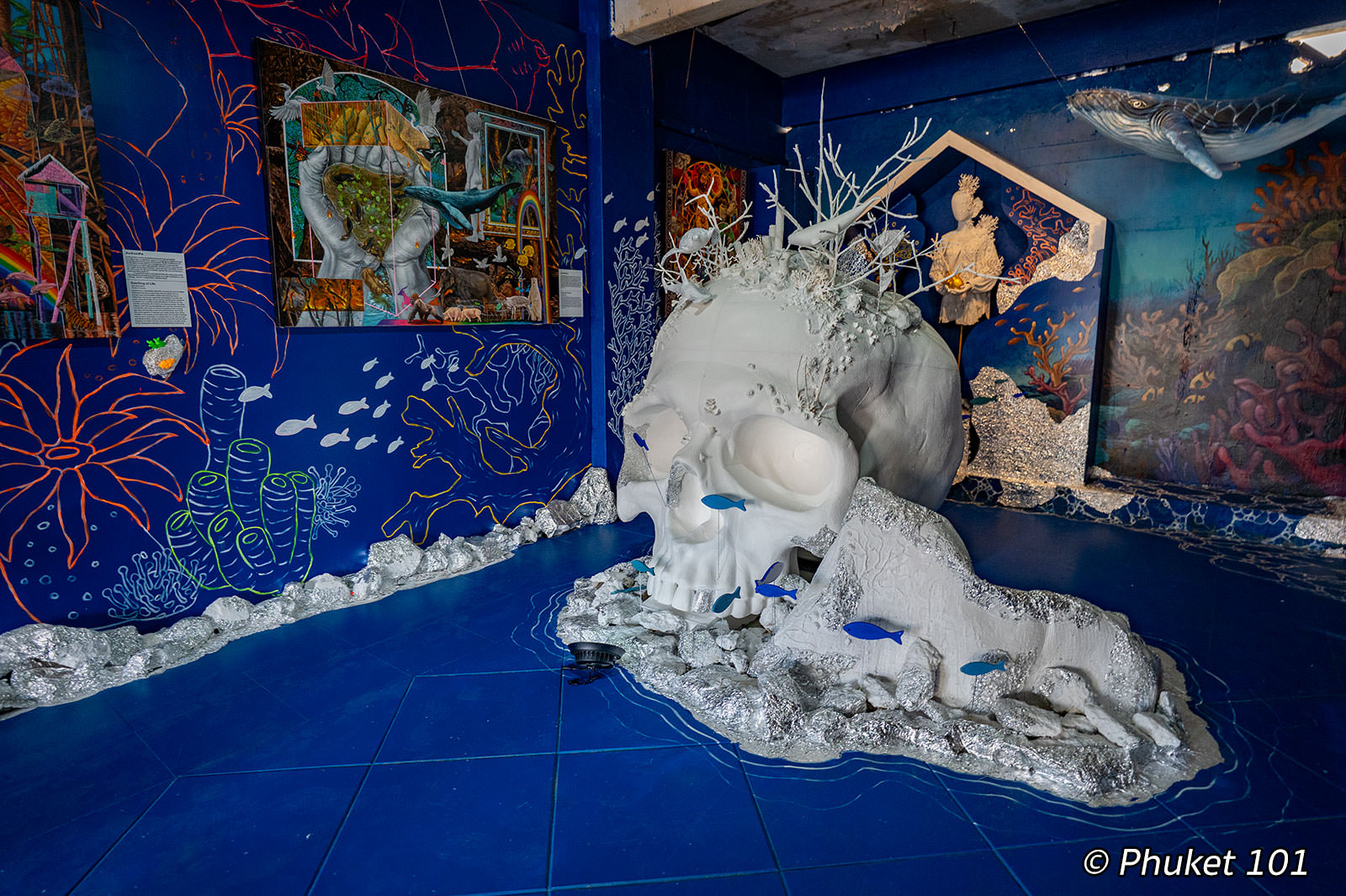
The pavilion is designed as a community creative hub rather than a traditional gallery. The centrepiece is the “White Room” (ห้องสีขาว), a participatory space where every surface, wall, floor, sofa, and even the table coverings, is open for visitors to draw, paint and write on. By this point in the Biennale, the room has been completely transformed by hundreds of contributions: drawings of local food, anime characters, flowers, Phuket buildings, abstract splashes and handwritten messages in Thai and English. Art supplies are provided on-site.
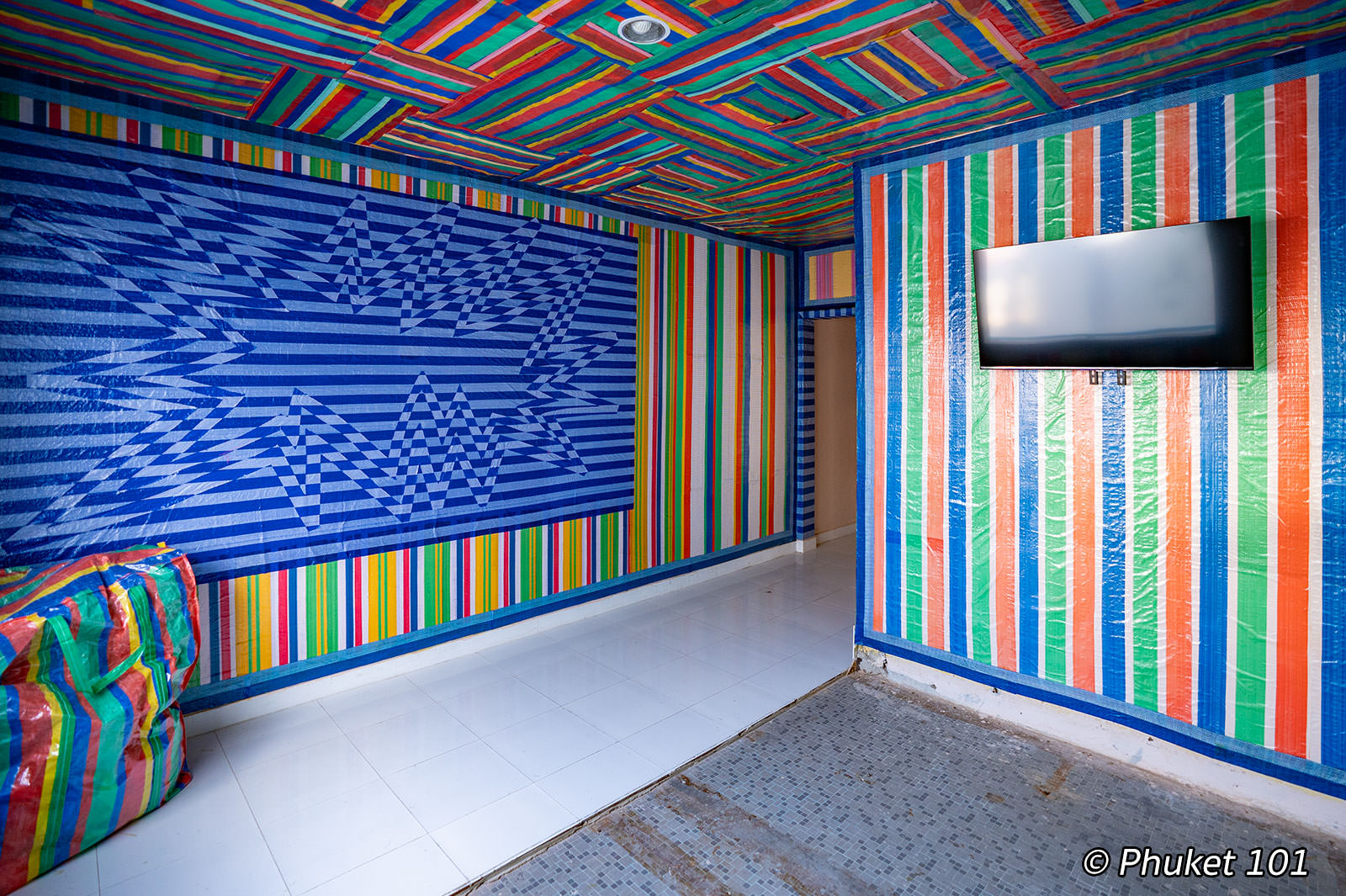
Other parts of the building feature spray-painted street art murals, including a large colourful lion, and a striking blue geometric installation made from woven tarpaulin stretched across an interior wall. The tarp piece plays with the angular patterns of traditional Thai woven plastic (the kind you see at markets and construction sites), scaled up to fill the space. Colourful checkered bunting hangs across the shopfront openings outside.
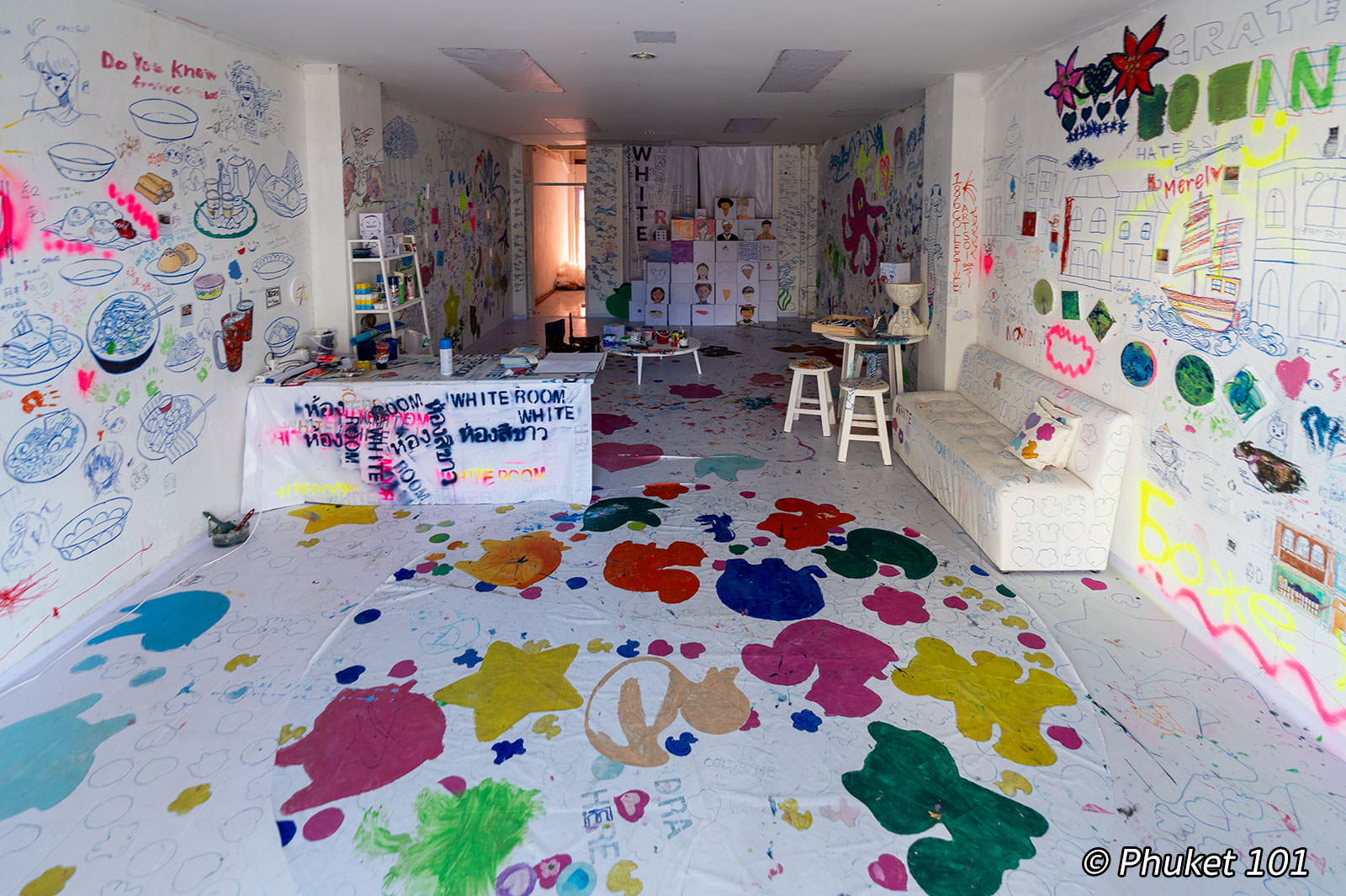
The project has links to the Asialink Sketchwalk Phuket 2025 drawing event and is promoted through its own Facebook page, though the specific organisers behind the pavilion are not publicly credited in available sources. It is clearly aimed at younger visitors and families, positioned as a playful, low-barrier entry point to the Biennale. It is a fun, informal stop that contrasts well with the more conceptual installations elsewhere.


The Thailand Biennale Phuket 2025 will run from November 2025 to April 2026. Those interested in learning more can visit:
🌐 www.thailandbiennale.org
📘 Facebook: facebook.com/thailandbiennale
📞 Ministry of Culture Hotline: 1765
Thailand Biennale Map
Read more about Thailand Biennale Phuket 2025