

The King Cruiser Wreck

The King Cruiser is the most famous wreck dive in the Phuket area and one of the largest accessible wrecks in Southeast Asia. The 85-metre twin-hulled catamaran sits upright on the sandy seabed at 32 metres deep, roughly 26 kilometres east of Phuket, between Shark Point and the Phi Phi Islands. It has been underwater since 4 May 1997 and has transformed into a thriving artificial reef.
The Story of the King Cruiser
The King Cruiser started life as a Japanese car ferry built in the 1960s. It was purchased by a Thai company called Songserm in 1990 and converted into a passenger-only ferry running daily between Phuket and Koh Phi Phi. For seven years, it carried hundreds of passengers back and forth on the same route without incident.
On 4 May 1997, with 561 passengers and 22 crew on board, the captain strayed off course and struck Anemone Reef, a submerged pinnacle that was well charted and known to every captain operating in those waters. The impact tore a large hole in one of the twin hulls. The ferry took on water immediately but stayed afloat for about two and a half hours, giving enough time for all passengers to be rescued by two police patrol boats and several fishing boats that responded to the emergency call. One elderly woman suffered a spinal injury, and several others were treated for shock, but nobody died.
Why the captain hit a well-known reef in normal weather conditions has never been fully explained. The official investigation found him guilty of negligence. But the incident generated plenty of theories that are still discussed in dive shops across Phuket today. Some speculated insurance fraud, as the ferry company was reportedly struggling financially on a route that was not very profitable. Others joked that local dive operators had paid the captain to create a wreck dive, since Phuket had none at the time. No evidence supports either theory, but they have become part of the wreck’s folklore.
What the Wreck Looks Like Today
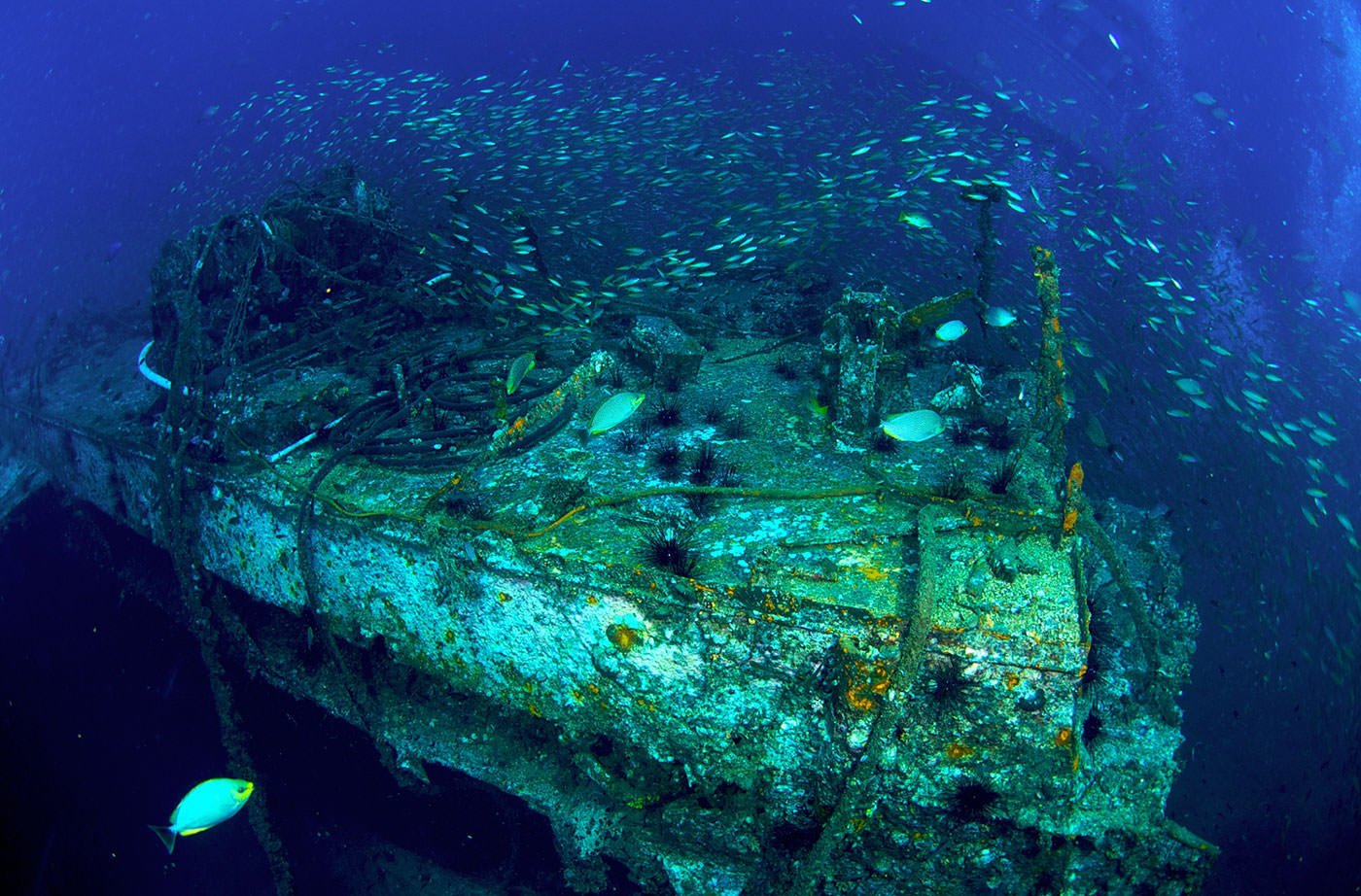
Nearly three decades underwater have changed the King Cruiser dramatically. The ferry settled upright on the sandy bottom at 32 metres, and originally the shallowest point was just 10 metres below the surface. Over the years, the upper decks have collapsed. The wheelhouse came down first, followed by sections of the top deck and passenger areas. Today, the shallowest part of the wreck sits at about 16-18 metres.
The structural collapse has actually made the dive more interesting in some ways. In 2003, the top deck fell and exposed three toilets at around 23 metres. Taking a photo sitting on a toilet at that depth has become a tradition among divers visiting the wreck. The collapse also created a valley between the two main staircases, which is now a gathering point for large schools of snapper and barracuda.
Penetration of the wreck is no longer safe or recommended due to the ongoing structural deterioration. But the exterior offers plenty to explore. The car deck is still accessible from the stern, where you can see the original machinery, a few car wheels, and rows of passenger seats and low coffee tables. The propellers at the stern sit at 32 metres in the sand, and large lionfish hang around the anchor winch area. Bamboo sharks are sometimes spotted resting near the propellers.
Soft corals now cover much of the hull in pink and purple. Sea fans hang from old beams. Nudibranchs, scorpionfish, moray eels, and clouds of fusiliers and snappers have made the wreck their home. A resident hawksbill turtle is a regular visitor and has been known to approach divers. In January 2022, the Thai Navy’s special operations divers removed a 40-metre ghost net that had become tangled in the wreck’s coral, protecting the reef that has built up on the structure over the years.
Diving the King Cruiser
Day trips to the King Cruiser depart from Chalong Bay every morning. The boat ride takes about 90 minutes. Most operators combine the wreck with two other dives at nearby sites like Shark Point, Anemone Reef, or Koh Dok Mai, making it a full three-dive day.
Divers descend using a mooring line attached to the stern. The descent takes you straight to the wreck at 18 metres. From there, you can explore the exterior of the hull at 22-26 metres, drop down to the propellers at 32 metres, or stay at 16-18 metres along the collapsed top deck. The dive typically lasts 30-40 minutes depending on depth and air consumption.
Currents can be strong and unpredictable at this site, which is why it is rated for advanced divers. Visibility varies between 5 and 20 metres depending on the season and conditions. The best visibility is from November to April. Monitor your air more carefully than usual here, as the depth means faster air consumption than at shallower sites.
King Cruiser Wreck Info
Maximum depth: 33 meters or 110 feet.
Difficulty level: Advanced.
Visibility: 5-20 meters.
Ship length: 85 meters.
Ship beam: 25 meters.
Sank: 4 May 1997.
Travel time from Chalong: 90 minutes by dive boat.