

Wednesday Buddha Postures and Their Stories
Wednesday is the only day with two Buddha postures in Thai tradition. People born on Wednesday during the day follow one image. Those born at night follow another. Both postures come from important moments in the Buddha’s life, but they carry very different meanings.
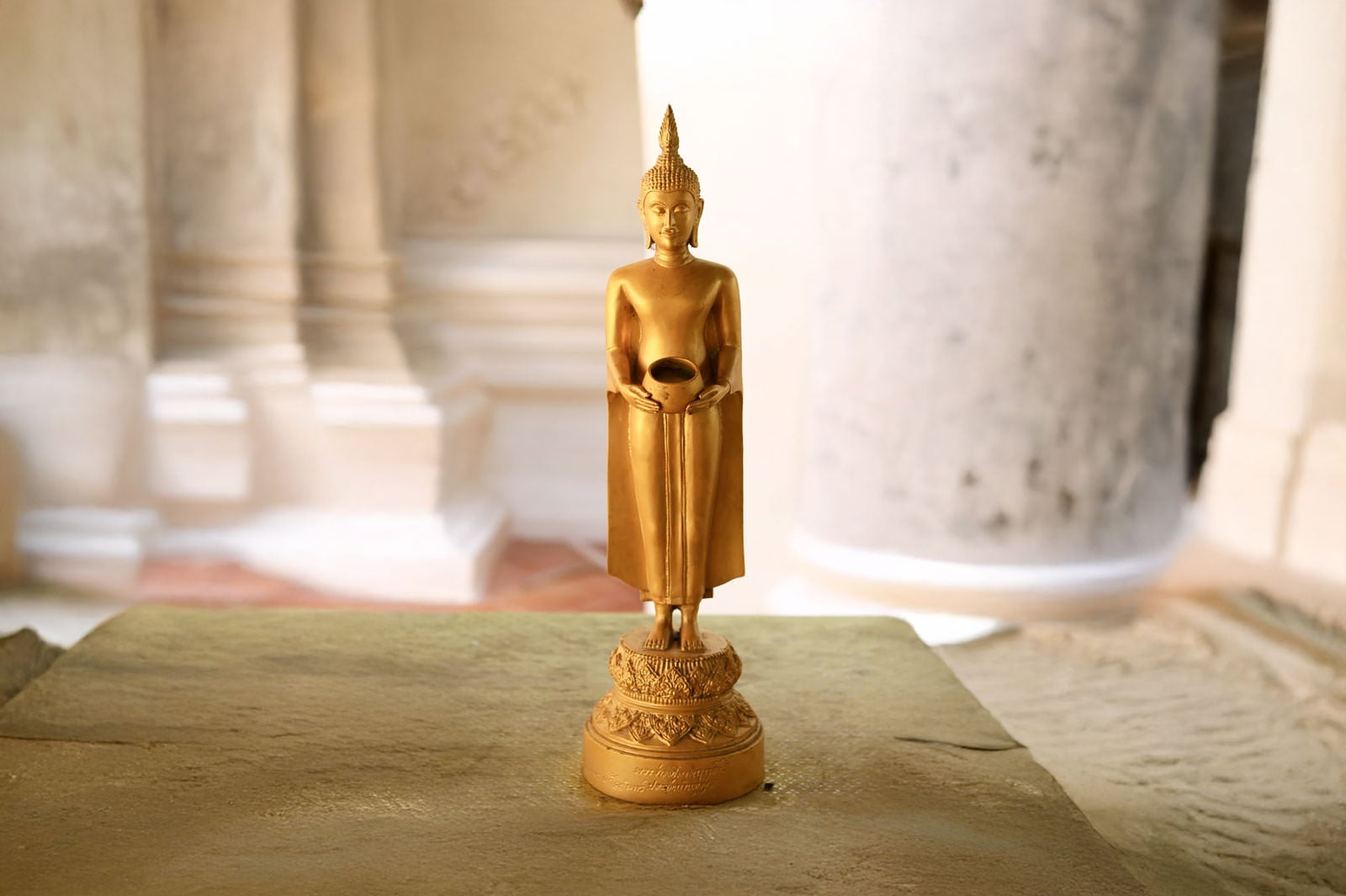
Wednesday Daytime: Pang Umbat (Receiving Alms)
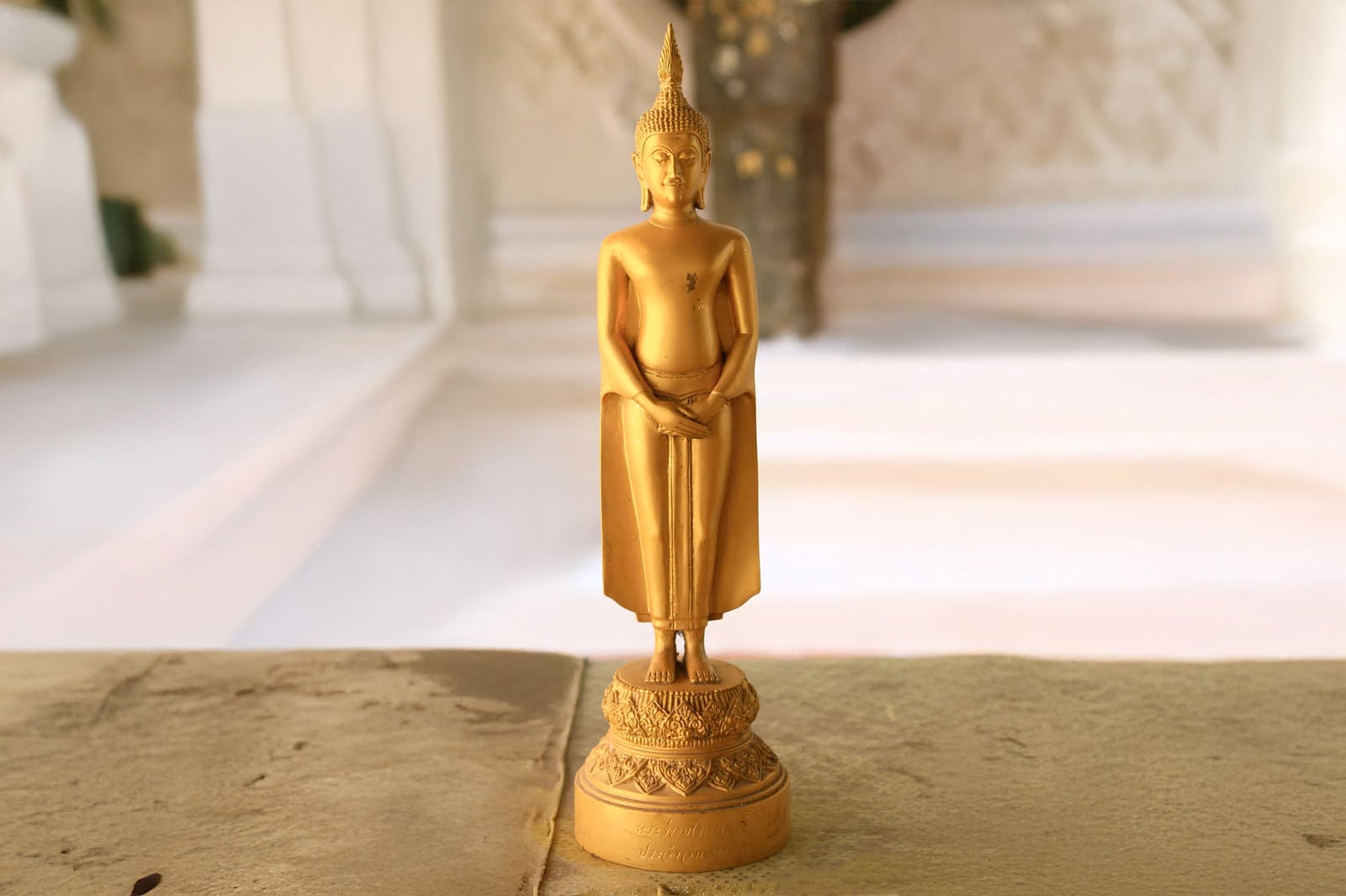
What it looks like
The Buddha stands upright with both hands held together at his abdomen. His palms cradle an alms bowl (บาตร). The posture is called Pang Umbat (ปางอุ้มบาตร) in Thai, which means “holding the alms bowl.”
The story behind it
This image recalls the Buddha’s first return to Kapilavatthu, his childhood home, after he became enlightened. The story appears in early Buddhist commentaries on the Dhammapada, a collection of the Buddha’s sayings.
When the Buddha arrived in the city, his father King Suddhodana expected him to come straight to the palace for meals. Instead, the Buddha went on his usual alms round the next morning. He walked from house to house through the streets. The king was shocked. He thought it was beneath his son’s royal dignity.
The Buddha explained that this wasn’t begging. It was a noble tradition followed by all Buddhas throughout history. By accepting food offered freely, he gave laypeople the chance to gain merit through generosity.
The practice of alms rounds appears throughout ancient Buddhist texts. One passage describes the Buddha “getting ready in the forenoon, took bowl and robe and went into Vesālī for alms.”
What it means
The posture represents humility, compassion, and the cycle of giving. Monks don’t demand food. Laypeople offer it freely. Both sides benefit. One receives physical sustenance, the other gains spiritual merit.
The image reminds visitors that accepting help isn’t shameful. It also shows that wealth and status don’t determine worth.
Thai birth belief
People born on Wednesday during the day are thought to be diplomatic problem-solvers. Thai tradition links them to the colour green.
Where to see it in Phuket
Wat Chalong, Phuket’s most important temple, displays all seven day-of-week Buddha images on the first two floors of the Phra Mahathat Chedi (the golden pagoda). The daytime Wednesday posture stands among them, often covered with gold leaf applied by devotees over the years.
Wednesday Nighttime: Pang Pa Lelai (Forest Retreat)
What it looks like
The Buddha sits on a rock in a relaxed posture, like sitting on a chair, not cross-legged. His right hand rests palm-up on his right knee. His left hand rests palm-down on his left knee. An elephant stands on one side, a monkey on the other. Trees rise behind him.
The Thai name is Pang Pa Lelai (ปางป่าเลไลยก์), meaning “forest retreat.” Some texts call it Pang Parileyya.
The story behind it
This posture comes from a well-documented episode in the monastic records: the conflict at Kosambī.
The Buddha was staying at a monastery in Kosambī when monks split into two groups. One group specialised in monastic rules. The other specialised in teachings. The dispute began over something small, whether it was acceptable to leave water in the bathroom dipper.
The argument grew. The monks became quarrelsome and contentious. They wounded each other with harsh words. The Buddha tried to make peace. The monks refused to listen.
The monastic records describe what happened next. The Buddha left the monastery and wandered until he reached Pārileyyaka forest. There he stayed in a grove at the foot of a tree.
Alone in the forest, the Buddha reflected: “Formerly I did not live at ease, being troubled by those quarrelsome monks of Kosambī. But now, being alone and without a companion, I live pleasantly and at ease.”
A noble elephant left his herd and came to the Buddha. The elephant brought water and food with his trunk. He cleared grass from the ground.
The Buddha said the mind of the noble elephant and the mind of the noble one among men harmonised in this: they both found delight in dwelling alone in the forest.
The monkey offering honey appears in later Buddhist commentaries, not the earliest records. A monkey saw the elephant serving the Buddha and wanted to help. He found wild honey, broke off the stick with the honeycomb, placed it on a leaf, and offered it to the Buddha.
What it means
The posture shows the value of solitude, peace, and harmony. It also serves as a warning against pointless conflict within spiritual communities.
Sometimes retreat is necessary. When people can’t resolve their differences, stepping back preserves dignity and clarity.
The elephant and monkey show what pure respect looks like. Their service was voluntary and sincere. Nobody asked them to help.
Thai birth belief
People born on Wednesday night are thought to be independent thinkers who work well alone. Thai tradition links them to the colour green, shared with daytime Wednesday, or sometimes black.
Where to see both Wednesday postures
Wat Chalong’s Phra Mahathat Chedi includes the nighttime Wednesday posture alongside the daytime version. Both are displayed within the same rotation of birth-day Buddhas on the first two floors.
Most Thai temples include a dedicated altar with the complete set of seven (or eight, counting both Wednesday postures) birthday Buddhas arranged in sequence. Look for a long table or shelf with small Buddha statues in different poses. Each will have a donation bowl in front.
In Bangkok, Wat Pho houses a particularly significant version of the nighttime posture called Phra Buddha Palilai. It was cast in the late 1700s during King Rama I’s reign. The statue sits in the front portico of the North Assembly Hall, showing the Buddha on a rock with trees behind and statues of the elephant and monkey in front.
Wat Benchamabophit (Marble Temple) in Bangkok displays 52 Buddha statues in its gallery, including all seven day-of-week postures. Phra Pathom Chedi in Nakhon Pathom, west of Bangkok, also exhibits the complete set.
What both postures teach
Wednesday’s two postures show opposite sides of spiritual life. The daytime image shows the Buddha engaged with society, accepting offerings and giving people the chance to practise generosity. The nighttime image shows him alone in the forest, choosing peace over conflict.
Both are valid responses to life. Sometimes the connection serves. Sometimes solitude heals.
Both postures show the Buddha staying true to his path. In Kapilavatthu, he taught his family by example. In Pārileyyaka, his retreat eventually led the quarrelling monks to reflect on their behaviour and seek reconciliation.
The images remind visitors that spiritual practice isn’t one-dimensional. It needs engagement and withdrawal. Service and stillness.
The Buddha Postures for the Days of the Week